1.1. Genesis of the Crystallographic Information File
S. R. Hall and B. McMahon
Abstract
Efficient exchange of information and data within and across scientific disciplines is essential for progress in science. The International Union of Crystallography (IUCr) has tracked and encouraged efforts to design a formal description and exchange mechanism for crystallographic data. The result of this involvement has been the Crystallographic Information File standard described in this volume.
Early approaches to the management of crystallographic data relied upon disk file formats derived from the input/output conventions of Fortran and associated 80-column punched-card images. Although such formats could be efficient and compact, they were inflexible and difficult to extend to embrace new types of data. The growth of computer networking made it important to design portable and extensible methods for exchanging data between different computer architectures and programming languages.
After initial experimentation with an extensible pseudo free-format mechanism still modelled on card-image formats, the IUCr commissioned a lightweight free-format mechanism based on the STAR File. This is a plain-text file format where data values are tagged with character strings identifying their role. By extension, standard tags may be assigned, and the attributes of the data they describe may be recorded in separate reference compilations.
This chapter traces the historical development of this approach: the crystallography community's choice of a restricted subset of STAR File functionality, its subsequent extension to describe large binary data sets, and, most importantly, the development of dictionary definition languages that allowed the description of data attributes using the same formalism as used for the data files themselves. Since 1991, several specialized collections of data attributes have been created for use in different fields of crystallography, and similar systems exist in a small number of related fields.
Links
Figures
The printed figures in this chapter were reduced to fit the physical page dimensions. The links below are to the ASCII text representations of the contents of the figures.
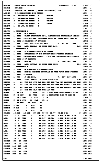
|
Fig. 1.1.3.1. An abbreviated example of a PDB format file. |
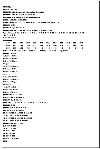
|
Fig. 1.1.3.2. An example of a CSD BCCAB format file. |
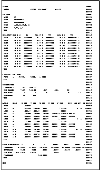
|
Fig. 1.1.4.1. An abbreviated example of a Standard Crystallographic File Structure (SCFS) format file. |
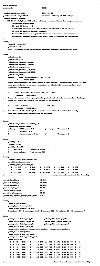
|
Fig. 1.1.6.1. Example 1 of a CIF (using the same data as shown in Fig. 1.1.3.1). |
|
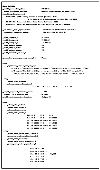
Fig. 1.1.6.2. Example 2 of a CIF (using the same data as shown in Fig. 1.1.3.2). |
|
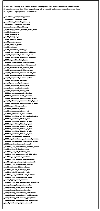
Fig. 1.1.7.1. Initial set of data items considered to be essential in a structure report submitted to Acta Crystallographica Section C. |
|
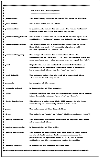
Fig. 1.1.8.1. Informal DDL used in the initial version of the core CIF dictionary (now superseded by DDL1.4). |
Dictionaries
The following CIF and related dictionaries are referenced in this chapter:

 core CIF dictionary
-
mmCIF dictionary
-
pdCIF dictionary
-
imgCIF dictionary
-
msCIF dictionary
-
rhoCIF dictionary
-
symCIF dictionary
Supplementary documents
The following historical documents may be of interest:
- Standard Crystallographic File Structure-87 Specification of IUCr exchange standard predating CIF (Brown, 1988)
References
Allen, F. H. (2002). The Cambridge Structural
Database: a quarter of a million crystal structures and rising.
Acta Cryst. B58, 380-388.

Anklesaria, F., McCahill, M., Lindner, P., Johnson, D., Torrey, D. & Alberti, B. (1993). The Internet gopher protocol (a distributed document search and retrieval protocol). RFC 1436. Network Working Group. http://www.ietf.org/rfc/rfc1436.txt.
ANSI/NISO (1995). Information retrieval (Z39.50): Application service definition and protocol specification. Z39.50-1995. http://lcweb.loc.gov/z3950/agency/1995doce.html.
Barnard, J. M. (1990). Draft specification
for revised version of the Standard Molecular Data (SMD) format.
J. Chem. Inf. Comput. Sci. 30, 81-96.

Berners-Lee, T. (1989). Information management: a proposal. Internal report. Geneva: CERN. http://www.w3.org/History/1989/proposal-msw.html.
Bernstein, F. C., Koetzle, T. F.,
Williams, G. J. B., Meyer, E. F. Jr, Brice, M. D.,
Rodgers, J. R., Kennard, O., Shimanouchi, T. & Tasumi, M.
(1977). The Protein Data Bank: a computer-based archival
file for macromolecular structures. J. Mol. Biol.
112, 535-542.


Bourne, P., Berman, H. M., McMahon, B.,
Watenpaugh, K. D., Westbrook, J. D. &
Fitzgerald, P. M. D. (1997). Macromolecular
Crystallographic Information File. Methods Enzymol.
277, 571-590.

Brown, I. D. (1988). Standard
Crystallographic File Structure-87. Acta Cryst. A44,
232.
 See also
HTML version.
See also
HTML version.
Busing, W. R., Martin, K. O. & Levy, H. A. (1962). ORFLS. Report ORNL-TM-305. Oak Ridge National Laboratory, Tennessee, USA.
Chapuis, G., Farkas-Jahnke, M., Pérez-Mato,
J. M., Senechal, M., Steurer, W., Janot, C., Pandey, D. &
Yamamoto, A. (1997). Checklist for the description of incommensurate
modulated crystal structures. Report of the International Union of
Crystallography Commission on Aperiodic Crystals. Acta Cryst.
A53, 95-100.
See also
HTML version
(http://www.iucr.org/iucr-top/comm/capd/checklist/index.html)
Fitzgerald, P. M. D., Berman, H.,
Bourne, P., McMahon, B., Watenpaugh, K. & Westbrook, J. (1996).
The mmCIF dictionary: community review and final approval.
Acta Cryst. A52, Suppl. C-575.
Freer, S. T. & Stewart, J. (1979).
Computer programming for protein crystallographic applications,
University of California at San Diego, 28-29 November 1978.
J. Appl. Cryst. 12, 426-427.

Greer, D. S. (2000). Macromolecular structure RFP response, revised submission. http://openmms.sdsc.edu/OpenMMS-1.5.1_Std/openmms/docs/specs/lifesci_00-11-01.pdf.
Hall, S. R. (1991). The STAR file: a new
format for electronic data transfer and archiving.
J. Chem. Inf. Comput. Sci. 31, 326-333.
Hall, S. R., Allen, F. H. &
Brown, I. D. (1991). The Crystallographic Information File
(CIF): a new standard archive file for crystallography.
Acta Cryst. A47, 655-685.
See also
HTML version
(http://www.iucr.org/iucr-top/cif/standard/cifstd1.html).
Hall, S. R. & Cook, A. P. F.
(1995). STAR dictionary definition language: initial
specification. J. Chem. Inf. Comput. Sci. 35,
819-825.
Hall, S. R. & Spadaccini, N. (1994).
The STAR File: detailed specifications. J. Chem. Inf. Comput.
Sci. 34, 505-508.
International Tables for Crystallography
(2002). Volume A, Space-group symmetry, edited by Th. Hahn.
Dordrecht: Kluwer Academic Publishers.
ISO (1986). ISO 8879. Information processing
- Text and office systems - Standard Generalized Markup Language
(SGML). Geneva: International Organization for Standardization.
ISO (2002). ISO/IEC 8824-1. Abstract Syntax
Notation One (ASN.1). Specification of basic notation.
Geneva: International Organization for Standardization.
See also
http://asn1.elibel.tm.fr/en/index.htm
Kahle, B. (1991). An information system for
corporate users: wide area information servers. Thinking Machines
technical report TMC-199.
Also Online (1991), 15, 56-60.
McDonald, R. S. & Wilks, P. A. (1988). JCAMP-DX: a standard form for exchange of infrared spectra in computer readable form. Appl. Spectrosc. 42, 151-162. See also http://www.jcamp.org/
Murray-Rust, P. & Rzepa, H. S.
(1999). Chemical markup language and XML. Part I. Basic
principles. J. Chem. Inf. Comput. Sci. 39, 928-942.
Murray-Rust, P. & Rzepa, H. S.
(2001). Chemical markup, XML and the world-wide web. Part II:
Information objects and the CMLDOM.
J. Chem. Inf. Comput. Sci. 41, 1113-1123.
Spadaccini, N., Hall, S. R. &
Castleden, I. R. (2000). Relational expressions in STAR File
dictionaries. J. Chem. Inf. Comput. Sci. 40,
1289-1301.
Stewart, J. (1963). XRAY63 Crystal Structure Calculations System. Report TR-64-6 (NSG-398). Computer Science Center, University of Maryland, USA, and Research Computer Center, University of Washington, USA.
Ulrich, E. L. et al. (1998).
XVIIth Intl Conf. Magn. Res. Biol. Systems. Tokyo, Japan.
See also Doreleijers, J. F., Mading, S., Maziuk, D., Yao, H.,
Yin, L., Zhu, J., Ulrich, E. L. & Markley, J. L. (2002).
Porting NMR data of ~1200 structures in the BioMagResBank.
http://www.nmrfam.wisc.edu/NMRFAM/research/research7.pdf
W3C (2001). Extensible Markup Language (XML). http://www.w3c.org/XML/.