5.2. STAR File utilities
N. Spadaccini, S. R. Hall and B. McMahon
Abstract
The STAR File is a general-purpose data format that explicitly tags data values with identifiers allowing them to be extracted and manipulated without needing to conform to a particular data model. Star_Base is a powerful stand-alone program that parses STAR Files and extracts specific items according to requests formulated in a simple and flexible but powerful query language. Several examples of its use are described, illustrating how the context of a data item is returned along with its value. Star.vim and StarMarkUp are applications for editing and browsing STAR Files. Some libraries and object classes for STAR and generalized CIF applications are also reviewed.
Links
Figures
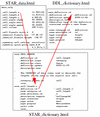
A printed figure in this chapter is reproduced below larger and in colour.
|
Fig. 5.2.5.1. Hyperlinking markup generated by StarMarkUp. The example is based on an extended relational dictionary definition language, StarDDL. |
Software
The following programs are referenced in this chapter:
 CIFOBJ
 JUMBO
JUMBOReferences
Berman, H. M., Battistuz, T., Bhat,
T. N., Bluhm, W. F., Bourne, P. E., Burkhardt, K.,
Feng, Z., Gilliland, G. L., Iype, L., Jain, S., Fagan, P.,
Marvin, J., Padilla, D., Ravichandran, V., Schneider, B., Thanki, N.,
Weissig, H., Westbrook, J. D. & Zardecki, C. (2002).
The Protein Data Bank.
Acta Cryst. D58, 899-907.

Berman, H. M., Westbrook, J., Feng, Z.,
Iype, L., Schneider, B. & Zardecki, C. (2002).
The Nucleic Acid Database.
Acta Cryst. D58, 889-898.
BioMagResBank (2004). NMR-STAR Dictionary. Version 3.0. (Under development.) http://www.bmrb.wisc.edu/dictionary/3.0html/.
Chang, W. & Bourne, P. E. (1998).
CIF applications. IX. A new approach for representing and manipulating
STAR files. J. Appl. Cryst. 31, 505-509.

Knuth, D. E. (1973). The art of computer programming. Vol. 3, Sorting and searching, pp. 422-447. Reading, MA: Addison-Wesley.
Linge, J. P., Nilges, M. & Ehrlich, L.
(1999). StarDOM: from STAR format to XML.
J. Biomol. NMR, 15, 169-172.
![[PubMed]](../graphics/pubmedborder.gif)
Murray-Rust, P. (1993). Analysis of the DDL/dictionary parsing problem. Proc. First Macromolecular Crystallographic Information File (CIF) Tools Workshop, ch. 12. New York: Columbia University.
Murray-Rust, P. (1998). The globalization of
crystallographic knowledge.
Acta Cryst. D54, 1065-1070.
Pinson, L. J. & Richard, R. S. (1991). Objective-C object-oriented programming techniques. Reading, MA: Addison-Wesley.
Robie, J., Lapp, J. & Schach, D. (1998). XML Query Language (XQL). http://www.w3.org/TandS/QL/QL98/pp/xql.html.
Schirripa, S. & Westbrook, J. D. (1996). CIFOBJ. A class library of mmCIF access tools. Version 3.01 reference guide. Technical Report NDB-269. Rutgers University, New Brunswick, New Jersey, USA. http://pdb.rutgers.edu/mmcif/CIFOBJ/cifobj/index.html.
Spadaccini, N. & Hall, S. R. (1994).
Star_Base: accessing STAR File data.
J. Chem. Inf. Comput. Sci. 34, 509-516.

Spadaccini, N., Hall, S. R &
Castleden, I. R. (2000). Relational expressions in STAR File
dictionaries.
J. Chem. Inf. Comput. Sci. 40, 1289-1301.

Ulrich, E. L., Markley, J. L.
& Kyogoku, Y. (1989). Creation of a nuclear magnetic
resonance data repository and literature database.
Protein Seq. Data Anal. 2, 23-37.
![[ChemPort]](../graphics/chemportborder.gif)
W3C (2004). Document Object Model (DOM). http://www.w3.org/DOM/.
Westbrook, J. D., Hsieh, S.-H.
& Fitzgerald, P. M. D. (1997). CIF applications.
VI. CIFLIB: an application program interface to CIF dictionaries
and data files.
J. Appl. Cryst. 30, 79-83.