|
International
Tables for Crystallography Volume A Space-group symmetry Edited by Th. Hahn © International Union of Crystallography 2006 |
International Tables for Crystallography (2006). Vol. A. ch. 8.1, pp. 720-725
https://doi.org/10.1107/97809553602060000514 Chapter 8.1. Basic concepts
a
Institut für Kristallographie, Universität, D-76128 Karlsruhe, Germany Part 8 provides the theoretical background to the data in the tables and diagrams of Volume A. In Chapter 8.1, the basic concepts are treated, such as point and vector spaces; motions (isometries) and their description by matrices and augmented matrices; crystal patterns (as mathematical models of ideal crystals) with their point and vector lattices; crystallographic symmetry operations and symmetry groups as well as space groups (as symmetry groups of crystal patterns), point groups (as symmetry groups of macroscopic crystals) and their relations. Keywords: symmetry; space groups; point groups; cosets; coset decomposition; crystal classes; motions; symmetry operations; symmetry groups; vector lattices; point lattices; crystal patterns; unit cell; symmetry elements. |
The aim of this part is to define and explain some of the concepts and terms frequently used in crystallography, and to present some basic knowledge in order to enable the reader to make best use of the space-group tables.
The reader will be assumed to have some familiarity with analytical geometry and linear algebra, including vector and matrix calculus. Even though one can solve a good number of practical crystallographic problems without this knowledge, some mathematical insight is necessary for a more thorough understanding of crystallography. In particular, the application of symmetry theory to problems in crystal chemistry and crystal physics requires a background of group theory and, sometimes, also of representation theory.
The symmetry of crystals is treated in textbooks by different methods and at different levels of complexity. In this part, a mainly algebraic approach is used, but the geometric viewpoint is presented also. The algebraic approach has two advantages: it facilitates computer applications and it permits statements to be formulated in such a way that they are independent of the dimension of the space. This is frequently done in this part.
A great selection of textbooks and monographs is available for the study of crystallography. Only Giacovazzo (2002) and Vainshtein (1994) will be mentioned here.
Surveys of the history of crystallographic symmetry can be found in Burckhardt (1988) and Lima-de-Faria (1990).
In addition to books, many programs exist by which crystallographic computations can be performed. For example, the programs can be used to derive the classes of point groups, space groups, lattices (Bravais lattices) and crystal families; to calculate the subgroups of point groups and space groups, Wyckoff positions, irreducible representations etc. The mathematical program packages GAP (Groups, Algorithms and Programming), in particular CrystGap, and Carat (Crystallographic Algorithms and Tables) are examples of powerful tools for the solution of problems of crystallographic symmetry. For GAP, see http://www.gap-system.org/ ; for Carat, see http://wwwb.math.rwth-aachen.de/carat/ . Other programs are provided by the crystallographic server in Bilbao: http://www.cryst.ehu.es/ .
Essential for the determination of crystal structures are extremely efficient program systems that implicitly make use of crystallographic (and noncrystallographic) symmetries.
In this part, as well as in the space-group tables of this volume, `classical' crystallographic groups in three, two and one dimensions are described, i.e. space groups, plane groups, line groups and their associated point groups. In addition to three-dimensional crystallography, which is the basis for the treatment of crystal structures, crystallography of two- and one-dimensional space is of practical importance. It is encountered in sections and projections of crystal structures, in mosaics and in frieze ornaments.
There are several expansions of `classical' crystallographic groups (groups of motions) that are not treated in this volume but will or may be included in future volumes of the IT series.
|
 is the field of
  , 5 or 6 holds. The crystal structure is then an irrational three-dimensional section through the
 Crystals are objects in the physical three-dimensional space in which we live. A model for the mathematical treatment of this space is the so-called point space, which in crystallography is known as direct or crystal space. In this space, the structures of finite real crystals are idealized as infinite perfect three-dimensional crystal structures (cf. Section 8.1.4). This implies that for crystal structures and their symmetries the surfaces of crystals as well as their defects and imperfections are neglected; for most applications, this is an excellent approximation.
The description of crystal structures and their symmetries is not as simple as it appears at first sight. It is useful to consider not only the above-mentioned point space but also to introduce simultaneously a vector space which is closely connected with the point space. Crystallographers are used to working in both spaces: crystal structures are described in point space, whereas face normals, translation vectors, Patterson vectors and reciprocal-lattice vectors are elements of vector spaces.
In order to carry out crystallographic calculations it is necessary to have a metrics in point space. Metrical relations, however, are most easily introduced in vector space by defining scalar products between vectors from which the length of a vector and the angle between two vectors are derived. The connection between the vector space  and the point space
  transfers both the metrics and the dimension of onto the point space in such a way that distances and angles in point space may be calculated.
The connection between the two spaces is achieved in the following way:
 of the vector space
  .
.The distance between two points P and Q in point space is given by the length  of the attached vector
  in vector space. In this expression,
  is the scalar product of with itself.
The angle determined by P, Q and R with vertex Q is obtained from  Here,
Here,  is the scalar product between
  and
and  . Such a point space is called an n-dimensional Euclidean space.
If we select in the point space an arbitrary point O as the origin, then to each point X of a unique vector  of is assigned, and there is a one-to-one correspondence between the points X of and the vectors of
  .
.
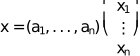
Referred to a vector basis  of , each vector x is uniquely expressed as
  or, using matrix multiplication,1
  .
.
Referred to the coordinate system  of , Fig. 8.1.2.1, each point X is uniquely described by the column of coordinates
  Thus, the real numbers
  are either the coefficients of the vector x of or the coordinates of the point X of .
![[Figure 8.1.2.1]](/figures/Abfig8o1o2o1thm.gif) | Representation of the point X with respect to origin O by the vector |
 . The vector
  of
of  by the coefficients
  . The coordinate system
  of the point space
 An instruction assigning uniquely to each point X of the point space an `image' point  , whereby all distances are left invariant, is called an isometry, an isometric mapping or a motion
  of . Motions are invertible, i.e., for a given motion
  , the inverse motion
  exists and is unique.
Referred to a coordinate system , any motion  may be described in the form
 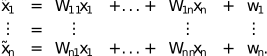 In matrix formulation, this is expressed as
  or, in abbreviated form, as
  , where
  , x and w are all
  columns and W is an
  square matrix. One often writes this in even more condensed form as
  , or
, or  ; here,
  is called the Seitz symbol.
A motion consists of a rotation part or linear part and a translation part. If the motion is represented by (W, w), the matrix W describes the rotation part of the motion and is called the matrix part of (W, w). The column w describes the translation part of the motion and is called the vector part or column part of (W, w). For a given motion, the matrix W depends only on the choice of the basis vectors, whereas the column w in general depends on the choice of the basis vectors and of the origin O; cf. Section 8.3.1
.
It is possible to combine the column and the matrix representing a motion into an  square matrix which is called the augmented matrix. The system of equations may then be expressed in the following form:
 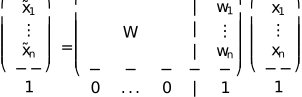 or, in abbreviated form, by
  . The augmentation is done in two steps. First, the column w is attached to the matrix and then the matrix is made square by attaching the
  row
row  . Similarly, the columns
  and have to be augmented to
  columns
  and
and  . The motion is now described by the one matrix
  instead of the pair (W, w).
If the motion is described by , the `inverse motion'  is described by
  , where
  . Successive application of two motions,
  and
and  , results in another motion
  :
:  with
with  .
.
This can be described in matrix notation as follows  and
and  with
with  or
or  with
with  .
.
It is a special advantage of the augmented matrices that successive application of motions is described by the product of the corresponding augmented matrices.
A point X is called a fixed point of the mapping if it is invariant under the mapping, i.e. 
In an n-dimensional Euclidean space , three types of motions can be distinguished:
 , where
  is called the
  and improper motions if
  . Improper motions are called
  ;
;  and
and  ; and
; and  , where
 In Fig. 8.1.2.2, the relations between the different types of motions in  are illustrated. The diagram contains all kinds of motions except the identity mapping
  which leaves the whole space invariant and which is described by
  . Thus, it is simultaneously a special rotation (with rotation angle 0) and a special translation (with translation vector o).
![[Figure 8.1.2.2]](/figures/Abfig8o1o2o2thm.gif) | Relations between the different kinds of motions in E3; det l.p. = determinant of the linear part. The identity mapping does not fit into this scheme properly and hence has been omitted. |
So far, motions in point space have been considered. Motions give rise to mappings of the corresponding vector space onto itself. If maps the points  and
and  of onto
  and
and  , the vector
  is mapped onto the vector
  . If the motion in is described by , the vectors v of are mapped according to
  . In other words, of the linear and translation parts of the motion of , only the linear part remains in the corresponding mapping of (linear mapping). This difference between the mappings in the two spaces is particularly obvious for translations. For a translation
  with translation vector
  , no fixed point exists in , i.e. no point of is mapped onto itself by . In , however, any vector v is mapped onto itself since the corresponding linear mapping is the identity mapping.
Definition:
A symmetry operation of a given object in point space is a motion of which maps this object (point, set of points, crystal pattern etc.) onto itself.
Remark: Any motion may be a symmetry operation, because for any motion one can construct an object which is mapped onto itself by this motion.
For the set of all symmetry operations of a given object, the following relations hold:
 . This operation
  is described (in any coordinate system) by
  or by
or by  is valid.
One can show, however, that in general the `commutative law'  is not obeyed for symmetry operations.
The properties (a ) to (d) are the group axioms. Thus, the set of all symmetry operations of an object forms a group, the symmetry group of the object or its symmetry. The mathematical theorems of group theory, therefore, may be applied to the symmetries of objects.
So far, only rather general objects have been considered. Crystallographers, however, are particularly interested in the symmetries of crystals. In order to introduce the concept of crystallographic symmetry operations, crystal structures, crystal patterns and lattices have to be taken into consideration. This will be done in the following section.
Crystals are finite real objects in physical space which may be idealized by infinite three-dimensional periodic `crystal structures' in point space. Three-dimensional periodicity means that there are translations among the symmetry operations of the object with the translation vectors spanning a three-dimensional space. Extending this concept of crystal structure to more general periodic objects and to n-dimensional space, one obtains the following definition:
Definition:
An object in n-dimensional point space is called an n-dimensional crystallographic pattern or, for short, crystal pattern if among its symmetry operations
 .
.Condition (i) guarantees the n-dimensional periodicity and thus excludes subperiodic symmetries like layer groups, rod groups and frieze groups. Condition (ii) takes into account the finite size of atoms in actual crystals.
Successive application of two translations of a crystal pattern results in another translation, the translation vector of which is the (vector) sum of the original translation vectors. Consequently, in addition to the n linearly independent translation vectors  , all (infinitely many) vectors
  (
( arbitrary integers) are translation vectors of the pattern. Thus, infinitely many translations belong to each crystal pattern. The periodicity of crystal patterns is represented by their lattices. It is useful to distinguish two kinds of lattices: vector lattices and point lattices. This distinction corresponds to that between vector space and point space, discussed above. The vector lattice is treated first.
Definition: The (infinite) set of all translation vectors of a crystal pattern is called the lattice of translation vectors or the vector lattice L of this crystal pattern.
In principle, any set of n linearly independent vectors may be used as a basis of the vector space . Most of these sets, however, result in a rather complicated description of a given vector lattice. The following theorem shows that among the (infinitely many) possible bases of the vector space special bases always exist, referred to which the survey of a given vector lattice becomes particularly simple.
Definitions:
(1) A basis of n vectors  of is called a crystallographic basis of the n-dimensional vector lattice L if every integral linear combination
  is a lattice vector of L. (2) A basis is called a primitive crystallographic basis of L or, for short, a primitive basis if it is a crystallographic basis and if, furthermore, every lattice vector t of L may be obtained as an integral linear combination of the basis vectors.
The distinction between these two kinds of bases can be expressed as follows. Referred to a crystallographic basis, the coefficients of each lattice vector must be either integral or rational. Referred to a primitive crystallographic basis, only integral coefficients occur. It should be noted that nonprimitive crystallographic bases are used conventionally for the description of `centred lattices', whereas reduced bases are always primitive; see Chapter 9.2
.
Example
The basis used conventionally for the description of the `cubic body-centred lattice' is a crystallographic basis because the basis vectors a, b, c are lattice vectors. It is not a primitive basis because lattice vectors with non-integral but rational coefficients exist, e.g. the vector  . The bases
  ,
,  ,
,  or
or  ,
,  ,
,  are primitive bases. In the first of these bases, the vector
  is given by
  , in the second basis by
  , both with integral coefficients only.
It can be shown that (in dimensions  ) the number of primitive bases for each vector lattice is infinite. There exists, however, a procedure called `basis reduction' (cf. Chapter 9.2
), which uniquely selects one primitive basis from this infinite set, thus permitting unambiguous description and comparison of vector lattices. Although such a reduced primitive basis always can be selected, in many cases conventional coordinate systems are chosen with nonprimitive rather than primitive crystallographic bases. The reasons are given in Section 8.3.1
. The term `primitive' is used not only for bases of lattices but also with respect to the lattices themselves, as in the crystallographic literature a vector lattice is frequently called primitive if its conventional basis is primitive.
) the number of primitive bases for each vector lattice is infinite. There exists, however, a procedure called `basis reduction' (cf. Chapter 9.2
), which uniquely selects one primitive basis from this infinite set, thus permitting unambiguous description and comparison of vector lattices. Although such a reduced primitive basis always can be selected, in many cases conventional coordinate systems are chosen with nonprimitive rather than primitive crystallographic bases. The reasons are given in Section 8.3.1
. The term `primitive' is used not only for bases of lattices but also with respect to the lattices themselves, as in the crystallographic literature a vector lattice is frequently called primitive if its conventional basis is primitive.
With the help of the vector lattices defined above, the concept of point lattices will be introduced.
Definition:
Given an arbitrary point  in point space and a vector lattice L consisting of vectors
  , the set of all points
  with
with  is called the point lattice belonging to and L.
A point lattice can be visualized as the set of end-points of all vectors of L, where L is attached to an arbitrary point of point space. Because each point X of point space could be chosen as the point , an infinite set of point lattices belongs to each vector lattice. Frequently, the point is chosen as the origin of the coordinate system of the point space.
An important aspect of a lattice is its unit cell.
Definition:
If is a crystallographic basis of a vector lattice L, the set of all vectors  with
with  is called a unit cell of the vector lattice.
The concept of a `unit cell' is not only applied to vector lattices in vector space but also more often to crystal structures or crystal patterns in point space. Here the coordinate system  and the origin of the unit cell have to be chosen. In most cases
  is taken, but in general we have the following definition:
Definition:
Given a crystallographic coordinate system of a crystal pattern and a point with coordinates  , a unit cell of the crystal pattern is the set of all points X with coordinates such that the equation
 holds.
Obviously, the term `unit cell' may be transferred to real crystals. As the volume of the unit cell and the volumes of atoms are both finite, only a finite number N of atoms can occur in a unit cell of a crystal. A crystal structure, therefore, may be described in two ways:
 representing the centre of an atom. To this point belong an infinite number of translationally equivalent points
  are lattice vectors. In this way, from each of the points
  within the unit cell a point lattice of translationally equivalent points is obtained. The crystal structure is then described by a finite number of interpenetrating infinite point lattices.
In most cases, one is not interested in the orientation of the vector lattice or the point lattices of a crystal structure in space, but only in the shape and size of a unit cell. From this point of view, a three-dimensional lattice is fully described by the lengths a, b and c of the basis vectors a, b and c and by the three interaxial angles α, β and γ. These data are called the lattice parameters, cell parameters or lattice constants of both the vector lattice and the associated point lattices of the crystal structure.
Crystallographic symmetry operations are special motions.
Definition: A motion is called a crystallographic symmetry operation if a crystal pattern exists for which it is a symmetry operation.
We consider a crystal pattern with its vector lattice L referred to a primitive basis. Then, by definition, each vector of L has integral coefficients. The linear part of a symmetry operation maps L onto itself:  . Since the coefficients of all vectors of L are integers, the matrix W is an integral matrix, i.e. its coefficients are integers. Thus, the trace of W,
  , is also an integer. In
  , by reference to an appropriate orthonormal (not necessarily crystallographic) basis, one obtains another condition for the trace,
  , where φ is the angle of rotation or rotoinversion. From these two conditions, it follows that φ can only be 0, 60, 90, 120, 180° etc., and hence the familiar restriction to one-, two-, three-, four- and sixfold rotations and rotoinversions results.2 These results imply for dimensions 2 and 3 that the matrix W satisfies the condition
  , with
  , 2, 3, 4 or 6.3 Consequently, for the operation (W, w) in point space the relation
  holds.
For the motion described by (W, w), this implies that a k-fold application results in a translation (with translation vector t) of the crystal pattern. The (fractional) translation  is called the intrinsic translation part (screw or glide part) of the symmetry operation. Whereas the `translation part' of a motion depends on the choice of the origin, the `intrinsic translation part' of a motion is uniquely determined. The intrinsic translation vector
  is the shortest translation vector of the motion for any choice of the origin.
If  , the symmetry operation has at least one fixed point and is a rotation, inversion, reflection or rotoinversion. If
  , the term is called the glide vector (for a reflection) or the screw vector (for a rotation) of the symmetry operation. Both types of operations, glide reflections and screw rotations, have no fixed point.
For the geometric visualization of symmetry, the concept of symmetry elements is useful.4 The symmetry element of a symmetry operation is the set of its fixed points, together with a characterization of the motion. For symmetry operations without fixed points (screw rotations or glide reflections), the fixed points of the corresponding rotations or reflections, described by  with
with  , are taken. Thus, in
  , symmetry elements are N-fold rotation points (
 , 3, 4 or 6), mirror lines and glide lines. In , symmetry elements are rotation axes, screw axes, inversion centres, mirror planes and glide planes. A peculiar situation exists for rotoinversions (except
  and
and  ). The symmetry element of such a rotoinversion consists of two components, a point and an axis. The point is the inversion point of the rotoinversion, and the axis of the rotoinversion is that of the corresponding rotation.
The determination of both the nature of a symmetry operation and the location of its symmetry element from the coordinate triplets, listed under Positions in the space-group tables, is described in Section 11.2.1 of Chapter 11.2
.
As mentioned in Section 8.1.3, the set of all symmetry operations of an object forms a group, the symmetry group of that object.
Definition:
The symmetry group of a three-dimensional crystal pattern is called its space group. In , the symmetry group of a (two-dimensional) crystal pattern is called its plane group. In  , the symmetry group of a (one-dimensional) crystal pattern is called its line group. To each crystal pattern belongs an infinite set of translations
  which are symmetry operations of that pattern. The set of all forms a group known as the translation subgroup
  of the space group
  of the crystal pattern. Since the commutative law
  holds for any two translations, is an Abelian group.
With the aid of the translation subgroup , an insight into the architecture of the space group can be gained.
Referred to a coordinate system , the space group is described by the set  of matrices W and columns w. The group is represented by the set of elements
  , where
  are the columns of coefficients of the translation vectors of the lattice L. Let (W, w) describe an arbitrary symmetry operation
  of . Then, all products
  for the different j have the same matrix part W. Conversely, every symmetry operation of the space group with the same matrix part W is represented in the set
  . The corresponding set of symmetry operations can be denoted by
  . Such a set is called a right coset of with respect to , because the element is the right factor in the products . Consequently, the space group may be decomposed into the right cosets
  , where the symmetry operations of the same column have the same matrix part W, and the symmetry operations
  differ by their matrix parts
  . This coset decomposition of with respect to may be displayed by the array
 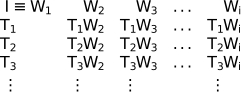 Here,
Here,  is the identity operation and the elements of form the first column, those of
  the second column etc. As each column may be represented by the common matrix part W of its symmetry operations, the number i of columns, i.e. the number of cosets, is at the same time the number of different matrices W of the symmetry operations of . This number i is always finite, and is the order of the point group belonging to , as explained below. Any element of a coset
  may be chosen as the representative element of that coset and listed at the top of its column. Choice of a different representative element merely results in a different order of the elements of a coset, but the coset does not change its content.5
Analogously, a coset  is called a left coset of with respect to , and can be decomposed into the left cosets
  . This left coset decomposition of a space group is always possible with the same
  as in the right coset decomposition. Moreover, both decompositions result in the same cosets, except for the order of the elements in each coset. A subgroup of a group with these properties is called a normal subgroup of the group; cf. Ledermann (1976). Thus, the translation subgroup is a normal subgroup of the space group .
The decomposition of a space group into cosets is the basis of the description of the space groups in these Tables. The symmetry operations of the space group are referred to a `conventional' coordinate system (cf. Section 8.3.1
) and described by matrices. In the space-group tables as general position (cf. Section 8.3.2
) for each column, a representative is listed whose coefficients  obey the condition
  . The matrix is not listed completely, however, but is given in a short-hand notation. In the expression
  , all vanishing terms and all
  are omitted, e.g.
 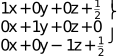 is replaced by
  . The first entry of the general position is always the identity mapping, listed as x, y, z. It represents all translations of the space group too.
As groups, some space groups are more complicated than others. Most easy to survey are the `symmorphic' space groups which may be defined as follows:
Definition:
A space group is called symmorphic if the coset representatives can be chosen in such a way that they leave one common point fixed.
In this case, the representative symmetry operations of a symmorphic space group form a (finite) group. If the fixed point is chosen as the origin of the coordinate system, the column parts  of the representative symmetry operations obey the equations
  Thus, for a symmorphic space group the representative symmetry operations may always be described by the special matrix–column pairs
  .
.
Symmorphic space groups may be easily identified by their Hermann–Mauguin symbols because these do not contain any glide or screw operation. For example, the monoclinic space groups with the symbols P2, C2, Pm, Cm,  and
and  are symmorphic, whereas those with the symbols
  , Pc, Cc,
  and
and  are not.
Unlike most textbooks of crystallography, in this section point groups are treated after space groups because the space group of a crystal pattern, and thus of a crystal structure, determines its point group uniquely.
The external shape (morphology) of a macroscopic crystal is formed by its faces. In order to eliminate the influence of growth conditions, the set of crystal faces is replaced by the set of face normals, i.e. by a set of vectors. Thus, the symmetry group of the macroscopic crystal is the symmetry group of the vector set of face normals. It is not the group of motions in point space, therefore, that determines the symmetry of the macroscopic crystal, but the corresponding group of linear mappings of vector space; cf. Section 8.1.2. This group of linear mappings is called the point group of the crystal. Since to each macroscopic crystal a crystal structure corresponds and, furthermore, to each crystal structure a space group, the point group of the crystal defined above is also the point group of the crystal structure and the point group of its space group.
To connect more formally the concept of point groups with that of space groups in n-dimensional space, we consider the coset decomposition of a space group with respect to the normal subgroup , as displayed above. We represent the right coset decomposition by  and the corresponding left coset decomposition by
  . If is referred to a coordinate system, the symmetry operations of are described by matrices W and columns w. As a result of the one-to-one correspondence between the i cosets
  and the i matrices , the cosets may alternatively be represented by the matrices . These matrices form a group of (finite) order i, and they describe linear mappings of the vector space connected with ; cf. Section 8.1.2. This group (of order i) of linear mappings is the point group
  of the space group , introduced above.
The difference between symmetry in point space and that in vector space may be exemplified again by means of some monoclinic space groups. Referred to conventional coordinate systems, space groups Pm, Pc, Cm and Cc have the same  matrices of their symmetry operations. Thus, the point groups of all these space groups are of the same type m. The space groups themselves, however, show a rather different behaviour. In Pm and Cm reflections occur, whereas in Pc and Cc only glide reflections are present.
Remark:
The usage of the term `point group' in connection with space groups is rather unfortunate as the point group of a space group is not a group of motions of point space but a group acting on vector space. As a consequence, the point group of a space group may contain operations which do not occur in the space group at all. This is apparent from the example of monoclinic space groups above. Nevertheless, the term `point group of a space group' is used here for historical reasons. A more adequate term would be `vector point group' of a space group or a crystal. It must be mentioned that the term `point group' is also used for the `site-symmetry group', defined in Section 8.3.2
. Site-symmetry groups are groups acting on point space.
It is of historic interest that the 32 types of three-dimensional crystallographic point groups were determined more than 50 years before the 230 (or 219) types of space group were known. The physical methods of the 19th century, e.g. the determination of the symmetry of the external shape or of tensor properties of a crystal, were essentially methods of determining the point group, not the space group of the crystal.
Acknowledgements
Part 8 is more than other parts of this volume the product of the combined efforts of many people. Most members of the IUCr Commission on International Tables made stimulating suggestions. Norman F. M. Henry, Cambridge, Theo Hahn, Aachen, and Aafje Looijenga-Vos, Groningen, have especially to be mentioned for their tireless efforts to find an intelligible presentation. Joachim Neubüser, Aachen, prepared the first draft for part 1 of the Pilot Issue (1972) under the title Mathematical Introduction to Symmetry. His article is the basis of the present text, to which again he made many valuable comments. J. Neubüser also stimulated the applications of normalizers in crystallography, outlined in Section 8.3.6
and Part 15
. L. Laurence Boyle, Canterbury, improved the English style and made constructive remarks.
References
 Brown, H., Bülow, R., Neubüser, J., Wondratschek, H. & Zassenhaus, H. (1978). Crystallographic groups of four-dimensional space. New York: Wiley.Google Scholar
Burckhardt, J. J. (1988). Die Symmetrie der Kristalle. Basel: Birkhäuser.Google Scholar
Flack, H. D., Wondratschek, H., Hahn, Th. & Abrahams, S. C. (2000). Symmetry elements in space groups and point groups. Addenda to two IUCr reports on the nomenclature of symmetry. Acta Cryst. A56, 96–98.Google Scholar
Giacovazzo, C. (2002). Editor. Fundamentals of crystallography, 2nd ed. IUCr texts on crystallography, No. 7. Oxford University Press.Google Scholar
Hermann, C. (1949). Kristallographie in Räumen beliebiger Dimensionszahl. I. Die Symmetrieoperationen. Acta Cryst. 2, 139–145.Google Scholar
International Tables for Crystallography
(2002). Vol. E. Subperiodic groups, edited by V. Kopsky & D. B. Litvin. Dordrecht: Kluwer Academic Publishers.Google Scholar
Janner, A. (2001). Introduction to a general crystallography. Acta Cryst. A57, 378–388.Google Scholar
Janssen, T., Janner, A., Looijenga-Vos, A. & de Wolff, P. M. (2004). International tables for crystallography, Vol. C, 3rd ed., edited by E. Prince, ch. 9.8. Dordrecht: Kluwer Academic Publishers.Google Scholar
Ledermann, W. (1976). Introduction to group theory. London: Longman.Google Scholar
Lima-de-Faria, J. (1990). Historical atlas of crystallography. Dordrecht: Kluwer Academic Publishers.Google Scholar
Opgenorth, J., Plesken, W. & Schulz, T. (1998). Crystallographic algorithms and tables. Acta Cryst. A54, 517–531.Google Scholar
Plesken, W. & Schulz, T. (2000). Counting crystallographic groups in low dimensions. Exp. Math. 9, 407–411.Google Scholar
Schwarzenberger, R. L. E. (1980). N-dimensional crystallography. San Francisco: Pitman.Google Scholar
Shubnikov, A. V. & Koptsik, V. A. (1974). Symmetry in science and art. New York: Plenum.Google Scholar
Smaalen, S. van (1995). Incommensurate crystal structures. Crystallogr. Rev. 4, 79–202.Google Scholar
Souvignier, B. (2003). Enantiomorphism of crystallographic groups in higher dimensions with results in dimensions up to 6. Acta Cryst. A59, 210–220.Google Scholar
Vainshtein, B. K. (1994). Fundamentals of crystals. Berlin: Springer-Verlag.Google Scholar
Wolff, P. M. de, Billiet, Y., Donnay, J. D. H., Fischer, W., Galiulin, R. B., Glazer, A. M., Hahn, Th., Senechal, M., Shoemaker, D. P., Wondratschek, H., Wilson, A. J. C. & Abrahams, S. C. (1992). Symbols for symmetry elements and symmetry operations. Acta Cryst. A48, 727–732.Google Scholar
Wolff, P. M. de, Billiet, Y., Donnay, J. D. H., Fischer, W., Galiulin, R. B., Glazer, A. M., Senechal, M., Shoemaker, D. P., Wondratschek, H., Hahn, Th., Wilson, A. J. C. & Abrahams, S. C. (1989). Definition of symmetry elements in space groups and point groups. Acta Cryst. A45, 494–499.Google Scholar
Yamamoto, A. (1996). Crystallography of quasiperiodic crystals. Acta Cryst. A52, 509–560.Google Scholar
Brown, H., Bülow, R., Neubüser, J., Wondratschek, H. & Zassenhaus, H. (1978). Crystallographic groups of four-dimensional space. New York: Wiley.Google Scholar
Burckhardt, J. J. (1988). Die Symmetrie der Kristalle. Basel: Birkhäuser.Google Scholar
Flack, H. D., Wondratschek, H., Hahn, Th. & Abrahams, S. C. (2000). Symmetry elements in space groups and point groups. Addenda to two IUCr reports on the nomenclature of symmetry. Acta Cryst. A56, 96–98.Google Scholar
Giacovazzo, C. (2002). Editor. Fundamentals of crystallography, 2nd ed. IUCr texts on crystallography, No. 7. Oxford University Press.Google Scholar
Hermann, C. (1949). Kristallographie in Räumen beliebiger Dimensionszahl. I. Die Symmetrieoperationen. Acta Cryst. 2, 139–145.Google Scholar
International Tables for Crystallography
(2002). Vol. E. Subperiodic groups, edited by V. Kopsky & D. B. Litvin. Dordrecht: Kluwer Academic Publishers.Google Scholar
Janner, A. (2001). Introduction to a general crystallography. Acta Cryst. A57, 378–388.Google Scholar
Janssen, T., Janner, A., Looijenga-Vos, A. & de Wolff, P. M. (2004). International tables for crystallography, Vol. C, 3rd ed., edited by E. Prince, ch. 9.8. Dordrecht: Kluwer Academic Publishers.Google Scholar
Ledermann, W. (1976). Introduction to group theory. London: Longman.Google Scholar
Lima-de-Faria, J. (1990). Historical atlas of crystallography. Dordrecht: Kluwer Academic Publishers.Google Scholar
Opgenorth, J., Plesken, W. & Schulz, T. (1998). Crystallographic algorithms and tables. Acta Cryst. A54, 517–531.Google Scholar
Plesken, W. & Schulz, T. (2000). Counting crystallographic groups in low dimensions. Exp. Math. 9, 407–411.Google Scholar
Schwarzenberger, R. L. E. (1980). N-dimensional crystallography. San Francisco: Pitman.Google Scholar
Shubnikov, A. V. & Koptsik, V. A. (1974). Symmetry in science and art. New York: Plenum.Google Scholar
Smaalen, S. van (1995). Incommensurate crystal structures. Crystallogr. Rev. 4, 79–202.Google Scholar
Souvignier, B. (2003). Enantiomorphism of crystallographic groups in higher dimensions with results in dimensions up to 6. Acta Cryst. A59, 210–220.Google Scholar
Vainshtein, B. K. (1994). Fundamentals of crystals. Berlin: Springer-Verlag.Google Scholar
Wolff, P. M. de, Billiet, Y., Donnay, J. D. H., Fischer, W., Galiulin, R. B., Glazer, A. M., Hahn, Th., Senechal, M., Shoemaker, D. P., Wondratschek, H., Wilson, A. J. C. & Abrahams, S. C. (1992). Symbols for symmetry elements and symmetry operations. Acta Cryst. A48, 727–732.Google Scholar
Wolff, P. M. de, Billiet, Y., Donnay, J. D. H., Fischer, W., Galiulin, R. B., Glazer, A. M., Senechal, M., Shoemaker, D. P., Wondratschek, H., Hahn, Th., Wilson, A. J. C. & Abrahams, S. C. (1989). Definition of symmetry elements in space groups and point groups. Acta Cryst. A45, 494–499.Google Scholar
Yamamoto, A. (1996). Crystallography of quasiperiodic crystals. Acta Cryst. A52, 509–560.Google Scholar

