|
International
Tables for Crystallography Volume C Mathematical, physical and chemical tables Edited by E. Prince © International Union of Crystallography 2006 |
International Tables for Crystallography (2006). Vol. C. ch. 1.1, pp. 2-3
|
The vectors a, b, c form a primitive crystallographic basis of the vector lattice L, if each translation vector  may be expressed as
  with u, v, w being integers.
A primitive basis defines a primitive unit cell for a corresponding point lattice. Its volume V may be calculated as the mixed product (triple scalar product) of the three basis vectors: 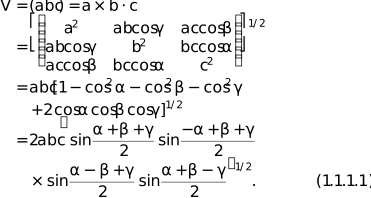 Here a, b and c designate the lengths of the three basis vectors and
  ,
,  and
and  the angles between them.
Each vector lattice L and each primitive crystallographic basis a, b, c is uniquely related to a reciprocal vector lattice  and a primitive reciprocal basis a*, b*, c*:
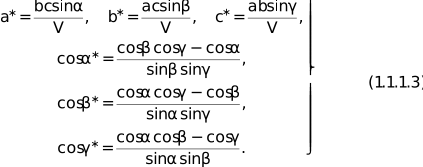
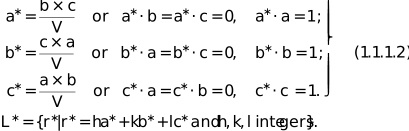 The lengths
  ,
,  and
and  of the reciprocal basis vectors and the angles
  ,
,  and
and  are given by:
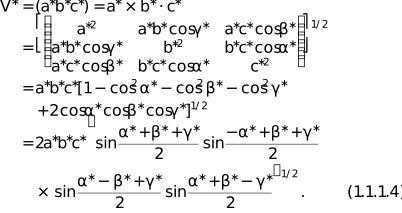
  a*, b*, c* define a primitive unit cell in a corresponding reciprocal point lattice. Its volume V* may be expressed by analogy with V [equation (1.1.1.1)
 ]:
]: 
In addition, the following equation holds:  As all relations between direct and reciprocal lattices are symmetrical, one can calculate a, b, c from a*, b*, c*:
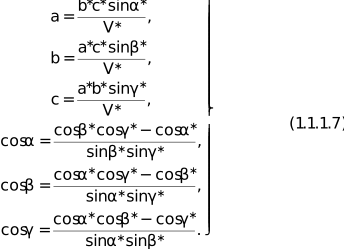 The unit-cell volumes V and V* may also be obtained from:

For certain lattice types, it is usual in crystallography to refer to a `conventional' crystallographic basis  instead of a primitive basis a, b, c. In that case,
  ,
,  , and
, and  with all their integral linear combinations are lattice vectors again, but there exist other lattice vectors
  ,
,  with at least two of the coefficients
  ,
,  ,
,  being fractional.
Such a conventional basis defines a conventional or centred unit cell for a corresponding point lattice, the volume  of which may be calculated by analogy with V by substituting for a, b, and c in (1.1.1.1).
If m designates the number of centring lattice vectors t with  , may be expressed as a multiple of the primitive unit-cell volume V:
  With the aid of equations (1.1.1.2) and (1.1.1.3), the reciprocal basis
  may be derived from . Again, each reciprocal-lattice vector
  is an integral linear combination of the reciprocal basis vectors, but in contrast to the use of a primitive basis only certain triplets h, k, l refer to reciprocal-lattice vectors.
Equation (1.1.1.5) also relates to  , the reciprocal cell volume referred to . From this it follows that
Table 1.1.1.1 contains detailed information on `centred lattices' described with respect to conventional basis systems.
| ||||||||||||||||||||||||||||||||||||||||||||||||||||||||


 ,
, 


As a direct lattice and its corresponding reciprocal lattice do not necessarily belong to the same type of Bravais lattices [IT A (2005, Section 8.2.5
)], the Bravais letter of is given in the last column of Table 1.1.1.1. Except for P lattices, a conventionally chosen basis for coincides neither with a*, b*, c* nor with . This third basis, however, is not used in crystallography. The designation of scattering vectors and the indexing of Bragg reflections usually refers to .
If the differences with respect to the coefficients of direct- and reciprocal-lattice vectors are disregarded, all other relations discussed in Part 1 are equally true for primitive bases and for conventional bases.
References
 International Tables for Crystallography
(2005). Vol. A, Space-group symmetry, edited by Th. Hahn, 5th ed. Heidelberg: Springer.Google Scholar
International Tables for Crystallography
(2005). Vol. A, Space-group symmetry, edited by Th. Hahn, 5th ed. Heidelberg: Springer.Google Scholar

