|
International
Tables for Crystallography Volume C Mathematical, physical and chemical tables Edited by E. Prince © International Union of Crystallography 2006 |
International Tables for Crystallography (2006). Vol. C. ch. 1.1, pp. 2-5
https://doi.org/10.1107/97809553602060000572 Chapter 1.1. Summary of general formulae
E. Kocha
a Institut für Mineralogie, Petrologie und Kristallographie, Universität Marburg, Hans-Meerwein-Strasse, D-35032 Marburg, Germany In this chapter, general geometrical formulae are given that describe (i) the relations between the lattice parameters and unit cells in direct and in reciprocal space and (ii) the relations between lattice vectors, point rows and net planes, and allow (iii) the calculation of various angles in direct and in reciprocal space (including the Miller formulae). Keywords: angles in direct and reciprocal space; basis; direct and reciprocal lattices; lattices; Miller formulae; point rows. |
In an ideal crystal structure, the arrangement of atoms is three-dimensionally periodic. This periodicity is usually described in terms of point lattices, vector lattices, and translation groups [cf. IT A (2005 , Section 8.1.4
)].
, Section 8.1.4
)].
The vectors a, b, c form a primitive crystallographic basis of the vector lattice L, if each translation vector  may be expressed as
  with u, v, w being integers.
A primitive basis defines a primitive unit cell for a corresponding point lattice. Its volume V may be calculated as the mixed product (triple scalar product) of the three basis vectors: 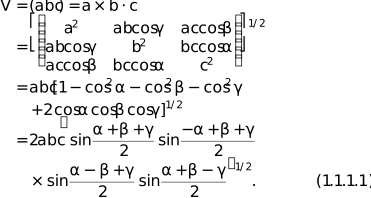 Here a, b and c designate the lengths of the three basis vectors and
  ,
,  and
and  the angles between them.
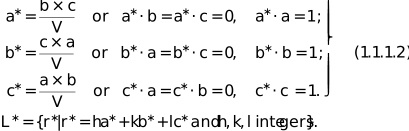
Each vector lattice L and each primitive crystallographic basis a, b, c is uniquely related to a reciprocal vector lattice  and a primitive reciprocal basis a*, b*, c*:
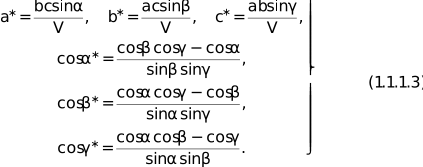
 The lengths
  ,
,  and
and  of the reciprocal basis vectors and the angles
  ,
,  and
and  are given by:
  a*, b*, c* define a primitive unit cell in a corresponding reciprocal point lattice. Its volume V* may be expressed by analogy with V [equation (1.1.1.1)]: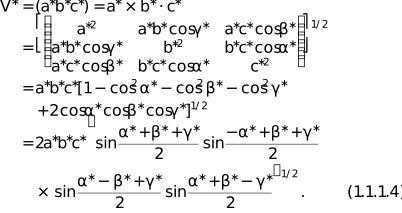
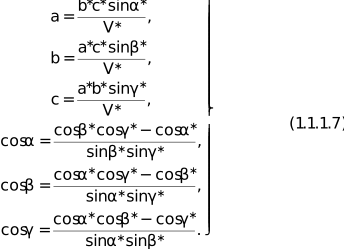
In addition, the following equation holds:  As all relations between direct and reciprocal lattices are symmetrical, one can calculate a, b, c from a*, b*, c*:
 The unit-cell volumes V and V* may also be obtained from:

For certain lattice types, it is usual in crystallography to refer to a `conventional' crystallographic basis  instead of a primitive basis a, b, c. In that case,
  ,
,  , and
, and  with all their integral linear combinations are lattice vectors again, but there exist other lattice vectors
  ,
,  with at least two of the coefficients
  ,
,  ,
,  being fractional.
Such a conventional basis defines a conventional or centred unit cell for a corresponding point lattice, the volume  of which may be calculated by analogy with V by substituting for a, b, and c in (1.1.1.1).
If m designates the number of centring lattice vectors t with  , may be expressed as a multiple of the primitive unit-cell volume V:
  With the aid of equations (1.1.1.2) and (1.1.1.3), the reciprocal basis
  may be derived from . Again, each reciprocal-lattice vector
  is an integral linear combination of the reciprocal basis vectors, but in contrast to the use of a primitive basis only certain triplets h, k, l refer to reciprocal-lattice vectors.
Equation (1.1.1.5) also relates to  , the reciprocal cell volume referred to . From this it follows that
Table 1.1.1.1 contains detailed information on `centred lattices' described with respect to conventional basis systems.
| ||||||||||||||||||||||||||||||||||||||||||||||||||||||||


 ,
, 


As a direct lattice and its corresponding reciprocal lattice do not necessarily belong to the same type of Bravais lattices [IT A (2005, Section 8.2.5
)], the Bravais letter of is given in the last column of Table 1.1.1.1. Except for P lattices, a conventionally chosen basis for coincides neither with a*, b*, c* nor with . This third basis, however, is not used in crystallography. The designation of scattering vectors and the indexing of Bragg reflections usually refers to .
If the differences with respect to the coefficients of direct- and reciprocal-lattice vectors are disregarded, all other relations discussed in Part 1 are equally true for primitive bases and for conventional bases.
The length t of a vector is given by  Accordingly, the length
  of a reciprocal-lattice vector
  may be calculated from
  If the coefficients u, v, w of a vector are coprime, [uvw] symbolizes the direction parallel to t. In particular, [uvw] is used to designate a crystal edge, a zone axis, or a point row with that direction.
The integer coefficients h, k, l of a vector  are also the coordinates of a point of the corresponding reciprocal lattice and designate the Bragg reflection with scattering vector r*. If h, k, l are coprime, the direction parallel to r* is symbolized by
  .
.
Each vector r* is perpendicular to a family of equidistant parallel nets within a corresponding direct point lattice. If the coefficients h, k, l of r* are coprime, the symbol (hkl) describes that family of nets. The distance d(hkl) between two neighbouring nets is given by  Parallel to such a family of nets, there may be a face or a cleavage plane of a crystal.
The net planes (hkl) obey the equation  Different values of n distinguish between the individual nets of the family; x, y, z are the coordinates of points on the net planes (not necessarily of lattice points). They are expressed in units a, b, and c, respectively.
Similarly, each vector with coprime coefficients u, v, w is perpendicular to a family of equidistant parallel nets within a corresponding reciprocal point lattice. This family of nets may be symbolized  . The distance
  between two neighbouring nets can be calculated from
  A layer line on a rotation pattern or a Weissenberg photograph with rotation axis [uvw] corresponds to one such net of the family of the reciprocal lattice.
The nets obey the equation  Equations (1.1.2.6) and (1.1.2.4) are essentially the same, but may be interpreted differently. Again, n distinguishes between the individual nets out of the family . h, k, l are the coordinates of the reciprocal-lattice points, expressed in units , , , respectively.
A family of nets (hkl) and a point row with direction [uvw] out of the same point lattice are parallel if and only if the following equation is satisfied: 
This equation is called the `zone equation' because it must also hold if a face (hkl) of a crystal belongs to a zone [uvw].
Two (non-parallel) nets  and
and  intersect in a point row with direction [uvw] if the indices satisfy the condition
  The same condition must be satisfied for a zone axis [uvw] defined by the crystal faces and .
Three nets , , and  intersect in parallel rows, or three faces with these indices belong to one zone if
  Two (non-parallel) point rows
  and
and  in the direct lattice are parallel to a family of nets (hkl) if
  The same condition holds for a face (hkl) belonging to two zones and .
Three point rows , , and  are parallel to a net (hkl), or three zones of a crystal with these indices have a common face (hkl) if
  A net (hkl) is perpendicular to a point row [uvw] if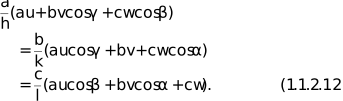
The angles between the normal of a crystal face and the basis vectors a, b, c are called the direction angles of that face. They may be calculated as angles between the corresponding reciprocal-lattice vector r* and the basis vectors  ,
,  and
and  :
: 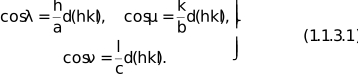 The three equations can be combined to give
  The first formula gives the ratios between a, b, and c, if for any face of the crystal the indices (hkl) and the direction angles λ, μ, and ν are known. Once the axial ratios are known, the indices of any other face can be obtained from its direction angles by using the second formula.
Similarly, the angles between a direct-lattice vector t and the reciprocal basis vectors  ,
,  and
and  are given by
  The angle
  between two direct-lattice vectors
  and
and  or between two corresponding point rows and may be derived from the scalar product
  as
as  Analogously, the angle
  between two reciprocal-lattice vectors
  and
and  or between two corresponding point rows
  and
and  or between the normals of two corresponding crystal faces and may be calculated as
  with
with 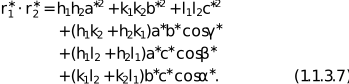
Finally, the angle  between a first direction [uvw] of the direct lattice and a second direction [hkl] of the reciprocal lattice may also be derived from the scalar product of the corresponding vectors t and r*.
Consider four faces of a crystal that belong to the same zone in consecutive order: , , , and  . The angles between the ith and the jth face normals are designated
  . Then the Miller formulae relate the indices of these faces to the angles :
  with
with  If all angles between the face normals and also the indices for three of the faces are known, the indices of the fourth face may be calculated. Equation (1.1.4.1) cannot be used if two of the faces are parallel.
From the definition of  ,
,  , and
, and  , it follows that all fractions in (1.1.4.1) are rational:
  Therefore, (1.1.4.1) may be rearranged to
  This equation allows the determination of one angle if two of the angles and the indices of all four faces are known.
References
 International Tables for Crystallography
(2005). Vol. A, Space-group symmetry, edited by Th. Hahn, 5th ed. Heidelberg: Springer.Google Scholar
International Tables for Crystallography
(2005). Vol. A, Space-group symmetry, edited by Th. Hahn, 5th ed. Heidelberg: Springer.Google Scholar

