|
International
Tables for Crystallography Volume C Mathematical, physical and chemical tables Edited by E. Prince © International Union of Crystallography 2006 |
International Tables for Crystallography (2006). Vol. C. ch. 1.1, pp. 3-4
|
The length t of a vector  is given by
  Accordingly, the length
  of a reciprocal-lattice vector
  may be calculated from
  If the coefficients u, v, w of a vector
  are coprime, [uvw] symbolizes the direction parallel to t. In particular, [uvw] is used to designate a crystal edge, a zone axis, or a point row with that direction.
The integer coefficients h, k, l of a vector  are also the coordinates of a point of the corresponding reciprocal lattice and designate the Bragg reflection with scattering vector r*. If h, k, l are coprime, the direction parallel to r* is symbolized by
  .
.
Each vector r* is perpendicular to a family of equidistant parallel nets within a corresponding direct point lattice. If the coefficients h, k, l of r* are coprime, the symbol (hkl) describes that family of nets. The distance d(hkl) between two neighbouring nets is given by  Parallel to such a family of nets, there may be a face or a cleavage plane of a crystal.
The net planes (hkl) obey the equation  Different values of n distinguish between the individual nets of the family; x, y, z are the coordinates of points on the net planes (not necessarily of lattice points). They are expressed in units a, b, and c, respectively.
Similarly, each vector with coprime coefficients u, v, w is perpendicular to a family of equidistant parallel nets within a corresponding reciprocal point lattice. This family of nets may be symbolized  . The distance
  between two neighbouring nets can be calculated from
  A layer line on a rotation pattern or a Weissenberg photograph with rotation axis [uvw] corresponds to one such net of the family of the reciprocal lattice.
The nets obey the equation  Equations (1.1.2.6)
 and (1.1.2.4) are essentially the same, but may be interpreted differently. Again, n distinguishes between the individual nets out of the family . h, k, l are the coordinates of the reciprocal-lattice points, expressed in units
  ,
,  ,
,  , respectively.
A family of nets (hkl) and a point row with direction [uvw] out of the same point lattice are parallel if and only if the following equation is satisfied: 
This equation is called the `zone equation' because it must also hold if a face (hkl) of a crystal belongs to a zone [uvw].
Two (non-parallel) nets  and
and  intersect in a point row with direction [uvw] if the indices satisfy the condition
  The same condition must be satisfied for a zone axis [uvw] defined by the crystal faces and .
Three nets , , and  intersect in parallel rows, or three faces with these indices belong to one zone if
  Two (non-parallel) point rows
  and
and  in the direct lattice are parallel to a family of nets (hkl) if
  The same condition holds for a face (hkl) belonging to two zones and .
Three point rows , , and  are parallel to a net (hkl), or three zones of a crystal with these indices have a common face (hkl) if
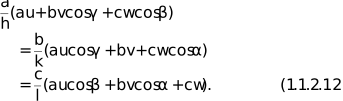
  A net (hkl) is perpendicular to a point row [uvw] if