|
International
Tables for Crystallography Volume D Physical properties of crystals Edited by A. Authier © International Union of Crystallography 2006 |
International Tables for Crystallography (2006). Vol. D. ch. 1.4, pp. 99-104
https://doi.org/10.1107/97809553602060000631 Chapter 1.4. Thermal expansion
a
Institut für Geowissenshaften, Universität Kiel, Olshausenstrasse 40, D-24098 Kiel, Germany This chapter discusses the reduction in the number of independent tensor components by crystal symmetry, representation surfaces, the quasiharmonic approximation and the Grüneisen relation. Experimental methods including diffraction, optical and electrical methods are presented. Finally, the relation between thermal expansion and crystal structure is discussed. Keywords: Grüneisen relation; acoustic branches; anharmonicity; capacitance method; interferometry; pushrod dilatometry; thermal expansion. |
If the temperature T of a solid is raised by an amount ΔT, a deformation takes place that is described by the strain tensor  :
:  The quantities
  are the coefficients of thermal expansion. They have dimensions of
  and are usually given in units of
  . Since is a symmetrical polar tensor of second rank and T is a scalar, is a symmetrical polar tensor of second rank
  . According to the properties of the strain tensor (cf. Section 1.3.1.3.2
 ), the `volume thermal expansion', β, is given by the (invariant) trace of the `linear' coefficients .
The magnitudes of thermal expansion in different directions,  , can be visualized in the following ways:

 ,
,  and
and  with principal values
  ,
,  and
and  :
: 
 represents the reciprocal of the square root of thermal expansion along that direction,
  (
( are the direction cosines of the particular direction).
 are positive, the quadric
  is represented by an ellipsoid, whose semiaxes have lengths
  . In this case, the square of the reciprocal length of radius vector
  , represents the amount of positive expansion in the particular direction,
  .
. . Then, the hyperboloid has one (belt-like) sheet (
 ,
,  and
and  . This `strain ellipsoid

 are used to specify the direction, the length of
The three possible graphical representations are shown in Fig. 1.4.1.1.
![[Figure 1.4.1.1]](/figures/Dafig1o4o1o1thm.gif)
|
Sections (ac plane) of representation surfaces for a trigonal (or tetragonal or hexagonal) crystal with |
 and
and  (similar to calcite). (
The maximum number of independent components of the tensor is six (in the triclinic system). With increasing symmetry, this number decreases as described in Chapter 1.1
. Accordingly, the directions and lengths of the principal axes of the representation surfaces are restricted as described in Chapter 1.3
(e.g. in hexagonal, trigonal and tetragonal crystals, the representation surfaces are rotational sheets and the rotation axis is parallel to the n-fold axis). The essential results of these symmetry considerations, as deduced in Chapter 1.1
and relevant for thermal expansion, are compiled in Table 1.4.1.1.
|
![[Scheme scheme1]](/schemes/Dach1o4scheme1.gif)
![[Scheme scheme2]](/schemes/Dach1o4scheme2.gif)
![[Scheme scheme3]](/schemes/Dach1o4scheme3.gif)
![[Scheme scheme4]](/schemes/Dach1o4scheme4.gif)
![[Scheme scheme5]](/schemes/Dach1o4scheme5.gif)
The coefficients of thermal expansion depend on temperature. Therefore, the directions of the principal axes of the quadrics in triclinic and monoclinic crystals change with temperature (except the principal axis parallel to the twofold axis in monoclinic crystals).
The thermal expansion of a polycrystalline material can be approximately calculated if the tensor of the single crystal is known. Assuming that the grains are small and of comparable size, and that the orientations of the crystallites are randomly distributed, the following average of [(1.4.1.4)] can be calculated:  If the polycrystal consists of different phases, a similar procedure can be performed if the contribution of each phase is considered with an appropriate weight.
It should be mentioned that the true situation is more complicated. The grain boundaries of anisotropic polycrystalline solids are subject to considerable stresses because the neighbouring grains have different amounts of expansion or contraction. These stresses may cause local plastic deformation and cracks may open up between or within the grains. These phenomena can lead to a hysteresis behaviour when the sample is heated up or cooled down. Of course, in polycrystals of a cubic crystal species, these problems do not occur.
If the polycrystalline sample exhibits a texture, the orientation distribution function (ODF) has to be considered in the averaging process. The resulting overall symmetry of a textured polycrystal is usually  (see Section 1.1.4.7.4.2
), showing the same tensor form as hexagonal crystals (Table 1.4.1.1), or mmm.
(see Section 1.1.4.7.4.2
), showing the same tensor form as hexagonal crystals (Table 1.4.1.1), or mmm.
Thermal expansion of a solid is a consequence of the anharmonicity of interatomic forces (see also Section 2.1.2.8
). If the potentials were harmonic, the atoms would oscillate (even with large amplitudes) symmetrically about their equilibrium positions and their mean central position would remain unchanged. In order to describe thermal expansion, the anharmonicity is most conveniently accounted for by means of the so-called `quasiharmonic approximation', assuming the lattice vibration frequencies ω to be independent of temperature but dependent on volume  . Anharmonicity is taken into account by letting the crystal expand, but it is assumed that the atoms vibrate about their new equilibrium positions harmonically, i.e. lattice dynamics are still treated in the harmonic approximation. The assumption
  , which is made for the harmonic oscillator, is a generalization of the postulate that the frequency of a harmonic oscillator does not depend on the amplitude of vibration.
This approach leads, as demonstrated below, to the Grüneisen relation, which combines thermal expansion with other material constants and, additionally, gives an approximate description of the temperature dependence of thermal expansion (cf. Krishnan et al., 1979; Barron, 1998).
For isotropic media, the volume expansion 

 , cf. (1.4.1.2), can be expressed by the thermodynamic relation
  κ being the isothermal compressibility. To obtain the quantity
  , the pressure p is deduced from the free energy F, whose differential is
  , i.e. from
  In a crystal consisting of N unit cells with p atoms in each unit cell, there are 3p normal modes with frequencies
  (denoted by an index s running from 1 to 3p) and with N allowed wavevectors
  (denoted by an index t running from 1 to N). Each normal mode
  contributes to the free energy by the amount
  The total free energy amounts, therefore, to
 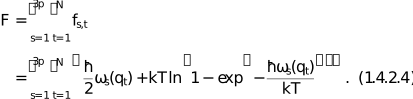 From (1.4.2.2)
 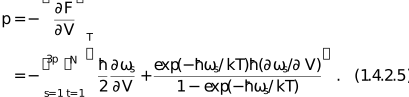 The last term can be written as
  where
where  is the Bose–Einstein distribution
Differentiation of (1.4.2.5) and (1.4.2.6) with respect to temperature at constant volume [see (1.4.2.1)] yields 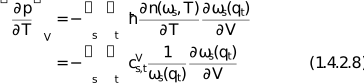 with
with  This quantity,
  (the Einstein function), is the well known contribution of the normal mode to the specific heat (at constant volume):
  Equation (1.4.2.8) can be simplified by the introduction of an `individual Grüneisen parameter'
  for each normal mode :
  Equation (1.4.2.8) then reads [with (1.4.2.1)]
  Based on these individual parameters , an average (or overall mode-independent) Grüneisen parameter
  can be defined as
  In this averaging process, the contribution of each normal mode to is weighted in the same way as it contributes to the specific heat
  [see (1.4.2.10)]. Equations (1.4.2.12) and (1.4.2.13) lead to the Grüneisen relation
  The above derivation was made for isotropic media. For anisotropic media,
  is replaced by the strain
  and
and  is replaced by the stiffness tensor
  [cf. Chapter 2.1
and equation (2.1.2.75)
]. Then the Grüneisen parameter turns out to be a second-rank tensor
[cf. Chapter 2.1
and equation (2.1.2.75)
]. Then the Grüneisen parameter turns out to be a second-rank tensor  :
:  In the Debye approximation, the mode frequencies scale linearly with the cut-off frequency
  . Therefore, with
  , the average isotropic Grüneisen parameter is calculated to be
  Since, in the Debye theory,
  is independent of temperature,
  turns out to be independent of temperature. As κ and V are only weakly temperature dependent, the thermal expansion β should then, according to (1.4.2.14), roughly behave like , i.e. β should be proportional to
  at very low temperatures, and should be approximately constant for
  (the Dulong–Petit law). This behaviour is found to be approximately satisfied for many compounds, even with different types of interatomic interaction, and γ takes values roughly between 1 and 2. Even in the case of crystals with highly anisotropic elastic and thermal behaviour, the three principal values of the tensor [(1.4.2.15)] are comparably uniform, having values of about 2 (Küppers, 1974).
Effectively, γ shows a certain more or less pronounced dependence on temperature. The individual are assumed to be temperature independent. However, being an average over the whole spectrum of excited modes [cf. (1.4.2.13)], will not necessarily have the same value at low temperatures (when only low frequencies are excited) as at high temperatures (when all modes are excited). Two limiting cases can be considered:
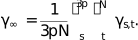
 is proportional to ω:

 describes the velocities of the three elastic waves propagating in a direction
  . From (1.4.2.16)
 , within a frequency interval ω to
  , is proportional to
  . The summation over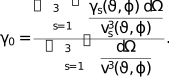
 can be calculated if the elastic constants are known. For isotropic solids, the term
  can be replaced (as done in Debye's theory of heat capacity) by
  , with
  being the velocity of the longitudinal wave and
  the velocity of the transverse waves.
In metals, the conduction electrons and magnetic interactions yield contributions to the free energy and to the specific heat. Accordingly, expression (1.4.2.14) can be augmented by introduction of an `electronic Grüneisen parameter',  , and a `magnetic Grüneisen parameter',
  , in addition to the `lattice Grüneisen parameter',
  , considered so far:
Although the strain tensor and the thermal expansion tensor in general contain components with  (shear strains), in practice only longitudinal effects, i.e. relative length changes
  with temperature changes ΔT, are measured along different directions and the results are later transformed to a common coordinate system. Diffraction methods directly yield this ratio . Other measuring techniques require separate measurements of Δl and l. The error in the measurement of l can usually be neglected. Thus, the accuracies of Δl and ΔT limit the accuracy of thermal expansion coefficients. The temperature interval ΔT is determined by two measurements of temperatures
  , with
  . To increase the accuracy of the difference ΔT, this interval should be large. The measured thermal expansion
  is usually assigned to a temperature at the midpoint of the temperature interval,
  . This procedure is only justified if thermal expansion does not depend on temperature.
Since, in fact, thermal expansion depends on temperature, in principle, smaller intervals should be chosen, which, in turn, enlarge the error of ΔT. Here, a compromise has to be made. Sometimes, after completion of a first run and after reviewing the preliminary course of  , it is necessary to repeat some measurements using smaller temperature intervals in temperature ranges with large curvatures.
The more-or-less curved course of  is usually fitted by polynomials in powers of temperature. Here, those T terms should be selected that are physically meaningful in the particular temperature range. For the low-temperature behaviour of a metal, a polynomial of type
  should be chosen. For minerals at higher temperatures, a polynomial
  is used (Saxena & Shen, 1992).
Temperature is usually measured by thermocouples and, in the cases of optical or electrical measurements (Sections 1.4.3.3 and 1.4.3.4) and at low temperatures also by platinum resistance thermometers. Above 1100 K, optical pyrometers can be used.
In order to measure the thermal expansion of a crystal, at least as many independent measurements are necessary as the tensor has independent components (fourth column in Table 1.4.1.1). It is advisable, however, to carry out more measurements than are necessary. In this case (of redundancy), a `best' set of tensor components is to be determined by least-squares methods as described below.
Let us assume the most general case of a triclinic crystal, where  independent measurements of thermal expansions
 were performed along m different directions with direction cosines
 with respect to the chosen coordinate system. Each measurement is related to the six unknown tensor components (to be determined) by
  If the are replaced by
 , using Voigt's one-index notation (Section 1.1.4.10.2
), then
, using Voigt's one-index notation (Section 1.1.4.10.2
), then  represents an overdetermined inhomogeneous system of m linear equations for the six unknowns . The coefficients
  , forming an
  matrix, are products containing direction cosines according to (1.4.3.1). The solution is obtained after several matrix calculations which are indicated by the formula (Nye, 1985)
 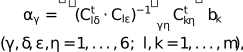 where a superscript `t' means transposed.
Instead of determining the tensor components of a triclinic or monoclinic crystal in a direct way, as outlined above, it is also possible to determine first the temperature change of the crystallographic unit cell and then, by formulae given e.g. by Schlenker et al. (1978), to deduce the tensor components . The direct approach is recommended, however, for reasons of the propagation of errors (Jessen & Küppers, 1991).
The experimental techniques of measuring relative length changes that are most widely used include diffraction, optical interferometry, pushrod dilatometry and electrical capacitance methods. If the specimens available are very small and/or irregular in shape, only diffraction methods can be used. The other methods require single-crystal parallelepipedal samples with at least 5 mm side lengths.
Thermal expansion expresses itself, on a microscopic scale, by a change of the interplanar spacings of lattice planes. These can be measured by use of diffraction methods from changes of Bragg angles  . Differentiation of the Bragg equation
  , giving
  , yields the thermal expansions in directions normal to lattice planes (hkl) (i.e. along
  ) and, if h has direction cosines
  with respect to the chosen Cartesian coordinate system,
 The coefficient
  permits a tremendous increase of sensitivity and accuracy if
  . That means, if possible, high-angle
  reflections should be used for measurement because, for a given Δd, the changes of Bragg angles
  to be measured increase with
  .
.
The most important diffraction techniques (X-radiation is preferentially used) are: the rotating-crystal method, the Weissenberg method and diffractometers with counter recording. If small single crystals ( approximately 50 µm) are not available, powder methods (using a Debye–Scherrer film camera or powder diffractometer) must be used, although the advantage of the highly accurate back-reflections, in general, cannot be used.
Experimental aspects of measuring absolute d-values are discussed in detail in Volume C
of International Tables for Crystallography (2004), Part 5
. Since only relative displacements are to be measured in the present case, many complications connected with the determination of absolute values do not apply for thermal expansion measurements, such as zero-point correction, eccentricity of the mounted sample, refraction, absorption and diffraction profile.
The basic principle of measuring thermal expansion by interferometry consists of converting sample-length changes into variations of optical path differences of two coherent monochromatic light beams, which are reflected from two opposite end faces of the sample (or planes corresponding to them). An He–Ne laser usually serves as a light source. A beam expander produces a parallel beam and interference by two planes, which are slightly inclined to each other, produces fringes of equal thickness. Thermal expansion causes a movement of this fringe pattern, which is detected by photodiodes. The number of fringes passing a reference mark is counted and gives a measure of the relative movement of the two planes.
As examples for various realizations of interferometric devices (Hahn, 1998), two basic designs will be described.
 (with a polished upper surface and a coarsely ground and non-reflecting lower surface) and is placed in between a bottom plate
  and a wedge-shaped plate
  (wedge angle of about
  ). The upper surface of
 ![[Figure 1.4.3.1]](/figures/Dafig1o4o3o1thm.gif)
![[Figure 1.4.3.2]](/figures/Dafig1o4o3o2thm.gif)
With this method, the expansion of the crystal is transmitted out of the cooled or heated region to an external measuring device by a rod made of a reference material whose thermal expansion is low and well known (usually silica glass) (cf. Gaal, 1998). If this rod is inside a tube of the same material (silica glass), and the specimen is inside as well, then the difference in expansion between the crystal and an equal length of the reference material is measured. Above 1100 K, instead of silica glass, high-purity alumina or single-crystal sapphire or tungsten rods are used.
To measure the displacement of the rods, several techniques are used. The most important are:
Temperature gradients in the rod and the tube can lead to severe complications. For every determination, the system should be calibrated by certified materials (White, 1998), such as α-Al2O3, Cu, Pt, fused silica, Si, W, Mg or Mo.
In a way similar to the interferometric methods, the change of the gap between the lower surface of P1 and the upper surface of P2 (Fig. 1.4.3.1) is used to determine the thermal expansion of the sample. This gap – with electrically conducting surfaces – is used as the capacitance in an electric circuit with a fixed inductance. The change of capacitance leads to a change of resonance frequency, which is measured.
The anharmonicities of the interatomic potentials gain importance with increasing vibration amplitudes of the atoms. Since, at a given temperature, weakly bonded atoms oscillate with larger amplitudes, they contribute to a larger degree to thermal expansion in comparison with stronger bonds. This correlation follows also from the Grüneisen relation (1.4.2.14) because α (or β) is proportional to the compressibility, which, in turn, is a rough measure of the interatomic and intermolecular forces.
This simple consideration allows qualitative predictions of the thermal expansion behaviour of a crystal species if the structure is known:
|
Buda et al. (1990) have calculated the thermal expansion of silicon by means of ab initio methods. It is to be expected that these methods, which are currently arduous, will be applicable to more complicated structures in the years to come and will gain increasing importance in this field (cf. Lazzeri & de Gironcoli, 1998).
It is observed rather frequently in anisotropic materials that an enhanced expansion occurs along one direction and a contraction (negative expansion) in directions perpendicular to that direction (e.g. in calcite). The volume expansion, i.e. the trace of , is usually positive in these cases, however. If the tensor of elastic constants is known, such negative expansions can mostly be explained by a lateral Poisson contraction caused by the large expansion (Küppers, 1974).
Only a few crystals show negative volume expansion and usually only over a narrow temperature range (e.g. Si and fused silica below about 120 K and quartz above 846 K) (White, 1993). Cubic ZrW2O8 was recently found to exhibit isotropic negative thermal expansion over the complete range of stability of this material (0.5–1050 K) (Mary et al., 1996). This behaviour is explained by the librational motion of practically rigid polyhedra and a shortening of Zr—O—W bonds by transverse vibration of the oxygen atom. By tailoring the chemical content (of TiO2 or LiAlSiO4) in a glassy matrix, an expansion coefficient can be achieved that is nearly zero over a desired temperature range.
A compilation of numerical values of the tensor components of more than 400 important crystals of different symmetry is given by Krishnan et al. (1979).
Phase transitions are accompanied and characterized by discontinuous changes of derivatives of the free energy. Since the thermal expansion β is a second-order derivative, discontinuities or changes of slope in the  curve are used to detect and to describe phase transitions (cf. Chapter 3.1
).
curve are used to detect and to describe phase transitions (cf. Chapter 3.1
).
References
 Barron, T. H. K. (1998). Generalized theory of thermal expansion of solids. In Thermal expansion of solids, edited by C. Y. Ho, ch. 1. Materials Park, Ohio: ASM International.Google Scholar
Buda, F., Car, R. & Parrinello, M. (1990). Thermal expansion of c-Si via ab initio molecular dynamics. Phys. Rev. B, 41, 1680–1683.Google Scholar
Gaal, P. S. (1998). Pushrod dilatometers. In Thermal expansion of solids, edited by C. Y. Ho, ch. 5. Materials Park, Ohio: ASM International.Google Scholar
Hahn, T. A. (1998). Thermal expansion measurements using optical interferometry. In Thermal expansion of solids, edited by C. Y. Ho, ch. 6. Materials Park, Ohio: ASM International.Google Scholar
International Tables for Crystallography
(2004). Vol. C. Mathematical, physical and chemical tables, 3rd ed., edited by E. Prince. Dordrecht: Kluwer Academic Publishers.Google Scholar
Jessen, S. M. & Küppers, H. (1991). The precision of thermal-expansion tensors of triclinic and monoclinic crystals. J. Appl. Cryst. 24, 239–242.Google Scholar
Krishnan, R. S., Srinivasan, R. & Devanarayanan, S. (1979). Thermal expansion of solids. Oxford: Pergamon.Google Scholar
Küppers, H. (1974). Anisotropy of thermal expansion of ammonium and potassium oxalates. Z. Kristallogr. 140, 393–398.Google Scholar
Lazzeri, M. & de Gironcoli, S. (1998). Ab initio study of Be(001) surface thermal expansion. Phys. Rev. Lett. 81, 2096–2099.Google Scholar
Mary, T. A., Evans, J. S. O., Vogt, T. & Sleight, A. W. (1996). Negative thermal expansion from 0.3 to 1050 Kelvin in ZrW2O8. Science, 272, 90–92.Google Scholar
Nye, J. F. (1985). Physical properties of crystals. Oxford: Clarendon Press.Google Scholar
Saxena, S. K. & Shen, G. (1992). Assessed data on heat capacity, thermal expansion, and compressibility of some oxides and silicates. J. Geophys. Res. 97, 19813–19825.Google Scholar
Schlenker, J. L., Gibbs, G. V. & Boisen, M. B. (1978). Strain-tensor components expressed in terms of lattice parameters. Acta Cryst. A34, 52–54.Google Scholar
White, G. K. (1993). Solids: thermal expansion and contraction. Contemp. Phys. 34, 193–204.Google Scholar
White, G. K. (1998). Thermal expansion reference materials. In Thermal expansion of solids, edited by C. Y. Ho, ch. 11. Materials Park, Ohio: ASM International.Google Scholar
Barron, T. H. K. (1998). Generalized theory of thermal expansion of solids. In Thermal expansion of solids, edited by C. Y. Ho, ch. 1. Materials Park, Ohio: ASM International.Google Scholar
Buda, F., Car, R. & Parrinello, M. (1990). Thermal expansion of c-Si via ab initio molecular dynamics. Phys. Rev. B, 41, 1680–1683.Google Scholar
Gaal, P. S. (1998). Pushrod dilatometers. In Thermal expansion of solids, edited by C. Y. Ho, ch. 5. Materials Park, Ohio: ASM International.Google Scholar
Hahn, T. A. (1998). Thermal expansion measurements using optical interferometry. In Thermal expansion of solids, edited by C. Y. Ho, ch. 6. Materials Park, Ohio: ASM International.Google Scholar
International Tables for Crystallography
(2004). Vol. C. Mathematical, physical and chemical tables, 3rd ed., edited by E. Prince. Dordrecht: Kluwer Academic Publishers.Google Scholar
Jessen, S. M. & Küppers, H. (1991). The precision of thermal-expansion tensors of triclinic and monoclinic crystals. J. Appl. Cryst. 24, 239–242.Google Scholar
Krishnan, R. S., Srinivasan, R. & Devanarayanan, S. (1979). Thermal expansion of solids. Oxford: Pergamon.Google Scholar
Küppers, H. (1974). Anisotropy of thermal expansion of ammonium and potassium oxalates. Z. Kristallogr. 140, 393–398.Google Scholar
Lazzeri, M. & de Gironcoli, S. (1998). Ab initio study of Be(001) surface thermal expansion. Phys. Rev. Lett. 81, 2096–2099.Google Scholar
Mary, T. A., Evans, J. S. O., Vogt, T. & Sleight, A. W. (1996). Negative thermal expansion from 0.3 to 1050 Kelvin in ZrW2O8. Science, 272, 90–92.Google Scholar
Nye, J. F. (1985). Physical properties of crystals. Oxford: Clarendon Press.Google Scholar
Saxena, S. K. & Shen, G. (1992). Assessed data on heat capacity, thermal expansion, and compressibility of some oxides and silicates. J. Geophys. Res. 97, 19813–19825.Google Scholar
Schlenker, J. L., Gibbs, G. V. & Boisen, M. B. (1978). Strain-tensor components expressed in terms of lattice parameters. Acta Cryst. A34, 52–54.Google Scholar
White, G. K. (1993). Solids: thermal expansion and contraction. Contemp. Phys. 34, 193–204.Google Scholar
White, G. K. (1998). Thermal expansion reference materials. In Thermal expansion of solids, edited by C. Y. Ho, ch. 11. Materials Park, Ohio: ASM International.Google Scholar

