|
International
Tables for Crystallography Volume I X-ray absorption spectroscopy and related techniques Edited by C. T. Chantler, F. Boscherini and B. Bunker © International Union of Crystallography 2024 |
International Tables for Crystallography (2024). Vol. I. ch. 3.44, pp. 564-566
https://doi.org/10.1107/S1574870722005468 Chapter 3.44. Self-absorption correctionsaDepartment of Physics, University of California, Santa Cruz, Santa Cruz, CA 95064, USA, and bLawrence Berkeley National Laboratory, Berkeley, CA 94720, USA Currently used self-absorption corrections for extended X-ray absorption fine structure and X-ray absorption near-edge structure fluorescence data are briefly reviewed. Keywords: self-absorption corrections. |
When all of the atoms of interest in a dilute or very thin sample receive the same incident flux of X-rays, the number of fluorescence photons is proportional to the photoelectric part of the X-ray absorption coefficient μ; see equation (3) in Bridges (2024 ). However, many samples are not in this limit: the concentration of the atoms of interest may not be low and the sample may be thick. In this case, the penetration of the X-rays into the sample depends on the total absorption coefficient, and if μ varies rapidly with energy E, as is the case for X-ray absorption near-edge structure (XANES) and extended X-ray absorption fine structure (EXAFS), the mean absorption depth also changes. Then, if μ decreases slightly at some energy, the X-rays penetrate farther into the sample and excite more atoms, and thus the number of fluorescence photons does not decrease as much as expected. This `self-absorption' effect reduces the EXAFS amplitude and can significantly distort the XANES.
Self-absorption has been addressed by several authors over the last few decades (Hayes & Boyce, 1982; Goulon et al., 1982; Tan et al., 1989; Tröger et al., 1992; Brewe et al., 1994; Pfalzer et al., 1999; Booth & Bridges, 2005; Li et al., 2014). Hayes & Boyce (1982) and also Goulon et al. (1982) briefly discussed errors from self-absorption effects but did not give an explicit correction function. Tan et al. (1989) and Brewe et al. (1994) also addressed self-absorption, but took a different approach; they estimated corrections to the amplitude (or coordination number) and the Debye–Waller factor σ2 when self-absorption was important. Tröger et al. (1992) applied a similar approach to that of Goulon et al. (1982) for the soft X-ray regime (O K edge) and developed an average correction function to extract the actual EXAFS function χ(k) from the experimental function; however, the correction was for thick samples and did not include changes in μ from the EXAFS oscillations. Booth & Bridges (2005) extended this calculation to include variable sample thicknesses and also included the effects of the EXAFS oscillations; the latter are important when the EXAFS oscillations are large, such as in ordered materials at low temperatures, for example copper foil. Other approaches have been developed for specialized cases: Li et al. (2014) considered self-absorption effects in multilayer systems for which refraction and multiple reflections are included, Brewe et al. (1994) considered a glancing emergent angle geometry and Pfalzer et al. (1999) considered the case of a large solid-angle detector.
Below, the self-absorption correction function is developed following the approach of Booth & Bridges (2005); the geometry and some parameters are given in Fig. 1. Defining y = x/sinφ and z = x/sinθ, and integrating over x, the measured fluorescence intensity If (see Bridges, 2024) is given by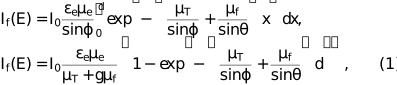 where the subscript e refers to the edge of interest, μf is the total absorption coefficient at the fluorescence energy, g = sinφ/sinθ, I0 is the incident intensity and μT =
  , where μb is the slowly changing background absorption from other edges/atoms.
  refers to the average absorption above the edge of interest, which is usually obtained from a spline fit through the EXAFS oscillations. Here, it is assumed that the effects of the finite solid angle of the detector are small enough to be neglected (Booth & Bridges, 2005); however, see Brewe et al. (1994) and Pfalzer et al. (1999) for special cases. The EXAFS function is given by
  and the experimental value by
  . Using equation (1) plus some algebra (Booth & Bridges, 2005), χexp can be written in terms of χ as
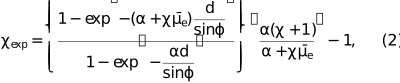 where α =
  . At this point the calculation is exact within the assumption of a uniform thickness (plus a uniform distribution of the atom of interest) and a small detector solid angle. The difficulty with it is that χexp is given as a function of χ and cannot be analytically inverted to give χ as a function of χexp for finite sample thicknesses (i.e. αd/sinφ < 3) because of the term
  /sinφ in the exponent. Note that
  and χ is typically less than 0.1. Thus, in most cases
  and the exponential term in χ [exp(
 /sinφ)] can be approximated as 1 − (
 /sinφ). Equation (2) then becomes a quadratic equation in χ, with a solution
 where
where 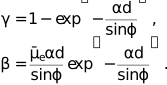
![[Figure 1]](/figures/bz5055fig1thm.gif)
The correction factor χ/χexp now oscillates in k-space as a result of the EXAFS oscillations (Booth & Bridges, 2005). An example of the improvement achieved using the above approximation is shown in Fig. 3 of Booth & Bridges (2005) for a 4.6 µm foil. Note that equation (2) can be inverted numerically and hence the approximation (equation 3) can be checked. This correction has been incorporated into several EXAFS packages such as RSXAP (REDUCE and SABCOR; Booth, 2010; Booth & Bridges, 2024) and IFEFFIT (Newville, 2004; Newville & Ravel, 2024). For RSXAP, equation (2) is now inverted numerically.
The distortion of the XANES from self-absorption is described by the same starting equation as used for EXAFS (equation 1) after background fluorescence contributions have been subtracted. Also, all treatments consider only the infinitely thick limit, for which the exponential term goes to zero. However, remember that the total absorption coefficient μT is a sum of μe and μb, where μb is the background contribution from other absorption processes. Following Haskel (1999), an energy EN needs to be chosen above the edge for normalization: it is assumed that this energy is well above the edge and that variations in μe are small (if not, a point should be chosen on  , for example at a `zero-crossing' in the EXAFS oscillations). The measured absorption is given by If(E)/I0(E), the value of this quantity at the normalization energy is If(EN)/I0(EN) and the normalized absorption is given by μe(E)/μe(EN). Defining the normalized measured absorption Xe as [If(E)/I0(E)]/[If(EN)/I0(EN)], Xe is given by
  where B = μf/μe(EN), δ = μb(E)/μe(EN) and δ′ = μb(EN)/μe(EN). Solving for μe(E)/μe(EN) and simplifying, one obtains (Haskel, 1999)
 Here, it is assumed that ɛe(E)/ɛe(EN) ≃ 1, and δ ≃ δ′ for a small energy range around the edge. Note that equation (6) is normalized (Xe ≃ 1) above the edge energy, where self-absorption effects are large. Consequently, the correction factor in equation (6) is ∼1.0 at EN and decreases as energy decreases towards the bottom of the edge; i.e. the experimental Xe is suppressed the most for energies near the bottom of the edge, where Xe ≃ 0. At this point on the edge, the extra correction factor is 1/[1 + 1/(Bg + δ)]; as Xe increases, the correction factor approaches 1.0. In contrast, at a white line, particularly for an LIII edge, the correction factor must be greater than 1 because Xe > 1 and the correction factor is 1/[1 − (Xe − 1)/(Bg + δ)]. As long as the correction factor in equation (6) is less than 3–4 this is typically a good approximation, but since it depends on the quality of the data and the choice of EN it should be checked.
References
 Booth, C. H. (2010). RSXAP EXAFS Analysis Package. https://lise.lbl.gov/RSXAP/
.Google ScholarBooth, C. H. & Bridges, F. (2005). Phys. Scr. 2005, 202.Google ScholarBooth, C. H. & Bridges, F. (2024). Int. Tables Crystallogr. I, ch. 6.19, 822–826
.Google ScholarBrewe, D. L., Pease, D. M. & Budnick, J. I. (1994). Phys. Rev. B, 50, 9025–9030.Google ScholarBridges, F. (2024). Int. Tables Crystallogr. I, ch. 3.41, 546–548
.Google ScholarGoulon, J., Goulon-Ginet, C., Cortes, R. & Dubois, J. M. (1982). J. Phys. Fr. 43, 539–548.Google ScholarHaskel, D. (1999). FLUO: Correcting XANES for Self-Absorption in Fluorescence Data. https://www3.aps.anl.gov/haskel/FLUO/Fluo-manual.pdf
.Google ScholarHayes, T. M. & Boyce, J. B. (1982). Solid State Physics, Vol. 37, edited by H. Ehrenreich, F. Seitz & D. Turnbull, p. 173. New York: Academic Press.Google ScholarLi, W.-B., Yang, X.-Y., Zhu, J.-T., Tu, Y.-C., Mu, B.-Z., Yu, H.-S., Wei, X.-J., Huang, Y.-Y. & Wang, Z.-S. (2014). J. Synchrotron Rad. 21, 561–567.Google ScholarNewville, M. (2004). IFEFFIT. https://cars9.uchicago.edu/ifeffit/
.Google ScholarNewville, M. & Ravel, B. (2024). Int. Tables Crystallogr. I, ch. 6.13, 791–795
.Google ScholarPfalzer, P., Urbach, J.-P., Klemm, M., Horn, S., denBoer, M. L., Frenkel, A. L. & Kirkland, J. P. (1999). Phys. Rev. B, 60, 9335–9339.Google ScholarTan, Z., Budnick, J. I. & Heald, S. M. (1989). Rev. Sci. Instrum. 60, 1021–1025.Google ScholarTröger, L., Arvanitis, D., Baberschke, K., Michaelis, H., Grimm, U. & Zschech, E. (1992). Phys. Rev. B, 46, 3283–3289.Google Scholar
Booth, C. H. (2010). RSXAP EXAFS Analysis Package. https://lise.lbl.gov/RSXAP/
.Google ScholarBooth, C. H. & Bridges, F. (2005). Phys. Scr. 2005, 202.Google ScholarBooth, C. H. & Bridges, F. (2024). Int. Tables Crystallogr. I, ch. 6.19, 822–826
.Google ScholarBrewe, D. L., Pease, D. M. & Budnick, J. I. (1994). Phys. Rev. B, 50, 9025–9030.Google ScholarBridges, F. (2024). Int. Tables Crystallogr. I, ch. 3.41, 546–548
.Google ScholarGoulon, J., Goulon-Ginet, C., Cortes, R. & Dubois, J. M. (1982). J. Phys. Fr. 43, 539–548.Google ScholarHaskel, D. (1999). FLUO: Correcting XANES for Self-Absorption in Fluorescence Data. https://www3.aps.anl.gov/haskel/FLUO/Fluo-manual.pdf
.Google ScholarHayes, T. M. & Boyce, J. B. (1982). Solid State Physics, Vol. 37, edited by H. Ehrenreich, F. Seitz & D. Turnbull, p. 173. New York: Academic Press.Google ScholarLi, W.-B., Yang, X.-Y., Zhu, J.-T., Tu, Y.-C., Mu, B.-Z., Yu, H.-S., Wei, X.-J., Huang, Y.-Y. & Wang, Z.-S. (2014). J. Synchrotron Rad. 21, 561–567.Google ScholarNewville, M. (2004). IFEFFIT. https://cars9.uchicago.edu/ifeffit/
.Google ScholarNewville, M. & Ravel, B. (2024). Int. Tables Crystallogr. I, ch. 6.13, 791–795
.Google ScholarPfalzer, P., Urbach, J.-P., Klemm, M., Horn, S., denBoer, M. L., Frenkel, A. L. & Kirkland, J. P. (1999). Phys. Rev. B, 60, 9335–9339.Google ScholarTan, Z., Budnick, J. I. & Heald, S. M. (1989). Rev. Sci. Instrum. 60, 1021–1025.Google ScholarTröger, L., Arvanitis, D., Baberschke, K., Michaelis, H., Grimm, U. & Zschech, E. (1992). Phys. Rev. B, 46, 3283–3289.Google Scholar

