|
International
Tables for Crystallography Volume I X-ray absorption spectroscopy and related techniques Edited by C. T. Chantler, F. Boscherini and B. Bunker © International Union of Crystallography 2024 |
International Tables for Crystallography (2024). Vol. I. ch. 5.11, pp. 683-686
https://doi.org/10.1107/S1574870722005481 Chapter 5.11. The cumulant approach and the ratio methodaDepartment of Physics, University of Trento, 38123 Trento-Povo, Italy For weak disorder, the distributions of interatomic distances sampled by extended X-ray absorption fine structure (EXAFS) can be parametrized in terms of their leading cumulants. For a sufficiently well isolated first coordination shell, accurate relative values of the cumulants with respect to a reference sample can be obtained by separate analysis of phases and amplitudes (the ratio method). The basics of both the cumulant approach and the ratio method are presented and their strengths and limitations are discussed. Keywords: cumulant analysis; ratio method. |
An EXAFS experiment samples a one-dimensional effective distribution of interatomic distances for each scattering path  where λ(k) is the photo-electron mean free path and ρ(r) is the real distribution of distances, the width and shape of which depend on atomic vibrations and sometimes also on structural disorder.
For disorder that is not too large, an effective distribution can effectively be characterized by the cumulant expansion method (see Appendix A ), whereby the EXAFS signal for one path is
  so that, for a single coordination shell,
 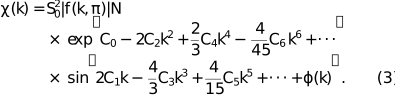 Odd and even cumulants Cn separately determine the phase and the amplitude of the signal. C1 and C2 are the mean and the variance of the distribution, respectively; higher-order odd and even cumulants measure the asymmetric and symmetric deviations from the normal shape, respectively. In particular, positive or negative values of the third cumulant correspond to a long tail on the positive or the negative side of the distribution, respectively.
The cumulants  of the real distribution ρ(r) can be recovered from the cumulants Cn of the effective distribution by the recursion formula (Vaccari et al., 2007)
  The difference between
  and C1 can be significant (Bunker, 1983; Freund et al., 1989),
  , and the corresponding transformation is included in most data-analysis packages. For n ≥ 2, the difference is much smaller and is frequently neglected.
The standard EXAFS analysis relies on the calculation of backscattering amplitudes, phase shifts and inelastic factors for all relevant single- and multiple-scattering paths. Coordination numbers and the leading cumulants (generally the first three for the first shell and the first two for the outer shells) are then evaluated by a nonlinear best fit of simulated EXAFS spectra to experimental spectra.
The ratio method (Bunker, 1983; Dalba et al., 1993) is an alternative approach for the analysis of the first shell when its contribution can be neatly singled out by Fourier filtering, for example when the leakage of contributions from longer paths is negligible (Schnohr et al., 2014). If the first coordination shell of the sample s only contains one atomic species, and if a reference m of known structure is available, the backscattering amplitudes, phase shifts and inelastic factors of which are the same as for the sample s, then the phases and the amplitudes of the first-shell EXAFS signal,  of the sample s can be separately analysed by comparison with the reference m.
The separation of phase and amplitude is made possible by complex Fourier filtering. If the direct and inverse transforms were performed for −∞ < r < +∞, one would obtain  from the inverse transform. Since the inverse transform is performed only for r > 0, both the real and the imaginary parts of
  differ from zero. The real part corresponds to the filtered EXAFS signal (to within the artefact of the Fourier filtering procedure):
  The real and imaginary parts can be combined to separately calculate the amplitude and phase of the filtered first-shell signal,
If the phase shifts φ(k) of the sample s and reference m are identical, they can be removed by subtracting the total phase of the reference from that of the sample,  A polynomial fit allows one to obtain the differences between the first odd cumulants:
  ,
,  , …
, …
If ΔΦ/2k is plotted against k2, the intercept gives ΔC1, the slope is proportional to ΔC3 and deviations from linearity imply a non-negligible influence of ΔC5 (Fig. 1, left).
![[Figure 1]](/figures/bz5057fig1thm.gif)
If |f(k, π)|,  and λ(k) for the sample s and reference m are identical, they can be removed by dividing the sample amplitude by the reference amplitude. The logarithm of the amplitude ratio is
  A polynomial fit allows one to obtain the coordination number ratio Ns/Nm and the differences between the first even cumulants:
  ,
,  , …
, …
If  is plotted against k2, the intercept corresponds to
  , the slope is proportional to ΔC2 and deviations from linearity imply a non-negligible influence of ΔC4 (Fig. 1, right). The term
  can be estimated from a rough knowledge of the interatomic distances
  and
and  and mean free path λ; its neglect could lead to incorrect Ns/Nm ratios.
The ratio method avoids the theoretical input of backscattering amplitudes, phase shifts and inelastic factors, provided that these quantities can be considered to be identical for the sample s and reference m. Additionally, it cancels the artefacts of the Fourier filtering procedure and reduces curved-wave effects. On the other hand, it only gives ratios of coordination numbers and relative values of cumulants  for well isolated first coordination shells. The method is particularly suited for temperature-dependent (Fornasini et al., 2004) or pressure-dependent (Freund et al., 1989; Fornasini et al., 2018) studies, where the low-T or low-p spectrum can be taken as a reference, or for the comparison of noncrystalline and crystalline phases of a system.
Relative values of the first cumulant are significant in themselves; they allow the direct measurement of the bond thermal expansion or of the bond compressibility by temperature- or pressure-dependent measurements, respectively.
Absolute values of the thermal contribution to the second cumulant (Debye–Waller exponent) in the harmonic approximation can be evaluated by fitting a correlated Debye model (Beni & Platzman, 1976; Sevillano et al., 1979),  or an Einstein model (Sevillano et al., 1979),
  to the temperature dependence of the experimental values. The comparison of experimental data with more refined quantum-perturbative approaches allows the evaluation of the absolute values of the thermal contribution to the third and fourth cumulants.
The temperature or pressure dependence of the first-shell cumulants obtained by the ratio method and by a nonlinear fit to simulated spectra should coincide: a comparison of the final results is thus an important cross-consistency check of the two procedures.
The detection of structural disorder effects by the ratio method is only possible in some cases, for example when an amorphous sample is compared with its crystalline counterpart or when a phase transition induces an abrupt variation of the temperature dependence with respect to Debye or Einstein behaviour. In general, the presence and the extent of structural contributions to the cumulants can only be estimated from the absolute values obtained by the nonlinear fit to simulated spectra.
The ratio method allows a quite effective elimination of the correlation between phase and amplitude parameters. Additionally, a simple inspection of plots such as those in Fig. 1 allows an immediate evaluation of the quality of the data and a visual estimation of the cumulant values.
Subtler technical differences have been discussed in Vaccari et al. (2007). The simulation codes can calculate the mean free path λ(k) as a function of k, but frequently take its effect into account through a factor exp[−2R/λ(k)], where R is an average distance; the effective distribution becomes  and the correction to the first cumulant lacks the 1/λ term. The ratio method accounts for the instantaneous r-dependence of the whole effective distribution P(r, λ), but considers λ to be independent of k; the errors in phases and amplitudes due to this approximation cancel out to a good extent in the comparison of two files (Bunker, 1983).
In conclusion, the ratio method (when applicable) and the nonlinear fitting method should be considered as complementary procedures.
Once the absolute values of the leading cumulants have been determined, the characteristic function of the distance distribution can be evaluated by the first terms of its cumulant expansion. The distance distribution can in turn be reconstructed by a Fourier transformation of the characteristic function (Dalba et al., 1993).
The strengths and limitations of the cumulant method have been highlighted by various authors. The convergence properties of the cumulant series for different distributions have been studied by Crozier et al. (1988), Dalba et al. (1993) and Yang et al. (1997). The inadequacy of the cumulant approach has been pointed out by Filipponi (2001) for systems affected by strong structural disorder such as liquids and by Mustre de Leon et al. (1992) for strongly anharmonic systems.
Only a limited number of polynomial coefficients  are determined in EXAFS analyses. The agreement of the temperature dependence of the polynomial coefficients
  with theoretical expectations can be a self-consistent check of the convergence properties of the cumulant series, in order that the polynomial coefficients
  can be considered as good estimates of the cumulants Cn (Fornasini et al., 2004).
The assessment of the uncertainty of EXAFS results is far from trivial (Abd el All et al., 2013). A number of instrumental factors are not under the complete control of the experimenters and require suitable data-analysis procedures and a critical discussion of results for a sound a posteriori evaluation of uncertainties.
EXAFS measurements should be repeated a convenient number of times and the corresponding spectra should be separately analysed. The cumulants obtained from different spectra by the same procedure of analysis represent a restricted sample of a parent population due to short-term fluctuations; the corresponding uncertainty should be estimated from the standard deviation of the distribution of mean values, which decreases when the number of spectra increases.
Different choices of the analysis parameters for the same spectrum (such as the windows and weights of Fourier transforms and the fitting intervals) lead to different values of the cumulants, which cannot be considered as independent samples: increasing the number of fitting intervals cannot decrease the final uncertainty. The point is here a sound choice of the different Fourier parameters and of the different fitting intervals. In the ratio method, the largest fitting interval can be chosen as the interval where the phase differences or the logarithms of amplitudes ratios of different spectra exhibit reasonable agreement (Fig. 1). The visual choice is somewhat arbitrary, but generally leads to quite conservative estimates of uncertainty. The values of each cumulant obtained by varying the analysis parameters can be considered as sampling a uniform distribution between the maximum and minimum value, and the corresponding uncertainty can be evaluated as the standard deviation of the distribution.
A further contribution to the uncertainty evaluation is obtained by comparing independent measurements performed on the same system in different laboratories or on samples of different thicknesses and possibly at two different absorption edges.
Finally, external accuracy checks can rely on the comparison of experimental results with theoretical models.
APPENDIX A
The initial moments of a distribution Φ(r) are defined as (Cramér, 1966)  where
where  is the normalization integral and α1 = m is the mean value of the variable r. The initial moment αn only exists if the integral
  exists; if the moment α of order n exists, all moments of order k < n also exist.
The central moments of the distribution Φ(r) are defined as  so that μ0 = 1, μ1 = 0,
  is the variance of the distribution,
  measures the asymmetry (or skewness) and μ4 measures the flatness (or kurtosis).
The characteristic function of a distribution Φ(r) is its Fourier transform  There is a one-to-one correspondence between a distribution Φ(r) and its characteristic function Ψ(t).
If all moments αn exist, the characteristic function can be expanded as a Maclaurin series around the origin t = 0, 
The second characteristic function is the logarithm of Ψ(t),  The second characteristic function can be expanded as a Maclaurin series around k = 0 as
  where the coefficients Cn are the cumulants or seminvariants of the distribution. The convergence interval of the cumulant series depends on the properties of the distribution Φ(r).
The first cumulant corresponds to the first initial moment C1 = α1 and the leading higher-order cumulants are simply connected to the central moments 
For EXAFS t = 2k, so that  and C0 = lnα0 = 0 for the real distribution and C0 ≠ 0 for the effective distribution of path lengths.
In the literature, the first cumulant has alternatively been defined as the average difference between the instantaneous distance r and the average distance of a reference spectrum (Stern et al., 1992) or even the minimum position of the effective potential (Yokoyama et al., 1996). These choices do not affect the cumulants of higher order but lead to different expressions for C0.
References
 Abd el All, N., Thiodjio Sendja, B., Grisenti, R., Rocca, F., Diop, D., Mathon, O., Pascarelli, S. & Fornasini, P. (2013). J. Synchrotron Rad. 20, 603–613.Google ScholarBeni, G. & Platzman, P. M. (1976). Phys. Rev. B, 14, 1514–1518.Google ScholarBunker, G. (1983). Nucl. Instrum. Methods Phys. Res. 207, 437–444.Google ScholarCramér, H. (1966). Mathematical Methods of Statistics. Princeton University Press.Google ScholarCrozier, E. D., Rehr, J. J. & Ingalls, R. (1988). X-ray Absorption, edited by D. C. Koningsberger & R. Prins, pp. 373–442. New York: John Wiley & Sons.Google ScholarDalba, G., Fornasini, P. & Rocca, F. (1993). Phys. Rev. B, 47, 8502–8514.Google ScholarFilipponi, A. (2001). J. Phys. Condens. Matter, 13, R23–R60.Google ScholarFornasini, P., a Beccara, S., Dalba, G., Grisenti, R., Sanson, A., Vaccari, M. & Rocca, F. (2004). Phys. Rev. B, 70, 174301.Google ScholarFornasini, P., Grisenti, R., Irifune, T., Shinmei, T., Mathon, O., Pascarelli, S. & Rosa, A. D. (2018). J. Phys. Condens. Matter, 30, 245402.Google ScholarFreund, J., Ingalls, R. & Crozier, E. D. (1989). Phys. Rev. B, 39, 12537–12547.Google ScholarMustre de Leon, J., Conradson, S. D., Batistić, I., Bishop, A. R., Raistrick, I. D., Aronson, M. C. & Garzon, F. H. (1992). Phys. Rev. B, 45, 2447–2457.Google ScholarSchnohr, C. S., Araujo, L. J. & Ridgway, M. C. (2014). J. Phys. Soc. Jpn, 83, 094602.Google ScholarSevillano, E., Meuth, H. & Rehr, J. J. (1979). Phys. Rev. B, 20, 4908–4911.Google ScholarStern, E. A., Ma, Y., Hanske-Petitpierre, O. & Bouldin, C. E. (1992). Phys. Rev. B, 46, 687–694.Google ScholarVaccari, M., Grisenti, R., Fornasini, P., Rocca, F. & Sanson, A. (2007). Phys. Rev. B, 75, 184307.Google ScholarYang, D. S., Fazzini, D. R., Morrison, T. I., Tröger, L. & Bunker, G. (1997). J. Non-Cryst. Solids, 210, 275–286.Google ScholarYokoyama, T., Kobayashi, K., Ohta, T. & Ugawa, A. (1996). Phys. Rev. B, 53, 6111–6122.Google Scholar

