|
International
Tables for Crystallography Volume I X-ray absorption spectroscopy and related techniques Edited by C. T. Chantler, F. Boscherini and B. Bunker © International Union of Crystallography 2024 |
International Tables for Crystallography (2024). Vol. I. ch. 4.3, pp. 600-605
https://doi.org/10.1107/S1574870720003237 Chapter 4.3. Sample-related issuesaCLNS IIT@Sapienza, Istituto Italiano di Tecnologia, Rome, Italy, and bNanotech, CNR, Rome, Italy This chapter discusses sample-related experimental issues and artifacts that can affect X-ray absorption spectroscopy (XAS) measurements. It focuses on three main topics: self-absorption effects, sample inhomogeneities and thickness effects, and other distortions such as Bragg peaks and standing-wave effects. The text provides an overview of various experimental issues that can corrupt XAS measurements and discusses approaches to mitigate or correct these artifacts. Keywords: samples; self-absorption; sample inhomogeneities. |
Apart from any obviously incorrect use of the X-ray absorption (XAS) technique, experimental artefacts can sometimes occur and corrupt XAS measurements. In some cases, they can be avoided by careful sample preparation, specific experimental arrangements or accurate pre-processing of the data set. In this chapter, we will overview a selection of these experimental issues, providing information that is useful to address this either prior to or after data collection. In particular, we will focus on the effects of self-absorption, sample inhomogeneities and other distortions.
With regard to self-absorption (Goulon et al., 1982 ), the present chapter focuses on strategies to reduce its effect and to correct X-ray absorption near-edge structure (XANES) and X-ray absorption fine-structure (XAFS) data, using soft and hard X-rays, with examples. In this chapter, we will also address nonlinearities due to sample inhomogeneities (roughness, thickness) and ways to detect thickness effects and how to correct for them when possible (Stern & Kim, 1981). Finally, we will discuss distortions due to Bragg peaks in single-crystal samples or sample holders (Chen et al., 2013), including diffraction peaks entering fluorescence and electron detectors (Davoli et al., 1995) and standing-wave effects.
X-ray fluorescence-yield detection is very effective when the concentration of the absorber atom is much lower than the molecular weight of the sample (an upper limit is conventionally fixed at around 1%). For more concentrated absorbers and thick samples, self-absorption effects (sometimes known as over-absorption) in the sample can lead to distorted spectra as a consequence of the variation in penetration depth into the sample as the X-ray energy is scanned through the absorption edge and the fine structure.
These effects are mainly governed by the geometry of the experimental setup, i.e. by the orientation of the sample surface with respect to the incident X-rays and the fluorescence detector. When an X-ray beam impinges on a sample at normal incidence, only the fluorescent photons produced in a thin region near the surface of the sample itself can be detected; those produced deeper in the sample are absorbed before they can reach the detector. When the absorption coefficient decreases, the fluorescent yield decreases accordingly. The proportionality with the absorption coefficient is maintained because the increased fluorescence yield caused by the augmented penetration depth of the incident X-rays in the sample does not reach the detector. Conversely, when the absorption coefficient increases, more fluorescent photons are produced near the surface, where they can be detected. On the other hand, when the sample surface is positioned at grazing incidence with respect to the incoming X-rays, the incident photons are absorbed in a thin region near the surface of the samples; all fluorescent photons generated in the sample can therefore then reach the detector. In this case, the modulation of the absorption coefficient as a function of the energy of the incident photons is partly compensated by the variation of the absorption length in the sample, giving rise to the saturation effect known as self-absorption.
The origin of this effect can easily be recovered from an analytical expression obtained by considering the scheme shown in Fig. 1: a radiation beam of intensity I0 at energy E impinging on a sample of total thickness zs at an angle θi to the surface. The fluorescence radiation is detected with a detector subtending a solid angle Ω centred at an angle θf to the surface. The fluorescence intensity If due to the edge of interest coming from an infinitively thin slice of sample of width dz at depth z is given by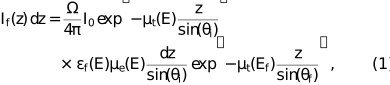 where μt is the total absorption coefficient of the sample, μe is the absorption coefficient of the photoabsorber, Ef is the fluorescence photon energy and ɛf is the fluorescence efficiency.
![[Figure 1]](/figures/qx0002fig1thm.gif)
|
Scheme of the fluorescence-detection geometry. |
By integrating over the entire depth of the sample and assuming the sample to be infinitely thick, we obtain the fluorescence intensity If(E) as which is valid under the assumption that the detector area is much larger than the squared sample-to-detector distance.
The consequences of self-absorption are an incorrect XANES shape, in particular the height of the white line, and attenuated XAFS oscillation amplitudes, resulting in incorrect estimation of the coordination numbers and Debye–Waller factors. In the limit of a pure element illuminated at grazing incidence, i.e. sin(θi) ≃ 0, the XAFS signal becomes totally flat. On the contrary, in a diluted sample irradiated at normal incidence, θi ≃ 90°, with grazing-angle detection, θf ≃ 0°, sin(θi)/sin(θf) becomes very large and the energy-independent term dominates the denominator of equation (2). As a result, the fluorescence intensity depends linearly on the absorption coefficient of the specific element under investigation.
When the normal photon-incidence and grazing-detection conditions are not fulfilled, the energy dependence of μt(E) in the denominator of equation (2) cannot be neglected. The linearity is lost because the μt(E) term includes the μe(E) term, which also appears in the numerator. This causes the amplitude of the EXAFS oscillations to be damped. This damping decreases when (i) the concentration of the absorber atom in the sample is low, since this decreases the contribution of μe(E) to μt(E), (ii) the geometrical factor sin(θi)/sin(θf) increases and (iii) the absorption of the fluorescent photons, μt(Ef), increases with respect to the absorption of the incident radiation, μt(E), which can be achieved in thin samples.
These rules of thumb are generally sufficient to reduce or control the effect of self-absorption within reasonable limits. Nevertheless, the characteristics of the samples are often such that self-absorption cannot be avoided. Sometimes, even macroscopically diluted samples may not locally be in the diluted limit (for example, consider the extreme case of a few rather large particles embedded in a nonfluorescent matrix, as is often the case in natural samples of geochemical and mineralogical interest; Manceau et al., 2002) and one may also obtain distorted spectra. As good practice, then, one should first make the absorbing particles small enough (i.e. small with respect to the absorption length) and mix them with inert filler or matrix when possible.
Although several approaches have been developed to deal with self-absorption (Eisebitt et al., 1993; Tröger et al., 1992; Pfalzer et al., 1999; Ravel & Newville, 2005; Booth & Bridges, 2005), successful corrections can only be obtained if the full composition of the sample (i.e. the exact chemical formula, the sample density, the concentration of the absorber atom and the sample thickness, if the approximation of an infinitely thick sample does not apply) together with the geometrical details of the experiment are known.
It is also important to understand that self-absorption largely affects the amplitude of the XAFS data; it affects the phase to a much lesser degree. Thus, in those selected cases where suitable experimental arrangements are impossible, and post-processing of the fluorescence data cannot be completed, it is still possible to obtain reliable information on E0 values and on the atomic distances around the absorbing element.
A number of successful examples and methods of dealing with self-absorption corrections can be found in the published literature, and it is well beyond the scope of this text to provide an exhaustive list of past achievements. One simple correction method developed by Eisebitt et al. (1993) is to measure the absorption at different incident angles. Since the angular dependence of the absorption can be calculated analytically, these measurements can be extrapolated to the limiting case of normal incidence and grazing detection. Another way to eliminate the self-absorption effect (Tröger et al., 1992) exploits the smoothness relation of the continuum X-ray absorption well away from absorption edges. As demonstrated by Heald (1988), the thickness effect can be accounted for by measuring the absorption as a function of sample thickness and extrapolating to zero thickness. The approach developed by Pfalzer et al. (1999) is based on calculation of the self-absorption effect from the known energy dependence of the absorption coefficient. As this latter depends on the geometry, an integration over the solid angle subtended by the detector is necessary.
An alternative method was proposed by Egry et al. (2008), in which fluorescence detection was used to address the local order in levitated liquid-metallic alloys. Due to experimental constraints, it was impossible to complete the experiment in the high dilution limit. In this case, instead of making use of approximate analytical corrections, the authors were able to compare the spectra taken in fluorescence mode on levitated solid samples with equivalent data taken in transmission mode on thin solid films with the same composition at room temperature. They then determined a correcting function S(k) = [χt(k) − χf(k)]/χt(k) experimentally, where χ(k) is the XAFS signal as a function of the wavevector k and the subscripts t and f indicate transmission and fluorescence mode, respectively. Finally, they used S(k) to adjust the relevant fluorescence data collected at higher temperatures and used the experimentally corrected data to obtain reliable coordination numbers.
Achkar and coworkers introduced a complementary approach to deal with self-absorption (Achkar et al., 2011) by measuring the nonresonant X-ray emission spectrum (normal emission) from a different absorption edge to that being investigated (for example, measuring the normal emission of the O K edge to probe the Cu L edges or the L-edge normal emission to probe the K edge of the same element). The authors demonstrate that the inverse of the normal emission is linearly proportional to the absorption cross section and that it is free of self-absorption or saturation effects. This occurs because the penetration depth decreases as the absorption increases when scanning through the absorption edge of interest. As a consequence, fewer atoms from the measured species contribute to the normal emission. Of course, this method requires an X-ray detector with sufficient energy resolution to separate normal from resonant emission, and this may be a limitation in some cases.
Unfortunately, self-absorption is not limited to photon-emission techniques. Saturation effects have also been observed in electron-yield detection geometry (Nakajima et al., 1999; Gota et al., 2000; Regan et al., 2001), when the electron escape depth is comparable to the X-ray penetration depth: at the extreme, all incident photons will generate electrons that escape the sample, producing an energy-independent signal. This effect is strongly material- and edge-dependent (for example, oxides may show stronger saturations than metals at the L3 edge, but it may be much the same at the L2 edge) and theoretical models probed against angular dependent measurements may provide the relevant parameter to correct experimental XAS data obtained with electron-yield detection.
Ideally, the amplitude of XAFS oscillations is independent of the thickness of the sample. In actual experiments, however, there is always some sort of leakage (i.e. that part of the transmitted intensity which is not attenuated into the sample as much as expected) and the absorption signal does depend on the distribution of the optical density of the sample across the beam profile (Stern & Kim, 1981). In this respect, excessive thickness or sample inhomogeneities can be the source of major distortions in XAS spectra due to the effect of uncompensated detection of the X-ray intensity impinging on the sample and the transmitted or emitted intensity (Bunker, 2010). In transmission experiments, it has been observed that thickness effects occurring in samples with thicknesses larger than 3–4 absorption lengths (including the substrate) will result in an excessive compression of XAFS oscillations (i.e. they have reduced amplitudes) or systematic distortions of the near-edge region, resulting in abnormally reduced coordination numbers.
A similar effect is observed when samples are inhomogeneous (i.e. the sample thickness is non-uniform on the scale determined by the absorption length of the material), both as an effect of the thickness distribution and of nonlinearities in the X-ray detection induced by monochromator harmonics and tails of the monochromator resolution function (Parratt et al., 1957).
Let us assume for simplicity that the incident beam is uniform over the sample surface and that P(x) is the sample-thickness distribution such that  . The effective X-ray attenuation is then
 where μ = μ(E) is the total absorption coefficient at energy E of the material under investigation. This is the cumulant Cn-generating function of the thickness variable x (see, for example, Kendall et al., 1977) and can be expanded in a power series as
 The first cumulant C1 is the average thickness
  and
and  is the variance of the thickness distribution. The latter is a positive quantity by definition, and consequently (μx)eff is always less than
  , i.e. the X-ray absorption is reduced in inhomogeneous samples.
As an example of the thickness effect on XAS spectra due to a non-uniform thickness distribution, let us introduce a real case in which the sample was a 0.92 M aqueous solution of rubidium bromide, i.e. intrinsically homogenous, but held in a cylindrical 1.1 mm diameter boron nitride capsule (Filipponi et al., 2003). The thickness distribution P(x) is the normalized chord-length distribution of a circumference of radius R, i.e. This distribution has mean R and variance R2/4, and, according to equation (4), in a first approximation this provides an effective attenuation of (μx)eff = μR − (μR)2/8.
By illuminating the sample with a beam-transversal dimension Δ smaller than the curvature radius, one actually intercepts the thickness distribution P(x) at some intermediate level: the smaller the beam, the more uniform the sample. In the limiting case of Δ ≃ 0, (μx)eff = 2μR. In Fig. 2 we show the effect of the Δ aperture on the absorption at the Br K edge of an aqueous solution of rubidium bromide contained in a cylindrical capsule. The distortion of the XANES region together with the reduction of the XAFS oscillation are evident.
![[Figure 2]](/figures/qx0002fig2thm.gif)
|
Effect of the cylinder sample geometry on XAS data collected at the Br K edge from an aqueous solution of rubidium bromide with two different values of the beam-transversal section Δ. The distortion of the white line and the compression of the XAFS oscillation are evident. |
More dramatic distortions can be observed when a fraction f of the sample area has pinholes in it (i.e. the portion of the sample where the beam is transmitted non-attenuated) and the remaining sample surface has a constant thickness x0, so that a fraction f of the X-ray beam leaks through the sample. This is often the case for very thin metallic foils or powder samples with grains that are larger than the absorption length. In this case, the thickness distribution takes the form P(x) = fδ(x) + (1 − f)δ(x − x0), where δ(x) is the Dirac delta distribution. The effective attenuation is then  and (μx)eff as a function of μ asymptotes to a constant value of ln(1/f) for large absorption coefficients.
As a general habit, samples for transmission XAS experiments should be made uniform on a scale determined by the absorption length of the material, both in thickness distribution and in shape. For powders this implies the selection of a small grain size, and this can be achieved by sieving or decanting the supernatant in an inert liquid. Suitable samples can then be assembled by mixing the selected powder with a matrix, or by deposition onto a X-ray-transparent supporting film. In their seminal article, Stern & Kim (1981) state that thickness effects in concentrated samples should become relevant when the absorption-edge step Δμx is greater than 1.5. If sample homogeneity cannot be achieved, however, one has to consider using fluorescence or electron-yield detection. However, physical effects such as large particle sizes and aggregation can cause breakdown of the linearity condition even in fluorescence experiments, resulting in systematic errors and incorrect conclusions, as in thickness-affected transmission measurements (Tannazi & Bunker, 2005). Regularization methods (Babanov et al., 2001) have also been proposed to correct for unavoidable thickness effects in powder samples.
XAFS studies on single-crystal samples or thin films supported on monocrystalline substrates are usually carried out by collecting the fluorescence yield using large-area multi-element detectors or in total electron-yield mode. However, these methods are also susceptible to distortion of the actual XAS spectra due to spurious peaks arising from the occurrence of Bragg reflections originating in the sample or the substrate. These reflections alter the absorption signal in two ways: either directly reaching one or more detector elements and saturating them or by modulating the fluorescence intensity with the excitation of X-ray standing waves (Tormen et al., 1999).
While the presence of Bragg peaks in some multi-element detectors can sometimes be eliminated from the measured spectra by ignoring the signals of the affected channels at the relevant energies, standing-wave signals are present in all of the detectors at the same time. Even though most XAS instruments at modern synchrotrons are equipped with seven, 13 or even a larger number of multi-element detectors, unfortunately the cost of eliminating some of the fluorescence channels from the averaging may be too high in terms of signal-to-noise ratio. In total electron-yield mode this is normally impossible, as the detection of the emitted electrons generally uses a single channel. A number of alternate experimental solutions exist to address these specific issues, either by vibrating (Spiga et al., 2003) or rotating (Pasternak et al., 2007) the sample holder, which is often embedded in cryostats or other sample-environment devices. Using such systems, the Bragg peak energy position changes with the angular orientation of the sample. By integrating the absorption signal at different angular positions, Bragg peaks are averaged in a given energy range. They are not deleted, but their effects are effectively reduced. As an example, in Fig. 3 we show the effect of vibrating a sample made of a thin absorbing film deposited on a single-crystal substrate. Bragg peaks are actually cancelled out by the vibrations induced on the sample.
![[Figure 3]](/figures/qx0002fig3thm.gif)
|
Comparison of raw total electron-yield spectra of a 2 nm thin film of LaCaMnO3 deposited on a 1 mm SrTiO3 single-crystal substrate acquired at 10 K and 45°/45° geometry. Blue line: steady sample. Green line: vibrating sample holder. |
The use of single- or multi-channel crystal analysers allows one to intrinsically eliminate the distorting elastic scattering contribution from the fluorescence XAS data (Llorens et al., 2012). Indeed, the unwanted diffraction signal does not interfere with the absorption detection as the photons diffracted (and thus elastically scattered) by the sample or substrate crystallites are not detected by the analysers since their energy is different from the selected fluorescence line energy.
Bragg peaks can also affect XAS data collected in transmission mode. The best-known example comes from the important distortions that are detected in the XAS spectra when studying samples held in diamond-anvil high-pressure cells. While the unwanted scattering from the single diamond crystals is often an asset in elastic or inelastic X-ray diffraction measurements, as the intense elastic scattering from the diamonds is confined to specific points of the reciprocal lattice, it represents a major limiting factor for XAS measurements. The diamonds used in high-pressure cells are generally single crystals and, depending on their orientation and on the photon energy, Bragg peaks may appear, leading to spectral artefacts that can sometimes dominate and totally spoil the XAS signal or the XAFS oscillations (Itié et al., 2016). Therefore, XAS experiments are limited to specific energies where the diamond Bragg peaks can be removed by changing the orientation of the cell. The importance of these distortions becomes increasingly prominent as the X-ray energy increases and the reciprocal lattice is reduced.
Historically, energy-dispersive absorption instruments were often used to deal with this issue, as the acquisition time is reduced and an optimized cell orientation to minimize the Bragg peak distortions can be achieved on a reasonable timescale, at the cost of a limited accessible energy range and signal-to-noise ratio. More recently, a new perspective in this domain has been offered by the synthesis of nanopolycrystalline diamond anvils that have entirely solved the problem and allow one to study matter in the megabar pressure range on energy-scanning XAS instruments (De Panfilis et al., 2015). In Fig. 4 we show the effect of Bragg peak distortions due to single-crystal diamonds on the XAS spectrum at the Xe K edge of a xenon-containing sample (Dewaele et al., 2016) and how access to nanopolycrystalline diamonds allowed a distortion-free measurement.
![[Figure 4]](/figures/qx0002fig4thm.gif)
|
Absorption spectra of a xenon-containing sample at the Xe K edge within a diamond-anvil high-pressure cell equipped with single-crystal diamonds (red curve) and nanopolycrystalline diamonds (blue curve). Courtesy of O. Mathon, ESRF. |
References
 Achkar, A. J., Regier, T. Z., Wadati, H., Kim, Y.-J., Zhang, H. & Hawthorn, D. G. (2011). Phys. Rev. B, 83, 081106.Google ScholarBabanov, Y. A., Ryazhkin, A. V. & Miyanaga, T. (2001). Nucl. Instrum. Methods Phys. Res. A, 470, 278–282.Google ScholarBooth, C. H. & Bridges, F. (2005). Phys. Scr. 2005, 202.Google ScholarBunker, G. (2010). Introduction to XAFS. A Practical Guide to X-ray Absorption Fine Structure Spectroscopy. Cambridge University Press.Google ScholarChen, D. L., Dong, J. C., Zhang, X. L., Quan, P. Y., Liang, Y. X., Hu, T. D., Liu, J., Wu, X., Zhang, Q. & Li, Y. D. (2013). J. Synchrotron Rad. 20, 243–248.Google ScholarDavoli, I., Gunnella, R., Castrucci, P., Bernardini, R. & De Crescenzi, M. (1995). J. Electron Spectrosc. Relat. Phenom. 76, 493–497.Google ScholarDe Panfilis, S., Gorelli, F., Santoro, M., Ulivi, L., Gregoryanz, E., Irifune, T., Shinmei, T., Kantor, I., Mathon, O. & Pascarelli, S. (2015). J. Chem. Phys. 142, 214503.Google ScholarDewaele, A., Worth, N., Pickard, C. J., Needs, R. J., Pascarelli, S., Mathon, O., Mezouar, M. & Irifune, T. (2016). Nat. Chem. 8, 784–790.Google ScholarEgry, I., Hennet, L., Kehr, M., Mathiak, G., De Panfilis, S., Pozdnyakova, I. & Zanghi, D. (2008). J. Chem. Phys. 129, 064508.Google ScholarEisebitt, S., Böske, T., Rubensson, J. E. & Eberhardt, W. (1993). Phys. Rev. B, 47, 14103–14109.Google ScholarFilipponi, A., De Panfilis, S., Oliva, C., Ricci, M. A., D'Angelo, P. & Bowron, D. T. (2003). Phys. Rev. Lett. 91, 165505.Google ScholarGota, S., Gautier-Soyer, M. & Sacchi, M. (2000). Phys. Rev. B, 62, 4187–4190.Google ScholarGoulon, J., Goulon-Ginet, C., Cortes, R. & Dubois, J. M. (1982). J. Phys. Fr. 43, 539–548.Google ScholarHeald, S. M. (1988). X-ray Absorption. Principles, Applications, Techniques of EXAFS, SEXAFS and XANES, edited by R. Prins & D. C. Konigsberger, pp. 87–118. New York: John Wiley & Sons.Google ScholarItié, J.-P., Baudelet, F. & Rueff, J.-P. (2016). X-ray Absorption and X-ray Emission Spectroscopy: Theory and Applications, edited by J. A. van Bokhoven & C. Lamberti, pp. 385–405. Chichester: John Wiley & Sons.Google ScholarKendall, M. G., Stuart, A. & Ord, J. K. (1977). The Advanced Theory of Statistics, Vol. 1, 4th ed. London: Charles Griffin & Co.Google ScholarLlorens, I., Lahera, E., Delnet, W., Proux, O., Braillard, A., Hazemann, J.-L., Prat, A., Testemale, D., Dermigny, Q., Gelebart, F., Morand, M., Shukla, A., Bardou, N., Ulrich, O., Arnaud, S., Berar, J.-F., Boudet, N., Caillot, B., Chaurand, P., Rose, J., Doelsch, E., Martin, P. & Solari, P. L. (2012). Rev. Sci. Instrum. 83, 063104.Google ScholarManceau, A., Marcus, M. A. & Tamura, N. (2002). Rev. Mineral. Geochem. 49, 341–428.Google ScholarNakajima, R., Stöhr, J. & Idzerda, Y. U. (1999). Phys. Rev. B, 59, 6421–6429.Google ScholarParratt, L. G., Hempstead, C. F. & Jossem, E. L. (1957). Phys. Rev. 105, 1228–1232.Google ScholarPasternak, S., Perrin, F., Ciatto, G., Palancher, H. & Steinmann, R. (2007). Rev. Sci. Instrum. 78, 075110.Google ScholarPfalzer, P., Urbach, J.-P., Klemm, M., Horn, S., denBoer, M., Frenkel, A. & Kirkland, J. (1999). Phys. Rev. B, 60, 9335–9339.Google ScholarRavel, B. & Newville, M. (2005). J. Synchrotron Rad. 12, 537–541.Google ScholarRegan, T. J., Ohldag, H., Stamm, C., Nolting, F., Lüning, J., Stöhr, J. & White, R. L. (2001). Phys. Rev. B, 64, 214422.Google ScholarSpiga, S., Mantovan, R., Fanciulli, M., Ferretti, N., Boscherini, F., d'Acapito, F., Schmidt, B., Grötzschel, R. & Mücklich, A. (2003). Phys. Rev. B, 68, 205419.Google ScholarStern, E. A. & Kim, K. (1981). Phys. Rev. B, 23, 3781–3787.Google ScholarTannazi, F. & Bunker, G. (2005). Phys. Scr. 2005, 953.Google ScholarTormen, M., De Salvador, D., Natali, M., Drigo, A., Romanato, F., Rossetto, G., Boscherini, F. & Mobilio, S. (1999). J. Appl. Phys. 86, 2533–2539.Google ScholarTröger, L., Arvanitis, D., Baberschke, K., Michaelis, H., Grimm, U. & Zschech, E. (1992). Phys. Rev. B, 46, 3283–3289.Google Scholar

