|
International
Tables for Crystallography Volume I X-ray absorption spectroscopy and related techniques Edited by C. T. Chantler, F. Boscherini and B. Bunker © International Union of Crystallography 2024 |
International Tables for Crystallography (2024). Vol. I. ch. 6.7, pp. 758-763
https://doi.org/10.1107/S1574870720003316 Chapter 6.7. The FDMX codeaSchool of Physics, University of Melbourne, Australia FDMX, or Finite Difference Method for XAFS, is an integrated software package designed for use with the full-potential FDMNES package to calculate extended energy-range X-ray absorption fine structure (XAFS) as well as X-ray absorption near-edge structure (XANES). It incorporates several routines and a large array of tabulated data to extend the application of the basic framework of FDMNES to higher energy photoelectron absorption spectra in a computationally efficient manner. These extensions notably include a physical modelling of thermal motion and outer-shell absorption contributions, and a highly sophisticated self-consistent plasmon-coupling model of inelastic electron scattering, quantifying the lifetime broadening associated with the imaginary component of the solid-state electron self-energy. This approach allows accurate calculations of X-ray absorption spectra over an energy range spanning several hundred electronvolts from the pre-edge region to the smooth atom-like region within a single consistent framework. FDMX utilizes a high-density representation of the electronic potential, and thereby provides unique insights into problems requiring detailed knowledge of the energy-dependence of the XAFS spectrum, particularly for large molecular compounds, organic and organometallic materials. Examples of these insights, including experimental analysis of low-energy electron inelastic mean free paths and correlated thermal displacement parameters, are discussed. Keywords: X-ray absorption; finite-difference methods; fine structure; XAFS. |
The use of full-potential modelling is a staple in X-ray absorption near-edge structure (XANES) theory and analysis owing to the high sensitivity of the near-edge region to chemical effects including ionization, oxidation and bonding, which impact on the valence state of the absorbing material. The associated variation in the detailed shape of the electronic potential can have a dramatic impact on the first 60 eV of an X-ray absorption fine-structure (XAFS) spectrum, as can any artefacts introduced by the use of approximations in the potential such as interstitial muffin tins or over-large regions of presumed spherical symmetry around atomic cores. Therefore, a full-potential model is required to derive reliable information regarding observed XANES, particularly for organic and other materials with complex bonding environments.
The finite-difference method is an effective technique to achieve such a modelling, but is computationally expensive and increasingly difficult to use when considering high-energy photoelectrons of decreasing wavelength. For this reason, the FDMNES code (Joly, 2001 ; Bunău et al., 2024) was built with a particular focus on the near-edge region. It has vast and robust applicability to X-ray spectroscopies involving low-energy photoelectrons, but when unmodified it fails for higher-energy regions where dense potential modelling is required and the physical processes of correlated thermal motion and inelastic photoelectron scattering become dominant.
We therefore present here the FDMX package (Bourke, Chantler et al., 2016a), which is currently available as an integrated package with FDMNES (Joly, 2001; Bunău et al., 2024), for the calculation of extended energy-range XAFS spectra within a single computation using a consistent full-potential model. Calculations may be performed upon arbitrary materials by establishing a repetitive unit cell or an isolated molecular structure with defined atomic positions. Electronic structures of the absorbing and neighbouring atoms may be adjusted following the conventions of FDMNES. Currently, FDMX is optimized for use with K-edge absorption spectra up to 1500 eV above the absorption edge (Bourke & Chantler, 2010a) or up to k = [0.263E (eV)]1/2 ≃ 20, and can produce results on an absolute scale for materials with a primary absorbing atom of 21 ≤ Z ≤ 92. Parameters for spectra associated with other edges may also be calculated; however, they must be analysed in a more detailed manner following the procedures outlined in the manual (Bourke, Chantler et al., 2016b).
For K-edge ionization, it is straightforward to determine complete spectra ready for direct comparison with experimental data in terms of absorption cross sections in Mbarn or mass attenuation coefficients in cm2 g−1. The various computational components of the FDMX package, and examples of its unique applications to extended-range analysis of XAFS and related phenomena, are described here.
The most critical aspect of excited-state broadening is the implementation of inelastic photoelectron scattering contributions, which strongly affect the accuracy of spectra from as low as 20 eV from the absorption edge. The key parameter here for XAFS calculations is the electron inelastic mean free path, or IMFP, which is defined as the mean distance travelled by an electron of a given energy between successive inelastic collisions (Powell & Jablonski, 2009). Recent years have seen significant interest and improvement in the theories used to derive the IMFP (Sorini et al., 2006; Denton et al., 2008; Bourke & Chantler, 2012; Da et al., 2014), and implemented within FDMX is one of the most sophisticated new models: the coupled-plasmon model (Bourke & Chantler, 2015). This approach derives a fully self-consistent plasmon resonance spectrum, enabling uniquely high-accuracy IMFP determinations, particularly at the energies of interest to XAFS.
The coupled-plasmon model uses an extension of the dielectric formalism developed by Tung et al. (1979) and Penn (1987). Knowledge of the complex dielectric function of a material, ɛ(q, ω) = ɛ1 + iɛ2, is sufficient to compute the electron IMFP due to the proportionality of the imaginary part of the negative inverse of the dielectric function, Im{−1/[ɛ(q, ω)]}, to the oscillator strength of electronic transitions at a given energy ℏω and momentum ℏq (Nikjoo et al., 2012). This quantity, which is known as the electron energy-loss function (ELF), is also equivalently proportional to the imaginary part of the electron self-energy in the presence of solid-state screening effects (Quinn, 1962; Penn, 1976). We can therefore write the inelastic scattering cross section or, in our case, the inverse electron IMFP, in terms of an integral of the ELF over available energy and momentum transitions following Tanuma et al. (1991), 
Here, E is the electron energy, EF is the Fermi energy and a0 is the Bohr radius, while the q± momentum limits are determined kinematically.
Our coupled-plasmon theory predicts the form of the ELF from an externally determined limiting value for the optical part of the loss spectrum (i.e. where q = 0) from density-functional theory, experiment or otherwise, and builds a complete loss function as a sum of basis Mermin dielectric functions ɛM (Mermin, 1970). These components are then recursively integrated to determine the lifetime broadening properties of higher-order plasmon resonances, and thus a self-consistent model of the loss function of the material. Mathematically, the procedure is given by (Bourke & Chantler, 2015)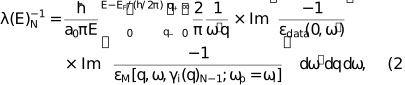


γi(q) is a resonance- and momentum-dependent lifetime broadening parameter, dωq/dq is the group velocity of a plasmon or single-electron excitation, Θ is a Heaviside step function, δ is a positive infinitesimal and N is an iteration index, which typically enables the formula to achieve convergence when N is set to a value of higher than three. Most importantly, the lifetime broadening function is neither a delta function [γi(q) = 0] nor a fixed function of q [γi(q) = γi], but is necessarily and explicitly γi(q).
The computed energy-dependent electron IMFP is translated to an energy-dependent broadening parameter via the simple relation
The XAFS spectrum is then broadened by a Lorentzian function of width Γλ(E) at all energies above the Fermi level EF, corresponding to the energy uncertainty of the finite-lifetime excited photoelectron or, equivalently, to the exponential reduction of the aggregate photoelectron wavefunction as it propagates through the absorbing material.
In addition to the photoelectron lifetime broadening, the core-hole relaxation contributes a broadening Γhole. We adopt an adiabatic approximation, considering only an energy-independent value for the relaxation lifetime τhole = 1/Γhole. As this is also a Lorentzian-type broadening, we simply have that the total broadening from the excited-state lifetime is given by Γ(E) = Γλ(E) + Γhole. By default, values for the core-hole broadening widths are derived from the tabulations of Scofield and of Kostroun and coworkers for Z = 21–50 (Scofield, 1969; Kostroun et al., 1971) and from Bambynek and coworkers for Z = 51–100 (Bambynek et al., 1972).
FDMX includes corrections to what we term the background absorption – the smooth atom-like absorption underpinning the XAFS oscillations – so that the calculated spectra may be compared directly with measured data. The first such correction is the inclusion of photoelectric absorption from the less strongly bound electrons within the absorbing atom; i.e. the L shells, M shells, valence electrons etc. This is performed using the form-factor calculations of the FFAST package (Chantler, 1995, 2000), which uses the multi-configurational Dirac–Hartree–Fock technique for the self-consistent evaluation of relativistic atomic wavefunctions and a local density approximation (LDA) for the treatment of the Coulomb and exchange-correlation potentials. The photoelectron absorption from FFAST is typically accurate to well within 1% for energies that are not close to an absorption edge, which is almost always the case for the background contribution from non-core electrons in a K-edge XAFS spectrum. The FFAST data allow the inclusion of background absorption from all absorbing and neighbouring atoms with Z ≤ 92.
A second contribution to the background absorption is also often necessary to account for the edge-jump discrepancy, which is sometimes called the triangle effect (Tantau et al., 2015). This discrepancy, which is common to all photo-absorption theories (Chantler & Bourke, 2014a), causes an underestimation of the photoelectric absorption relative to the experimental result, but does not affect the form of the XAFS oscillations themselves. A standard parameterization of the XAFS spectrum is given by where μ(E) is the total photoelectric absorption from a given edge, μ0(E) is the calculated absorption in the absence of backscattering (i.e. atom-like absorption) and χ(E) is the oscillatory component or XAFS signal. Owing to the energy-dependence of XAFS, the absorption spectrum of a material will generally approach the form of the μ0 function after several hundred eV, but in practice it is rare that μ0(E) can be recovered in the near-edge region by a direct extrapolation of the experimental high-energy absorption cross section (Creagh, 2006). Therefore, a corrective term, η(E), is added to resolve the discrepancy:
The cause of the discrepancy is not currently proven, but it is found empirically that an exponential function of the form η(E) = Aexp[(E − E0)/B], where A and B are adjustable parameters, can often be used to achieve good agreement between experiment and theory (Chantler & Bourke, 2010). Alternatively, FDMX can apply a Victoreen form η(E) = A(E03/E3) + B(E04/E4), which is designed to mimic the long-term behaviour of the background absorption in accordance with dielectric sum rules (Victoreen, 1949). These functions allow a smooth scaling of the background absorption without artificial oscillatory structures, unlike a cubic spline, and tend to produce quite good results even for materials where the offset is large (Bourke, Chantler et al., 2016a). The choice of parameters themselves, however, must be fixed by the user in accordance with a best fit to experiment.
Thermal motion within the absorbing material is an increasingly strong effect in XAFS spectra as the energy is increased from the ionization edge, presenting ideally as a frequency-dependent exponential reduction of the XAFS signal. FDMX implements thermal corrections via a Debye–Waller formalism based on the correlated Debye model of Beni & Platzman (1976).
For an explicitly path-dependent theory, it is convenient to parameterize thermal motion via an array of path-dependent isotropic thermal parameters (ITPs)  corresponding to mean-square relative displacements between the absorbing atom and its nearby neighbours. Higher-order ITPs can also be used for multiple-scattering paths when the scattering atoms are not arranged co-linearly (Rehr et al., 2009). However, it is not yet realistic for XAFS to fit more than about three independent ITPs with any degree of confidence, whereas it is not uncommon to have, for example, 80 discrete paths or, for example, 40 independent atom positions (r, θ, φ). Therefore, assigning or fitting these parameters remains a complex art in standard available packages. Further, within the full-potential finite-difference modelling of the wavefunction, scattering paths are not explicitly separated, meaning that it is not practicable to treat these parameters as a complete and orthogonal set, and so an effective ITP
  is used. For most structures, this approximates to the shortest or most degenerate scattering path, which is significantly the most dominant at energies where thermal effects represent the greatest contributor to the accuracy of the calculation.
The ITP for any given scattering path is conventionally given in terms of the mean-square relative displacements of the absorbing atom, 〈(u0 · Rj)2〉, its backscattering neighbouring atom 〈(uj · Rj)2〉 and the displacement correlation function 〈(u0 · Rj)2 · (uj · Rj)2〉 following
u0 is the instantaneous displacement of the absorbing atom from its equilibrium position, uj is the same for its neighbour j and Rj is a unit vector pointing from the photo-absorber to atom j. The displacement of atoms within the absorbing material is a result of the propagation of resonant phonons with energy ℏωqλ, where ℏq is the phonon momentum and λ is the polarization index. For the special case of a monoatomic crystal, we can write the mean-square relative thermal displacement in terms of resonant phonons qλ following Beni & Platzman (1976):
Here, m is the atomic mass, kB is the Boltzmann constant, eqλ is a unit vector in the direction of polarization of the phonon qλ and T is the temperature of the material. The temperature may be user-defined within FDMX, or will otherwise default to 298 K. Detailed determinations of the phonon spectrum ωqλ can be performed explicitly via experiment (Fornasini et al., 2004) or density-functional theory (Vila et al., 2007), or may be estimated using an Einstein or Debye model. FDMX utilizes a pairwise-correlated Debye model, which enables the following approximation for the XAFS ITP (Greegor & Lytle, 1979):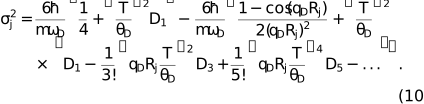
θD, ωD and qD are the Debye temperature, Debye frequency and Debye wavenumber of the absorbing material, respectively, which are related by

V is the mean volume per atom in the material, and the Dn parameters are a series of definite integrals given by
This approach enables a close estimate of the ITP  of the dominant scattering path j, and hence a sufficiently accurate value for the effective ITP
  in most applications. In the high-energy limit, for a monoatomic cubic structure, it has been demonstrated to approach the correct experimental value from crystallography (Tantau et al., 2015). The ITP then manifests within the XAFS spectrum by a direct adjustment to the calculated absorption cross section following
 where k is the photoelectron wavenumber, μ(k) is the total photoelectric cross section and μ0(k) is the associated atom-like background contribution from the ionized shell (see Section 3). Empirically, it is seen that
  typically provides a good estimate for the thermal contributions despite approximations in the derivation of its value, with the errors in the final XAFS spectrum arising from these approximations tending to be quite small relative to other effects. In particular, at high photoelectron energies the impact of inelastic electronic scattering processes tends to be more significant, while in the XANES region, where thermal motion is a weak contributor, approximations in
  currently contribute significantly less to the error budget than approximations or artefacts in the detailed shape of the electronic potential (Glover et al., 2007).
As FDMX is integrated within FDMNES, usage of the package is a straightforward extension to the FDMNES inputs via a series of (mostly optional) keywords (see, for example, Bunău et al., 2024). The use of the fdmx keyword activates default computational settings for extended-range XAFS calculations plus the inclusion of thermal, broadening and background absorption effects, and in many cases is sufficient to produce an accurate spectrum up to several hundred electronvolts from the absorption edge. An example result is given in Fig. 1 for elemental tin, calculated using default parameters and inclusive of an exponential edge-jump correction using the keyword Expntl.
![[Figure 1]](/figures/qx0013fig1thm.gif)
Depending on the material properties, however, it may be necessary to make key adjustments to the default computational framework. Commonly useful keywords include adimp, which controls the finite-difference method grid spacing in an energy-dependent fashion, and is decreased at high energies to prevent aliasing in the interaction between the electronic potential and the high-frequency photoelectron wavefunction. Conversely, the cluster radius is correspondingly reduced to limit computational expense. The rate at which these changes are made and the values of these parameters can be altered by the user to ensure appropriate convergence, and is especially recommended for low-density materials.
Physical processes may also be controlled (or omitted) via keywords. The temperature of measurement may be altered using Tmeas, the Debye temperature set with TDebye, or even the effective ITP itself set using DWFactor. This can be especially useful for samples analysed at extreme temperatures or materials with high structural disorder. In particular, it may be necessary to override  in materials where the dominant scattering path is unclear or highly energy-dependent, such as, for example, in transition-metal oxides where the second coordination shell is highly degenerate but only strongly dominant in the XANES region. Further, strongly amorphous or low-density clusters may require specific adjustments owing to periodicity approximations in the simple scattering Debye model.
Similarly, keywords exist to control broadening, the background absorption parameters and the Fermi level used for both the photoelectric absorption spectrum and the dielectric response of the material. The best results are obtained for the IMFP broadening Γλ by the use of an external optical ELF, which may for example come from optical measurements (Palik, 1998) or from a DFT package such as WIEN2k (Blaha et al., 2020; Ambrosch-Draxl & Sofo, 2006), via the ELFin keyword. The Mermin keyword can then be used to generate a self-consistent coupled-plasmon calculation of the IMFP up to a specified order N (as in equation 2).
Spectra calculated using FDMX are particularly useful for extended energy-range analysis of complex molecular structures, including organic and organometallic samples where different coordination shells can be isolated via different energy regions in the XAFS spectrum. This is made possible by the full-potential modelling, which enables accurate theoretical data for both the near-edge and extended-range energies. As an example, a recent study was able to differentiate between conformational states of ferrocene and decamethyl-ferrocene, systems that only differ by a 36° rotational offset, for the first time using a direct positional probe (Bourke, Islam et al., 2016).
Other demonstrated applications include the analysis of fundamental thermal processes, such as the recent isolation of energy-dependent ITPs and analysis of phonon correlation between coordination shells in silver. Shown in Fig. 2 are fitted ITPs from different energy windows in the XAFS spectrum, starting around the silver K-edge energy of 25.52 keV (Tantau et al., 2015). A clear transition is observable to the dominant scattering path within the first 50 eV of the XAFS spectrum. A similar analysis could also be used in a temperature-dependent fashion, enabling quantifications of static disorder and zero-point motion.
![[Figure 2]](/figures/qx0013fig2thm.gif)
Perhaps the most high-profile application of the FDMX approach to date is in the extraction of experimental electron IMFPs (Bourke & Chantler, 2010b). Fitting routines linked with the FDMX code and high absolute-accuracy experimental data have been shown to produce the most precise estimates of IMFPs that are currently available in the 10–120 eV energy range (Chantler & Bourke, 2010), and have been responsible for significant breakthroughs in fundamental electron-scattering theory (Chantler & Bourke, 2014b, 2015). Further details of the extraction of IMFP data from XAFS spectra are available in Bourke (2024), but in Fig. 3 we present an illustration of IMFPs extracted using FDMX fitting for molybdenum, compared with dielectric theory with and without second-order scattering losses. It is apparent from the results that not only does the plasmon-coupling approach favoured by FDMX significantly improve upon lossless modelling, but also that there is much more that can be investigated from such analyses in the very low energy XANES regime.
![[Figure 3]](/figures/qx0013fig3thm.gif)
|
Values of the IMFP of molybdenum derived from fits of FDMX theory to high absolute-accuracy experimental XAFS data. Comparison is made with the many-pole Lindhard dielectric theory for IMFP calculation and the more robust plasmon-coupling model that incorporates second-order excitation broadening and is used within FDMX. |
These applications are merely the first breakthroughs available with a full-potential approach that covers the entire energy spectrum of XAFS. Future developments to FDMX will include sophisticated fitting routines and the control of a greater array of structural, physical and electronic parameters in order to delve more deeply into the underlying processes involved in this critical X-ray absorption spectroscopy.
FDMX is currently available as a free download from the CNRS website (http://neel.cnrs.fr/spip.php?rubrique1007
) and from the School of Physics X-ray Optics and Synchrotron Science Group at The University of Melbourne (http://www.ph.unimelb.edu.au/~chantler/opticshome/home.html
; Bourke, Chantler et al., 2016b).
Acknowledgements
The FDMX package is a collaborative effort and could not have existed without the hard work and commitment of its co-authors Y. Joly and C. T. Chantler. In addition to their helpful insights and expertise, contributions of ideas, testing and general support have come from many of our colleagues, including N. A. Rae, L. J. Tantau, M. T. Islam and J. L. Glover.
References
 Ambrosch-Draxl, C. & Sofo, J. O. (2006). Comput. Phys. Commun. 175, 1–14.Google ScholarBambynek, W., Crasemann, B., Fink, R. W., Freund, H.-U., Mark, H., Swift, C. D., Price, R. E. & Rao, P. V. (1972). Rev. Mod. Phys. 44, 716–813.Google ScholarBeni, G. & Platzman, P. M. (1976). Phys. Rev. B, 14, 1514–1518.Google ScholarBlaha, P., Schwarz, K., Tran, F., Laskowski, R., Madsen, G. K. H. & Marks, L. D. (2020). J. Chem. Phys. 152, 074101.Google ScholarBourke, J. D. (2024). Int. Tables Crystallogr. I, ch. 6.7, 758–763
.Google ScholarBourke, J. D. & Chantler, C. T. (2010a). Nucl. Instrum. Methods Phys. Res. A, 619, 33–36.Google ScholarBourke, J. D. & Chantler, C. T. (2010b). Phys. Rev. Lett. 104, 206601–206604.Google ScholarBourke, J. D. & Chantler, C. T. (2012). J. Phys. Chem. A, 116, 3202–3205.Google ScholarBourke, J. D. & Chantler, C. T. (2015). J. Phys. Chem. Lett. 6, 314–319.Google ScholarBourke, J. D., Chantler, C. T. & Joly, Y. (2016a). J. Synchrotron Rad. 23, 551–559.Google ScholarBourke, J. D., Chantler, C. T. & Joly, Y. (2016b). FDMX User's Guide.Google ScholarBourke, J. D., Islam, M. T., Best, S. P., Tran, C. Q., Wang, F. & Chantler, C. T. (2016). J. Phys. Chem. Lett. 7, 2792–2796.Google ScholarBunău, O., Ramos, A. Y. & Joly, Y. (2024). Int. Tables Crystallogr. I, ch. 6.6, 752–757
.Google ScholarChantler, C. T. (1995). J. Phys. Chem. Ref. Data, 24, 71–643.Google ScholarChantler, C. T. (2000). J. Phys. Chem. Ref. Data, 29, 597–1056.Google ScholarChantler, C. T. & Bourke, J. D. (2010). J. Phys. Chem. Lett. 1, 2422–2427.Google ScholarChantler, C. T. & Bourke, J. D. (2014a). J. Phys. Condens. Matter, 26, 145401.Google ScholarChantler, C. T. & Bourke, J. D. (2014b). Phys. Rev. B, 90, 174306.Google ScholarChantler, C. T. & Bourke, J. D. (2015). J. Phys. Condens. Matter, 27, 455901.Google ScholarCreagh, D. C. (2006). International Tables for Crystallography, Vol. C, 1st online ed., edited by E. Prince, pp. 213–220. Chester: International Union of Crystallography.Google ScholarDa, B., Shinotsuka, H., Yoshikawa, H., Ding, Z. J. & Tanuma, S. (2014). Phys. Rev. Lett. 113, 063201.Google Scholarde Jonge, M. D., Tran, C. Q., Chantler, C. T., Barnea, Z., Dhal, B. B., Paterson, D., Kanter, E. P., Southworth, S. H., Young, L., Beno, M. A., Linton, J. A. & Jennings, G. (2007). Phys. Rev. A, 75, 032702.Google ScholarDenton, C. D., Abril, I., Garcia-Molina, R., Moreno-Marín, J. C. & Heredia-Avalos, S. (2008). Surf. Interface Anal. 40, 1481–1487.Google ScholarFornasini, P., a Beccara, S., Dalba, G., Grisenti, R., Sanson, A., Vaccari, M. & Rocca, F. (2004). Phys. Rev. B, 70, 174301.Google ScholarGlover, J. L., Chantler, C. T., Soldatov, A. V., Smolentsev, G. & Feiters, M. C. (2007). AIP Conf. Proc. 882, 625–627.Google ScholarGreegor, R. B. & Lytle, F. W. (1979). Phys. Rev. B, 20, 4902–4907.Google ScholarJoly, Y. (2001). Phys. Rev. B, 63, 125120.Google ScholarKostroun, V. O., Chen, M. H. & Crasemann, B. (1971). Phys. Rev. A, 3, 533–545.Google ScholarMermin, N. D. (1970). Phys. Rev. B, 1, 2362–2363.Google ScholarNikjoo, H., Uehara, S. & Emfietzoglou, D. (2012). Interaction of Radiation with Matter. Boca Raton: CRC Press.Google ScholarPalik, E. D. (1998). Handbook of Optical Constants of Solids, Vol. III. New York: Academic Press.Google ScholarPenn, D. R. (1976). Phys. Rev. B, 13, 5248–5254.Google ScholarPenn, D. R. (1987). Phys. Rev. B, 35, 482–486.Google ScholarPowell, C. J. & Jablonski, A. (2009). Nucl. Instrum. Methods Phys. Res. A, 601, 54–65.Google ScholarQuinn, J. J. (1962). Phys. Rev. 126, 1453–1457.Google ScholarRehr, J. J., Kas, J. J., Prange, M. P., Sorini, A. P., Takimoto, Y. & Vila, F. (2009). C. R. Phys. 10, 548–559.Google ScholarScofield, J. H. (1969). Phys. Rev. 179, 9–16.Google ScholarSorini, A. P., Kas, J. J., Rehr, J. J., Prange, M. P. & Levine, Z. H. (2006). Phys. Rev. B, 74, 165111–165118.Google ScholarTantau, L. J., Chantler, C. T., Bourke, J. D., Islam, M. T., Payne, A. T., Rae, N. A. & Tran, C. Q. (2015). J. Phys. Condens. Matter, 27, 266301.Google ScholarTanuma, S., Powell, C. J. & Penn, D. R. (1991). Surf. Interface Anal. 17, 911–926.Google ScholarTung, C. J., Ashley, J. C. & Ritchie, R. H. (1979). Surf. Sci. 81, 427–439.Google ScholarVictoreen, J. A. (1949). J. Appl. Phys. 20, 1141–1147.Google ScholarVila, F. D., Rehr, J. J., Rossner, H. H. & Krappe, H. J. (2007). Phys. Rev. B, 76, 014301.Google Scholar
Ambrosch-Draxl, C. & Sofo, J. O. (2006). Comput. Phys. Commun. 175, 1–14.Google ScholarBambynek, W., Crasemann, B., Fink, R. W., Freund, H.-U., Mark, H., Swift, C. D., Price, R. E. & Rao, P. V. (1972). Rev. Mod. Phys. 44, 716–813.Google ScholarBeni, G. & Platzman, P. M. (1976). Phys. Rev. B, 14, 1514–1518.Google ScholarBlaha, P., Schwarz, K., Tran, F., Laskowski, R., Madsen, G. K. H. & Marks, L. D. (2020). J. Chem. Phys. 152, 074101.Google ScholarBourke, J. D. (2024). Int. Tables Crystallogr. I, ch. 6.7, 758–763
.Google ScholarBourke, J. D. & Chantler, C. T. (2010a). Nucl. Instrum. Methods Phys. Res. A, 619, 33–36.Google ScholarBourke, J. D. & Chantler, C. T. (2010b). Phys. Rev. Lett. 104, 206601–206604.Google ScholarBourke, J. D. & Chantler, C. T. (2012). J. Phys. Chem. A, 116, 3202–3205.Google ScholarBourke, J. D. & Chantler, C. T. (2015). J. Phys. Chem. Lett. 6, 314–319.Google ScholarBourke, J. D., Chantler, C. T. & Joly, Y. (2016a). J. Synchrotron Rad. 23, 551–559.Google ScholarBourke, J. D., Chantler, C. T. & Joly, Y. (2016b). FDMX User's Guide.Google ScholarBourke, J. D., Islam, M. T., Best, S. P., Tran, C. Q., Wang, F. & Chantler, C. T. (2016). J. Phys. Chem. Lett. 7, 2792–2796.Google ScholarBunău, O., Ramos, A. Y. & Joly, Y. (2024). Int. Tables Crystallogr. I, ch. 6.6, 752–757
.Google ScholarChantler, C. T. (1995). J. Phys. Chem. Ref. Data, 24, 71–643.Google ScholarChantler, C. T. (2000). J. Phys. Chem. Ref. Data, 29, 597–1056.Google ScholarChantler, C. T. & Bourke, J. D. (2010). J. Phys. Chem. Lett. 1, 2422–2427.Google ScholarChantler, C. T. & Bourke, J. D. (2014a). J. Phys. Condens. Matter, 26, 145401.Google ScholarChantler, C. T. & Bourke, J. D. (2014b). Phys. Rev. B, 90, 174306.Google ScholarChantler, C. T. & Bourke, J. D. (2015). J. Phys. Condens. Matter, 27, 455901.Google ScholarCreagh, D. C. (2006). International Tables for Crystallography, Vol. C, 1st online ed., edited by E. Prince, pp. 213–220. Chester: International Union of Crystallography.Google ScholarDa, B., Shinotsuka, H., Yoshikawa, H., Ding, Z. J. & Tanuma, S. (2014). Phys. Rev. Lett. 113, 063201.Google Scholarde Jonge, M. D., Tran, C. Q., Chantler, C. T., Barnea, Z., Dhal, B. B., Paterson, D., Kanter, E. P., Southworth, S. H., Young, L., Beno, M. A., Linton, J. A. & Jennings, G. (2007). Phys. Rev. A, 75, 032702.Google ScholarDenton, C. D., Abril, I., Garcia-Molina, R., Moreno-Marín, J. C. & Heredia-Avalos, S. (2008). Surf. Interface Anal. 40, 1481–1487.Google ScholarFornasini, P., a Beccara, S., Dalba, G., Grisenti, R., Sanson, A., Vaccari, M. & Rocca, F. (2004). Phys. Rev. B, 70, 174301.Google ScholarGlover, J. L., Chantler, C. T., Soldatov, A. V., Smolentsev, G. & Feiters, M. C. (2007). AIP Conf. Proc. 882, 625–627.Google ScholarGreegor, R. B. & Lytle, F. W. (1979). Phys. Rev. B, 20, 4902–4907.Google ScholarJoly, Y. (2001). Phys. Rev. B, 63, 125120.Google ScholarKostroun, V. O., Chen, M. H. & Crasemann, B. (1971). Phys. Rev. A, 3, 533–545.Google ScholarMermin, N. D. (1970). Phys. Rev. B, 1, 2362–2363.Google ScholarNikjoo, H., Uehara, S. & Emfietzoglou, D. (2012). Interaction of Radiation with Matter. Boca Raton: CRC Press.Google ScholarPalik, E. D. (1998). Handbook of Optical Constants of Solids, Vol. III. New York: Academic Press.Google ScholarPenn, D. R. (1976). Phys. Rev. B, 13, 5248–5254.Google ScholarPenn, D. R. (1987). Phys. Rev. B, 35, 482–486.Google ScholarPowell, C. J. & Jablonski, A. (2009). Nucl. Instrum. Methods Phys. Res. A, 601, 54–65.Google ScholarQuinn, J. J. (1962). Phys. Rev. 126, 1453–1457.Google ScholarRehr, J. J., Kas, J. J., Prange, M. P., Sorini, A. P., Takimoto, Y. & Vila, F. (2009). C. R. Phys. 10, 548–559.Google ScholarScofield, J. H. (1969). Phys. Rev. 179, 9–16.Google ScholarSorini, A. P., Kas, J. J., Rehr, J. J., Prange, M. P. & Levine, Z. H. (2006). Phys. Rev. B, 74, 165111–165118.Google ScholarTantau, L. J., Chantler, C. T., Bourke, J. D., Islam, M. T., Payne, A. T., Rae, N. A. & Tran, C. Q. (2015). J. Phys. Condens. Matter, 27, 266301.Google ScholarTanuma, S., Powell, C. J. & Penn, D. R. (1991). Surf. Interface Anal. 17, 911–926.Google ScholarTung, C. J., Ashley, J. C. & Ritchie, R. H. (1979). Surf. Sci. 81, 427–439.Google ScholarVictoreen, J. A. (1949). J. Appl. Phys. 20, 1141–1147.Google ScholarVila, F. D., Rehr, J. J., Rossner, H. H. & Krappe, H. J. (2007). Phys. Rev. B, 76, 014301.Google Scholar

