|
International
Tables for Crystallography Volume I X-ray absorption spectroscopy and related techniques Edited by C. T. Chantler, F. Boscherini and B. Bunker © International Union of Crystallography 2024 |
International Tables for Crystallography (2024). Vol. I. ch. 6.2, pp. 728-733
https://doi.org/10.1107/S1574870720003365 Chapter 6.2. EDA: EXAFS data-analysis software packageaEXAFS Spectroscopy Laboratory, Institute of Solid State Physics, University of Latvia, Riga, Latvia The EXAFS data-analysis software package EDA consists of a suite of programs running under a Windows operating system environment that is designed to perform all steps of conventional EXAFS data analysis such as extraction of the XANES/EXAFS parts of the X-ray absorption coefficient, Fourier filtering and EXAFS fitting using the Gaussian and cumulant models. The package also includes two advanced approaches which allow the reconstruction of the radial distribution function (RDF) from EXAFS based on the regularization-like method and the calculation of configuration-averaged EXAFS using a set of atomic configurations obtained from molecular-dynamics or Monte Carlo simulations. Keywords: EXAFS; XANES. |
The EXAFS data-analysis software package EDA (Kuzmin, 1995 ) is described in detail, emphasizing its key features. The full package, documentation and application examples are available for download at http://www.dragon.lv/eda/
.
) is described in detail, emphasizing its key features. The full package, documentation and application examples are available for download at http://www.dragon.lv/eda/
.
The EDA package has been under continuous development since 1988. It was created with the idea of being intuitively simple and fast, guiding the user step by step through each part of the EXAFS analysis. Originally developed for MS-DOS compatible operating systems, the current version of the package consists of a set (Table 1) of interactive programs running under the Windows operating system environment. The originality of the EDA package is mainly related to (i) the procedure for extraction of the EXAFS oscillation from the experimental data performed by the EDAEES code, (ii) the regularization-like method for the reconstruction of the radial distribution function (RDF) from EXAFS performed by the EDARDF code (Kuzmin, 1997) and (iii) the calculation of configuration-averaged EXAFS based on the results of molecular-dynamics or Monte Carlo simulations performed by the EDACA code (Kuzmin & Evarestov, 2009).
|
 ,
,  ,
, The various components of the EDA package and their relations are shown in Fig. 1, in which the main steps of the analysis and the computer codes involved are given. We will describe them briefly below.
![[Figure 1]](/figures/qx0020fig1thm.gif)
|
Flowchart of EXAFS data analysis by the EDA package. |
When performing an XAS experiment, one usually obtains two signals I0(E) and I(E), which are proportional to the intensity of the X-ray beam with energy E before and after interaction with the sample. These two signals are used to calculate the X-ray absorption coefficient μ(E) using the EDAFORM code.
At this point, the X-ray absorption near-edge structure (XANES) of μ(E) can be isolated and analysed by calculating its first and second derivatives using the EDAXANES code. This step allows one to precisely determine the position of the absorption edge and thus to check the reproducibility of the energy scale for the single sample or to determine the absorption-edge shift ΔE due to variation of the effective charge of the absorbing atom in different compounds.
The extraction of the EXAFS, χ(E) = [μ(E) − μb(E) − μ0(E)]/Δμ0(E), is implemented in the EDAEES code using the following sophisticated procedure. The background contribution μb(E) is determined by extrapolating the pre-edge background as μb(E) = A − B/E3. Next, the atomic-like contribution μ0(E) is determined as  +
+  +
+  , where the three functions
  ,
,  =
=  (where Pn is the polynomial of order n) and
  =
=  [where S3(k, p) is the smoothing cubic spline with parameter p] are calculated in series, the first in E-space and the latter two in k-space (k is the photoelectron wavenumber). The EXAFS normalization is performed as
  . Such a procedure guarantees the accurate determination of the μ0(E) function and as a result the EXAFS χ(k), even if the experimental data are far from ideal. The k scale is conventionally defined as k = [(2me/ℏ2)(E − E0)]1/2, where me is the electron mass, ℏ is Planck's constant and E0 is the threshold energy, i.e. the energy of a free electron with zero momentum. Deglitching and normalization of the EXAFS to the edge jump Δμ0(E) obtained from the reference compound, theoretical tables (Teo, 1986) or a constant are also possible.
The extracted experimental EXAFS χ(k) can be directly compared with the configuration-averaged EXAFS calculated based on the results of molecular-dynamics (MD) or Monte Carlo (MC) simulations by the EDACA code or can be analysed in a more conventional way. In the latter case, the Fourier filtering procedure [i.e. direct and back Fourier transforms (FTs) with some suitable `window' function] is applied using the EDAFT code to separate the contribution from the required range in R-space to the total EXAFS. Such an approach allows one to simplify the analysis, at least for a contribution from the first coordination shell of the absorbing atom.
Finally, the EXAFS from a single or several coordination shells can be simulated using different models to extract structural information. The EDA package allows one to use three models (the first two will be discussed below): (i) a conventional multi-component parameterized model within the Gaussian or cumulant approximation (the EDAFIT code; see Section 2), (ii) an arbitrary RDF model determined by the regularization-like approach (the EDARDF code; see Section 3) and (iii) the so-called `splice' model (Stern et al., 1992; combined use of the EDAFT and EDAPLOT codes is required). To perform simulations, one needs to provide the scattering amplitude f(k, R) and phase shift φ(k, R) functions for each scattering path. These data can be obtained from the experimental EXAFS spectrum of some reference compound, taken from tables (Teo, 1986; McKale et al., 1988) or calculated theoretically. In the EDA package, one has possibility of using the theoretical data calculated by the FEFF8/9 codes (Ankudinov et al., 1998; Rehr et al., 2010; Kas et al., 2024), which can be extracted from the feff****.dat files by the EDAFEFF code.
Finally, the EDAPLOT code is provided for visualization, comparison and simple mathematical analysis of any data obtained within the EDA package. Note that since all data are kept in simple ASCII format, they can be easily imported to and treated by any other codes.
The fitting of the EXAFS χ(k) in k-space within the single-scattering curved-wave approximation is implemented in the EDAFIT code, which is based on the cumulant expansion of the EXAFS equation (Rehr & Albers, 2000; Kuzmin & Chaboy, 2014), 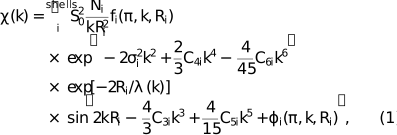 where k = [k′2 + (2me/ℏ2)ΔE0i]1/2 is the photoelectron wavenumber corrected for the difference E0i in the energy origin between experiment and theory,
  is the scale factor taking into account amplitude damping owing to multielectron effects, Ni is the coordination number of the ith shell, Ri is the radius of the ith shell,
  is the mean-square relative displacement (MSRD) or Debye–Waller factor, C3i, C4i, C5i and C6i are cumulants of a distribution taking into account anharmonic effects and/or non-Gaussian disorder, λ(k) = k/Γ (where Γ is a constant) is the mean free path (MFP) of the photoelectron, f(π, k, Ri) is the backscattering amplitude of the photoelectron owing to the atoms of the ith shell, and φ(π, k, Ri) = ψ(π, k, Ri) + 2δl(k) − lπ is the phase shift containing contributions from the absorber 2δl(k) and the backscatterer ψ(π, k, Ri) (where l is the angular momentum of the photoelectron).
The fitting parameters of the model are  , Ri,
, Ri,  , ΔE0i, C3i, C4i, C5i, C6i and Γ. The maximum number of fitting parameters which can be used in the EXAFS model is limited by the Nyquist criterion Npar = 2ΔkΔR/π (Stern, 1993).
Note that when the functions f(π, k, Ri) and φ(π, k, Ri) are extracted from the EXAFS spectrum of a reference compound, the values of the fitting parameters will be relative. To compare different models obtained by fitting the EXAFS using the EDAFIT code, Fisher's F0.95 criterion, implemented in the FTEST code (Kuzmin, 1995), can be applied.
The regularization-like method implemented in the EDARDF code allows one to determine the model-independent RDF G(R) from the experimental EXAFS. It is especially suitable for analysis of the first coordination shell in locally distorted or disordered materials, such as low-symmetry crystals (for example those with Jahn–Teller distortions), amorphous compounds, glasses and systems with strongly anharmonic behaviour, where decomposition into the cumulant series fails. At the same time, the method can also be used in more simple cases as a starting point for the selection of a conventional model as described in the previous section.
The RDF G(R) is determined by inversion of the EXAFS equation within the single-scattering approximation, using the iterative method described in Kuzmin & Purans (2000). Two regularizing criteria are applied after each iteration to restrict the shape of G(R) to physically significant solutions: it must be a positive-defined and smooth function.
The use of the method is demonstrated in Fig. 2 for the case of tin tungstate, which exists in two phases: α-SnWO4 and β-SnWO4 (Kuzmin et al., 2015). In the orthorhombic α-SnWO4 phase the W atoms are sixfold-coordinated by O atoms, and the WO6 octahedra are strongly distorted due to the second-order Jahn–Teller effect because of the W6+(5d0) electronic configuration. The six W—O bonds in α-SnWO4 are split into two groups of four short bonds at ∼1.82 Å and two long bonds at ∼2.15 Å. In cubic β-SnWO4 the W atoms have a slightly deformed WO4 tetrahedral coordination with W—O bond lengths of about 1.77 Å. An increase in temperature from 10 to 300 K weakly affects the W–O bonding in the WO4 tetrahedra and also the group of the four shortest W—O bonds in the WO6 octahedra. At the same time, the distant group of two weakly bound O atoms in the WO6 octahedra shift to longer distances and become more broadened. Thus, the reconstructed RDFs nicely reproduce the W L3-edge EXAFS in both tin tungstates and allow one to follow the distortion of the tungsten first shell in detail.
![[Figure 2]](/figures/qx0020fig2thm.gif)
|
Upper panel: comparison of the experimental (circles) and calculated (solid lines) W L3-edge EXAFS spectra χ(k)k2 for the first coordination shell of tungsten in α-SnWO4 (lower curves) and β-SnWO4 (upper curves) at 10 K. Lower panel: calculated RDFs GW–O(R) for W—O bonds within the first coordination shell of tungsten in α-SnWO4 and β-SnWO4 at 10 K (solid lines) and 300 K (dashed lines). The groups of four and two O atoms are indicated. |
Another example, shown in Fig. 3, concerns the local atomic structure relaxation upon crystallite size reduction in ZnWO4 (Kalinko & Kuzmin, 2011). Crystalline ZnWO4 has a monoclinic (P2/c) wolframite-type structure built up of distorted WO6 and ZnO6 octahedra joined by their edges into infinite zigzag chains. Distortion of the metal–oxygen octahedra leads to splitting of the W–O and Zn–O distances into three groups of two O atoms each with bond lengths of about 1.79, 1.91 and 2.13 Å around the W atoms and 2.03, 2.09 and 2.22 Å around the Zn atoms. Note that the three W–O groups are well resolved in the RDF (Fig. 3). Upon reduction of the crystallite size to ∼2 nm, a significant relaxation of the atomic structure occurs, leading to some broadening of the RDF peaks, especially at large distances (2.1–2.4 Å), whereas the nearest O atoms become more strongly bound. Such structural changes in ZnWO4 nanoparticles correlate with their optical and vibrational properties.
![[Figure 3]](/figures/qx0020fig3thm.gif)
|
The reconstructed RDFs G(R) for the first coordination shell of tungsten and zinc in nanoparticle and microcrystalline ZnWO4. |
Other examples of application of the method include the dehydration process in molybdenum oxide hydrate (Kuzmin & Purans, 2000), the effect of composition and crystallite size reduction in tungstates (Kuzmin & Purans, 2001; Anspoks, Kalinko, Timoshenko et al., 2014; Kuzmin et al., 2014) and studies of the local environment in glasses (Kuzmin & Purans, 1997; Rocca et al., 1998, 1999; Kuzmin et al., 2006).
A particular feature of the EDA package is its ability to perform more advanced calculations of the configuration-averaged EXAFS based on the results of molecular-dynamics (MD) simulations (Fig. 4; Kuzmin & Evarestov, 2009; Kuzmin & Chaboy, 2014; Kuzmin et al., 2016). Note that a set of atomic configurations generated using the Monte Carlo simulation (a Beccara & Fornasini, 2008) can also be used in a similar manner. To use this approach, called MD-EXAFS, one needs to provide an *.XYZ file containing temporal snapshots of atomic coordinates, which can be obtained from most MD codes such as GULP (Gale & Rohl, 2003), DLPOLY (Todorov et al., 2006), LAMMPS (Plimpton, 1995) or CP2K (VandeVondele et al., 2005). Additionally, an input file with a set of commands for the FEFF8/9 code is also required.
![[Figure 4]](/figures/qx0020fig4thm.gif)
|
Flowchart of the MD-EXAFS calculations. |
Care should be taken to obtain proper configuration-averaged EXAFS. This means that the number of snapshots should be sufficiently large (usually a few thousand) to obtain good statistics, and the time step between subsequent snapshots should be sufficiently small to properly sample the dynamic properties of the material. The MD-EXAFS approach allows one to validate different theoretical models, for example force fields, and/or perform the EXAFS interpretation far beyond the nearest coordination shells.
Examples of the application of this method cover many compounds: SrTiO3 (Kuzmin & Evarestov, 2009), ReO3 (Kalinko et al., 2009), germanium (Timoshenko et al., 2011), NiO (Anspoks et al., 2010, 2012; Anspoks, Kalinko, Kalendarev et al., 2014), LaCoO3 (Kuzmin et al., 2011), ZnO (Timoshenko et al., 2014), AWO4 (A = Ca, Sr, Ba) tungstates (Kalinko et al., 2016), Y2O3 (Jonane, Lazdins et al., 2016), FeF3 (Jonane, Timoshenko et al., 2016) and UO2 (Bocharov et al., 2017).
The case of microcrystalline and nanocrystalline (6 nm) NiO (Anspoks et al., 2012) is illustrated in Fig. 5. The Ni K-edge EXAFS spectra of both compounds are dominated by contributions from the first two coordination shells (Ni–O1 and Ni–Ni2) of nickel. However, the outer shells are responsible for a number of well resolved peaks located above ∼3 Å in the Fourier transforms. Owing to the cubic rock-salt structure of NiO, multiple-scattering events play an important role in the formation of EXAFS and must be treated properly. The classical MD simulations (Anspoks et al., 2012) were performed using the force-field model, including two-body central force interactions between atoms described by a sum of the Buckingham and Coulomb potentials. The effects of crystallite size, thermal disorder and the nickel vacancy concentration were taken into account. The calculated configuration-averaged EXAFS reproduces the experimental data well for both nickel oxides. In the case of nanocrystalline NiO, damping of the EXAFS oscillations owing to the atomic structure relaxation and a progressive decrease in the amplitude of the FT peaks at longer distances are observed as a result of the reduction in crystallite size.
![[Figure 5]](/figures/qx0020fig5thm.gif)
|
Comparison of the experimental (circles) and calculated configuration-averaged (solid lines) Ni K-edge EXAFS spectra χ(k)k2 (upper panel) and their Fourier transforms (lower panel) for bulk and nanosized NiO at 300 K. |
Funding information
This work was supported by Latvian Science Council grant No. 187/2012.
References
 a Beccara, S. & Fornasini, P. (2008). Phys. Rev. B, 77, 172304.Google ScholarAnkudinov, A. L., Ravel, B., Rehr, J. J. & Conradson, S. D. (1998). Phys. Rev. B, 58, 7565–7576.Google ScholarAnspoks, A., Kalinko, A., Kalendarev, R. & Kuzmin, A. (2012). Phys. Rev. B, 86, 174114.Google ScholarAnspoks, A., Kalinko, A., Kalendarev, R. & Kuzmin, A. (2014). Thin Solid Films, 553, 58–62.Google ScholarAnspoks, A., Kalinko, A., Timoshenko, J. & Kuzmin, A. (2014). Solid State Commun. 183, 22–26.Google ScholarAnspoks, A., Kuzmin, A., Kalinko, A. & Timoshenko, J. (2010). Solid State Commun. 150, 2270–2274.Google ScholarBocharov, D., Chollet, M., Krack, M., Bertsch, J., Grolimund, D., Martin, M., Kuzmin, A., Purans, J. & Kotomin, E. (2017). Prog. Nucl. Energy, 94, 187–193.Google ScholarGale, J. D. & Rohl, A. L. (2003). Mol. Simul. 29, 291–341.Google ScholarJonane, I., Lazdins, K., Timoshenko, J., Kuzmin, A., Purans, J., Vladimirov, P., Gräning, T. & Hoffmann, J. (2016). J. Synchrotron Rad. 23, 510–518.Google ScholarJonane, I., Timoshenko, J. & Kuzmin, A. (2016). Phys. Scr. 91, 104001.Google ScholarKalinko, A., Bauer, M., Timoshenko, J. & Kuzmin, A. (2016). Phys. Scr. 91, 114001.Google ScholarKalinko, A., Evarestov, R., Kuzmin, A. & Purans, J. (2009). J. Phys. Conf. Ser. 190, 012080.Google ScholarKalinko, A. & Kuzmin, A. (2011). J. Non-Cryst. Solids, 357, 2595–2599.Google ScholarKas, J. J., Vila, F. D. & Rehr, J. J. (2024). Int. Tables Crystallogr. I, ch. 6.8, 764–769
.Google ScholarKuzmin, A. (1995). Physica B, 208–209, 175–176.Google ScholarKuzmin, A. (1997). J. Phys. IV, 7, C2-213–C2-214.Google ScholarKuzmin, A., Anspoks, A., Kalinko, A. & Timoshenko, J. (2016). Z. Phys. Chem. 230, 537–549.Google ScholarKuzmin, A., Anspoks, A., Kalinko, A., Timoshenko, J. & Kalendarev, R. (2014). Phys. Scr. 89, 044005.Google ScholarKuzmin, A., Anspoks, A., Kalinko, A., Timoshenko, J. & Kalendarev, R. (2015). Solar Energy Mater. Solar Cells, 143, 627–634.Google ScholarKuzmin, A. & Chaboy, J. (2014). IUCrJ, 1, 571–589.Google ScholarKuzmin, A., Dalba, G., Fornasini, P., Rocca, F. & Šipr, O. (2006). Phys. Rev. B, 73, 174110.Google ScholarKuzmin, A., Efimov, V., Efimova, E., Sikolenko, V., Pascarelli, S. & Troyanchuk, I. O. (2011). Solid State Ionics, 188, 21–24.Google ScholarKuzmin, A. & Evarestov, R. A. (2009). J. Phys. Condens. Matter, 21, 055401.Google ScholarKuzmin, A. & Purans, J. (1997). Proc. SPIE, 2968, 180–185.Google ScholarKuzmin, A. & Purans, J. (2000). J. Phys. Condens. Matter, 12, 1959–1970.Google ScholarKuzmin, A. & Purans, J. (2001). Radiat. Meas. 33, 583–586.Google ScholarMcKale, A. G., Veal, B. W., Paulikas, A. P., Chan, S. K. & Knapp, G. S. (1988). J. Am. Chem. Soc. 110, 3763–3768.Google ScholarPlimpton, S. (1995). J. Comput. Phys. 117, 1–19.Google ScholarRehr, J. J. & Albers, R. C. (2000). Rev. Mod. Phys. 72, 621–654.Google ScholarRehr, J. J., Kas, J. J., Vila, F. D., Prange, M. P. & Jorissen, K. (2010). Phys. Chem. Chem. Phys. 12, 5503–5513.Google ScholarRocca, F., Dalba, G., Grisenti, R., Bettinelli, M., Monti, F. & Kuzmin, A. (1998). J. Non-Cryst. Solids, 232–234, 581–586.Google ScholarRocca, F., Monti, F., Kuzmin, A., Dalmaso, A. & Pasqualini, D. (1999). J. Synchrotron Rad. 6, 737–739.Google ScholarStern, E. A. (1993). Phys. Rev. B, 48, 9825–9827.Google ScholarStern, E. A., Ma, Y., Hanske-Petitpierre, O. & Bouldin, C. E. (1992). Phys. Rev. B, 46, 687–694.Google ScholarTeo, B. K. (1986). EXAFS: Basic Principles and Data Analysis. Berlin: Springer.Google ScholarTimoshenko, J., Anspoks, A., Kalinko, A. & Kuzmin, A. (2014). Acta Mater. 79, 194–202.Google ScholarTimoshenko, J., Kuzmin, A. & Purans, J. (2011). Centr. Eur. J. Phys. 9, 710–715.Google ScholarTodorov, I. T., Smith, W., Trachenko, K. & Dove, M. T. (2006). J. Mater. Chem. 16, 1911–1918.Google ScholarVandeVondele, J., Krack, M., Mohamed, F., Parrinello, M., Chassaing, T. & Hutter, J. (2005). Comput. Phys. Commun. 167, 103–128.Google Scholar
a Beccara, S. & Fornasini, P. (2008). Phys. Rev. B, 77, 172304.Google ScholarAnkudinov, A. L., Ravel, B., Rehr, J. J. & Conradson, S. D. (1998). Phys. Rev. B, 58, 7565–7576.Google ScholarAnspoks, A., Kalinko, A., Kalendarev, R. & Kuzmin, A. (2012). Phys. Rev. B, 86, 174114.Google ScholarAnspoks, A., Kalinko, A., Kalendarev, R. & Kuzmin, A. (2014). Thin Solid Films, 553, 58–62.Google ScholarAnspoks, A., Kalinko, A., Timoshenko, J. & Kuzmin, A. (2014). Solid State Commun. 183, 22–26.Google ScholarAnspoks, A., Kuzmin, A., Kalinko, A. & Timoshenko, J. (2010). Solid State Commun. 150, 2270–2274.Google ScholarBocharov, D., Chollet, M., Krack, M., Bertsch, J., Grolimund, D., Martin, M., Kuzmin, A., Purans, J. & Kotomin, E. (2017). Prog. Nucl. Energy, 94, 187–193.Google ScholarGale, J. D. & Rohl, A. L. (2003). Mol. Simul. 29, 291–341.Google ScholarJonane, I., Lazdins, K., Timoshenko, J., Kuzmin, A., Purans, J., Vladimirov, P., Gräning, T. & Hoffmann, J. (2016). J. Synchrotron Rad. 23, 510–518.Google ScholarJonane, I., Timoshenko, J. & Kuzmin, A. (2016). Phys. Scr. 91, 104001.Google ScholarKalinko, A., Bauer, M., Timoshenko, J. & Kuzmin, A. (2016). Phys. Scr. 91, 114001.Google ScholarKalinko, A., Evarestov, R., Kuzmin, A. & Purans, J. (2009). J. Phys. Conf. Ser. 190, 012080.Google ScholarKalinko, A. & Kuzmin, A. (2011). J. Non-Cryst. Solids, 357, 2595–2599.Google ScholarKas, J. J., Vila, F. D. & Rehr, J. J. (2024). Int. Tables Crystallogr. I, ch. 6.8, 764–769
.Google ScholarKuzmin, A. (1995). Physica B, 208–209, 175–176.Google ScholarKuzmin, A. (1997). J. Phys. IV, 7, C2-213–C2-214.Google ScholarKuzmin, A., Anspoks, A., Kalinko, A. & Timoshenko, J. (2016). Z. Phys. Chem. 230, 537–549.Google ScholarKuzmin, A., Anspoks, A., Kalinko, A., Timoshenko, J. & Kalendarev, R. (2014). Phys. Scr. 89, 044005.Google ScholarKuzmin, A., Anspoks, A., Kalinko, A., Timoshenko, J. & Kalendarev, R. (2015). Solar Energy Mater. Solar Cells, 143, 627–634.Google ScholarKuzmin, A. & Chaboy, J. (2014). IUCrJ, 1, 571–589.Google ScholarKuzmin, A., Dalba, G., Fornasini, P., Rocca, F. & Šipr, O. (2006). Phys. Rev. B, 73, 174110.Google ScholarKuzmin, A., Efimov, V., Efimova, E., Sikolenko, V., Pascarelli, S. & Troyanchuk, I. O. (2011). Solid State Ionics, 188, 21–24.Google ScholarKuzmin, A. & Evarestov, R. A. (2009). J. Phys. Condens. Matter, 21, 055401.Google ScholarKuzmin, A. & Purans, J. (1997). Proc. SPIE, 2968, 180–185.Google ScholarKuzmin, A. & Purans, J. (2000). J. Phys. Condens. Matter, 12, 1959–1970.Google ScholarKuzmin, A. & Purans, J. (2001). Radiat. Meas. 33, 583–586.Google ScholarMcKale, A. G., Veal, B. W., Paulikas, A. P., Chan, S. K. & Knapp, G. S. (1988). J. Am. Chem. Soc. 110, 3763–3768.Google ScholarPlimpton, S. (1995). J. Comput. Phys. 117, 1–19.Google ScholarRehr, J. J. & Albers, R. C. (2000). Rev. Mod. Phys. 72, 621–654.Google ScholarRehr, J. J., Kas, J. J., Vila, F. D., Prange, M. P. & Jorissen, K. (2010). Phys. Chem. Chem. Phys. 12, 5503–5513.Google ScholarRocca, F., Dalba, G., Grisenti, R., Bettinelli, M., Monti, F. & Kuzmin, A. (1998). J. Non-Cryst. Solids, 232–234, 581–586.Google ScholarRocca, F., Monti, F., Kuzmin, A., Dalmaso, A. & Pasqualini, D. (1999). J. Synchrotron Rad. 6, 737–739.Google ScholarStern, E. A. (1993). Phys. Rev. B, 48, 9825–9827.Google ScholarStern, E. A., Ma, Y., Hanske-Petitpierre, O. & Bouldin, C. E. (1992). Phys. Rev. B, 46, 687–694.Google ScholarTeo, B. K. (1986). EXAFS: Basic Principles and Data Analysis. Berlin: Springer.Google ScholarTimoshenko, J., Anspoks, A., Kalinko, A. & Kuzmin, A. (2014). Acta Mater. 79, 194–202.Google ScholarTimoshenko, J., Kuzmin, A. & Purans, J. (2011). Centr. Eur. J. Phys. 9, 710–715.Google ScholarTodorov, I. T., Smith, W., Trachenko, K. & Dove, M. T. (2006). J. Mater. Chem. 16, 1911–1918.Google ScholarVandeVondele, J., Krack, M., Mohamed, F., Parrinello, M., Chassaing, T. & Hutter, J. (2005). Comput. Phys. Commun. 167, 103–128.Google Scholar

