|
International
Tables for Crystallography Volume I X-ray absorption spectroscopy and related techniques Edited by C. T. Chantler, F. Boscherini and B. Bunker © International Union of Crystallography 2024 |
International Tables for Crystallography (2024). Vol. I. ch. 6.9, pp. 770-776
https://doi.org/10.1107/S1574870720003389 Chapter 6.9. FitItaPaul Scherrer Institute, WLGA 217, 5232 Villigen, Switzerland, and bSmart Materials International Research Center, Southern Federal University of Russia, Sladkova 178/24, Rostov-on-Don 344090, Russian Federation FitIt is software for local structure refinement based on X-ray absorption near-edge structure (XANES) fitting. In this approach, a few structural parameters are varied and the discrepancy between theoretical and experimental spectra is minimized. High computational efficiency is achieved using multidimensional interpolation of spectra in the space of structural parameters. This approach also allowed the development of a visual interface to see the influence of structural parameters on XANES in real time. The software package is flexible and uses external codes for XANES calculations, for example FEFF9 and FDMNES. The principal component analysis in FitIt simplifies the interpretation of large series of experimental spectra, in particular time-resolved data. The main possibilities of FitIt are demonstrated using three examples. XANES fitting based on non-muffin-tin calculations is shown for a molecule of a planar nickel complex. A refinement of the crystal structure was performed for indium arsenide under high pressure. The analysis of time-resolved spectral series is demonstrated for a photocatalytic system with a cobaloxime catalyst. FitIt is free software for academic research purposes and can be downloaded from http://nano.sfedu.ru/fitit/ . Keywords: XANES; local structure; fitting; multidimensional interpolation. |
Quantitative analysis of XANES spectra has become more important with the ongoing evolution of experimental XAS. The modern trend in the development of XAS-based techniques is the enhancement of time, spatial and spectroscopic resolution. As a side effect, the energy range of spectra is limited. X-ray free-electron lasers (XFELs) provide a time-resolution of below 100 fs, but the energy bandwidth of such sources is less than 1%. Tuning the undulator gap of an XFEL takes minutes. Therefore, XANES measurements with such a machine have successfully been demonstrated (Lemke et al., 2013 ); however, EXAFS measurements are extremely difficult at XFEL facilities. Diffraction-limited storage rings (DLSRs) are expected to provide unique possibilities for focusing and imaging, including XAS imaging. The huge number of pixels in such images limit the range of XAS spectra to the XANES region only (Hitchcock & Toney, 2014). High energy-resolved fluorescence-detected (HERFD) XAS increases the resolution of the spectrum below the limit of a core-hole width and gives additional site selectivity, but at the expense of the count rate (Glatzel & Bergmann, 2005; Glatzel, Sikora et al., 2009). Therefore, the energy range is also often limited by XANES.
XANES is a very informative part of the X-ray absorption spectrum. Photoelectrons, which are generated during core-level excitation, have a large mean free path (Müller et al., 1982). Therefore, their multiple scattering from surrounding atoms is probable. As a result, XANES is sensitive to local three-dimensional structure around the X-ray-absorbing atom. Information about the electronic structure, in particular the oxidation state, is also accessible by XANES (Glatzel, Smolentsev et al., 2009). For example, the white lines of the L3 spectra of 3d and 4d elements correspond to a transition to unoccupied d-states; consequently, they reflect the valence configuration. For the K edges of 3d elements, the high sensitivity to the oxidation state is indirect. It arises from the screening of a core level by valence electrons. Nevertheless, these effects cannot experimentally be separated from the influence of the structure around the atom of interest on the spectrum. Therefore, calculations of XANES for different models of the local and electronic structure and comparison with the experimental data are preferable.
The codes for XANES calculations for a given geometry rely on different approximations and are often optimized for specific cases. Therefore, we typically compare various methods and select the appropriate method for the structural refinement. The FEFF code (Ankudinov et al., 1998; Rehr et al., 2010; Kas et al., 2024) is based on the full multiple-scattering theory with a self-consistent muffin-tin potential. MXAN also uses full multiple scattering, but with a parametrized potential (Benfatto et al., 2001, 2024). FDMNES employs the finite-difference method with a non-muffin-tin potential (Joly, 2001; Bunău et al., 2024). A universal tool for structure determination from XANES should allow the use of different approximations. The full-potential finite-difference method was computationally challenging a few years ago, but is now more practical (Guda et al., 2015). Approaches that go beyond the one-electron theory are under development and are still very computationally demanding (Kumagai et al., 2009; Maganas et al., 2013; Guo et al., 2016). Therefore, the minimization of the number of calculations for different geometries is important for structure determination from XANES in an acceptable time.
The FitIt software developed for structural refinement from XANES (Smolentsev & Soldatov, 2006, 2007) is (i) flexible (owing to its modular structure; it uses external programs for XANES calculations and a user can easily adapt it to any new code), (ii) visual (the influence of structural parameters on XANES is seen in real time; such changes can be visually distinguished from systematic problems, for example those arising from imperfections in the method for XANES calculations) and (iii) computationally efficient (the interpolation of the spectrum in the space of structural parameters minimizes the number of the required calculations and, as a result, the overall computation time).
At a later stage, owing to the increasing number of experiments generating large series of XANES spectra, principal component analysis (PCA; Smolentsev, Guilera et al., 2009) and the possibility of fitting differential spectra (Smolentsev et al., 2006, 2008) were added. The basic idea implemented in FitIt, which is the variation of structural parameters and the minimization of the discrepancy between theory and experiment, is the same as in MXAN. The difference between them is that MXAN is linked to only one implementation of the full multiple-scattering approach; it does not use the multidimensional interpolation and therefore does not provide the same possibilities for visualization and combination with more precise but computationally time-consuming methods. However, a recent version of MXAN performs configurational averaging (Chillemi et al., 2016). Such an approach is important for studying disordered systems such as proteins and ions in solution. In particular, the method can be coupled with molecular-dynamics (MD) calculations and hundreds of geometrical configurations that represent the MD trajectory can be averaged (D'Angelo et al., 2010).
In the following section, we describe the methods implemented in FitIt: the XANES fitting procedure, the multidimensional interpolation approximation (Smolentsev & Soldatov, 2006) and the PCA-based approach for the analysis of spectral series (Smolentsev, Guilera et al., 2009). Three applications of FitIt are then shown. A molecular complex of nickel represents the first example of structural refinement from XANES using the non-muffin-tin approach (Smolentsev et al., 2007). Indium arsenide (InAs) under high pressure provides an example of structural refinement of crystalline materials using FitIt (Smolentsev et al., 2006). Finally, we demonstrate how the analysis of time-resolved XANES spectra provides the structure of a catalytic intermediate of a cobaloxime catalyst (Smolentsev et al., 2015).
The local structure refinement from XANES is based on the minimization of the discrepancy between theoretical and experimental spectra by varying structural parameters. The structural transformations are performed automatically with the FitIt tools, which are typically sufficient for molecules. For crystals, some external programs, for example Atoms from the Demeter (IFEFFIT) package (Ravel & Newville, 2005; Newville & Ravel, 2024), can be used. When dealing with molecules, one has to define rigid groups and then translate or rotate them along different axes. For crystalline materials, one can vary the positions of atoms in the unit cell as well as the cell constants.
XANES fitting includes two steps: the interpolation of spectra and minimization of the discrepancy between theory and experiment. Firstly, we construct the interpolation of the spectrum as a function of structural parameters. This allows the prediction of XANES for any values of parameters within selected limits of variation. Calculations using external codes such as FEFF (Ankudinov et al., 1998; Rehr et al., 2010; Kas et al., 2024) and FDMNES (Joly, 2001; Bunău et al., 2024) are performed during this step. Plugins to generate the required input files and export the results are part of the FitIt package. The interface of FitIt proposes sets of parameters for calculations with several external programs. Initially, they are used to check the quality of interpolation and are therefore called control points. If they have to be included in the polynomial, then they become interpolation nodes.
As a second step, we minimize the discrepancy between interpolated spectra μi(E) and experimental spectra μexp(E) by varying the structural parameters. The mean-square deviation is used as the main criterion,  The Chebyshev criterion is an alternative:
 Here, E1 and E2 are energy limits for the comparison of spectra. In many cases, the analysis involves two states of the material. One spectrum corresponds to the known structure, while the goal is to determine the structure in the second state. In this case, a fitting of the differential spectrum can be performed,
 Here,
Here,  and
and  are the experimental and theoretical spectra for the reference phase with known structure. To exclude the influence of nonstructural parameters on the results of structural refinement, we perform the analysis in two steps. Firstly, we test the method of XANES calculations using the reference phase of the material or a closely related system with known structure. We choose the best method of calculation and select optimal values for the nonstructural parameters that give the best agreement with the experiment. As a second step, we switch to the system with unknown structure and vary the structure. All nonstructural parameters are fixed to their optimal values during structural refinement.
If the experimental input is a large series of spectra then it is decomposed using PCA (Smolentsev, Guilera et al., 2009) into a few components and their weights. Such a decomposition procedure can have some degrees of freedom. The corresponding PCA parameters can vary along with the structure during minimization of the discrepancy between theory and experiment.
Multidimensional interpolation of XANES is used to minimize the number of required calculations of XANES for different sets of structural parameters (Smolentsev & Soldatov, 2006). The following expansion of the spectrum is used: Here, p1, p2 … pn are the initial values of structural parameters and δp1, δp2 … δpn are the deviations from their initial values. The spectra calculated with an external program, μ(E, pk), and interpolated XANES, μi(E, pk), are equal for interpolation nodes pk. Therefore, energy-dependent coefficients An(E) and Bmn(E) are obtained by solving the system of equations
 An iterative procedure is used to check and improve the polynomial. It is based on the idea that the higher order cross-terms are negligible if they are the product of any previously neglected term and another parameter. This procedure, together with a few examples, is described in greater detail in Smolentsev & Soldatov (2006). It has been implemented in the interface of FitIt for the construction of the interpolation.
Principal component analysis (Malinowski, 1991) is used to analyze large series of experimental spectra. Each spectrum in the series is described as a linear combination of several components with unknown weights which are dependent on the number of the spectrum in the series. Some or all of the spectroscopic components can be unknown. The goal of this method is to determine all statistically significant spectra that are mixed in the time-resolved series and their weights for each spectrum in the series.
The large matrix of measured spectra μij is represented as where i is the energy point index, sik is spectroscopic component number k and wkj is the weight of component k for the measured spectrum number j. Mathematically, such a decomposition does not have a unique solution: for any matrix Tpk that can be inverted,
 is another solution.
Therefore, the search for a physically meaningful solution can be performed in two steps. Firstly, singular value decomposition is used to find any (mathematical) solution where the elements of the diagonal matrix lkm are sorted in a decreasing order and wkj = lkmvmj.
Quantitative criteria (Malinowski, 1991) are available to determine the number of statistically meaningful components from the analysis of elements of lkm, where r is the number of energy points and c is the number of time points. The minima of IE and IND correspond to the number of observable components.
As a second step, the mathematical solution is transformed into a physically meaningful solution. A priori knowledge about XANES and a system can be used. For instance, all of the spectra have to be positive and normalized, the weights should be in the interval from zero to one and for many applications they should have only one maximum. We have demonstrated (Smolentsev, Guilera et al., 2009) that using only such limitations (the corresponding algorithms are known as self-modelling curve resolution; Jiang et al., 2004; Maeder, 1987; Manne et al., 1999) is not sufficient to find a unique solution for XANES. Therefore, in FitIt we add an additional criterion, the similarity to the theoretical spectrum, to determine the components. The model for calculations can have some parameters. Therefore, minimization is performed with simultaneous variation of elements of the matrix Tpk and structural parameters. Other codes such as Demeter (Ravel & Newville, 2005), WinXAS (Ressler, 1998) and XANDA (Klementiev, 2012, 2024) use experimental spectra of reference compounds to determine the elements of Tpk, which transforms the mathematical solution into a physical solution.
The structural refinement based on XANES employing non-muffin-tin potentials has been demonstrated for the first time using Ni(acacR)2 as an example, where R is a para tertiary butylbenzyl group attached to acetylacetonate in the 3-position (Smolentsev et al., 2007). The calculations were performed for the part of the complex shown in Fig. 1. The muffin-tin approximation is widely used in calculations of XANES within the full multiple-scattering theory, for example in FEFF9 (Rehr et al., 2010; Kas et al., 2024) and MXAN (Benfatto et al., 2001, 2024), even if there is a full-potential version of the full multiple scattering (Hatada et al., 2009). The finite-difference method implemented in FDMNES (Joly, 2001; Bunău et al., 2024) uses the non-muffin-tin potential and has been combined with FitIt.
![[Figure 1]](/figures/qx0023fig1thm.gif)
Different approaches for XANES calculations have been tested for Ni(acacR)2: full multiple scattering with the muffin-tin potential (FEFF8), the finite-difference method with the muffin-tin potential (FDMNES) and the non-muffin-tin finite-difference method (FDMNES). The use of the non-muffin-tin approach is essential to reproduce the experimental spectrum (Smolentsev et al., 2007). Within the muffin-tin approximation, the potential is spherically symmetric inside atomic spheres and is constant in the interstitial regions between atoms. Two types of non-muffin-tin effects are possible: (i) asymmetry inside atomic spheres, for example owing to the influence of strong covalent bonds, and (ii) variable interstitial potential. We found that the potential in the interstitial region between the atoms Ni—O—C1—C2 is not constant. This area is close to the absorbing atom and is relevant to the XANES calculations.
The parameters that were fitted during the structural refinement are shown in Fig. 1. The limits of variation were Ni—O distance, 1.76–1.92 Å; O—C1 distance, 1.22–1.38 Å; C1—C2 distance, 1.30–1.46 Å; O—Ni—O angle, 80–100°. All of them significantly influence the shape of the XANES (Fig. 2 and Table 1). These distances change the position of maximum B and the minimum at the energy above 8380 eV (compare spectra 3, 4 and 5). The angle influences the relative position of maxima A and B and affects the intensity of feature C (compare spectra 1 and 2).
|
![[Figure 2]](/figures/qx0023fig2thm.gif)
The applied interpolation polynomial is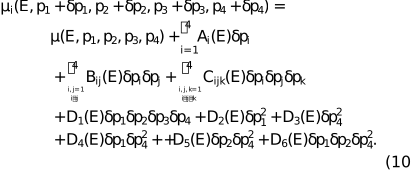 It has 21 interpolation nodes. Thus, only 21 calculations using the time-consuming finite-difference method are required to predict the shape of the theoretical spectrum for any values of parameters within the selected limits of variation.
The best-fit spectrum reproduces all of the features of the experiment (Fig. 3). The values of the structural parameters that correspond to this spectrum are Ni—O distance 1.83 Å, O—C1 distance 1.28 Å, C1—C2 distance 1.39 Å and O—Ni—O angle 93°. These values are close to those determined usingX-ray diffraction for the related nickel complex (Cotton & Wise, 1966), EXAFS data (Feiters et al., 2005) and geometry optimization with density-functional theory (Smolentsev et al., 2007). If the full multiple scattering with the muffin-tin approximation is used for structural refinement, then the best-fit values (Ni—O distance 1.94 Å, O—C1 distance 1.28 Å, C1—C2 distance 1.43 Å and O—Ni—O angle 102°) are far from the expected values. This confirms that in the present case the use of the non-muffin-tin potential is essential to precisely determine the structure from XANES.
![[Figure 3]](/figures/qx0023fig3thm.gif)
The structure of a crystalline compound was determined with FitIt for the first time using InAs under high pressure as an example (Smolentsev et al., 2006). A transition from the Fm3m to the Cmcm phase is observed when the pressure is increased from 14 to 19 GPa. The goal was to determine the structure of the high-pressure phase; the structure at 14 GPa was well known. For the Fm3m phase, calculations with the non-muffin-tin finite-difference method agree with the experiment (Fig. 4). The unit-cell constants for the Cmcm phase p1 = a = c, p2 = b and the internal cell parameter p3 = δ were the fitted parameters. δ represents the displacement of atoms from their position in the Fm3m phase: (0, 3/4 − δ, 1/4) and (0, 1/4 − δ, 1/4). They varied within the limits 5.396–5.096 Å for p1, 5.396–5.696 Å for p2 and 0–0.1 for p3. During the construction of the interpolation polynomial, it was found that the dependence of the spectrum on the internal parameter p3 is strongly nonlinear. Owing to the symmetry, even powers were used in the polynomial expansion for this parameter. Three expansion terms  ,
,  and
and  were required for precise interpolation within selected limits. The linear terms dominate in the interpolation as a function of the unit-cell constants. As a result, a quite complex polynomial has been obtained,
 The experimental spectral changes observed from comparison of the Fm3m and Cmcm phases are small. To increase the sensitivity of the fitting procedure, we have compared the experimental and theoretical differential spectra μCmcm − μFm3m and minimized the discrepancy between them. The best-fit results are presented in Fig. 4. The corresponding values of the parameters are a = c = 5.366 ± 0.025 Å, b = 5.411 ± 0.025 Å and δ = 0.025 ± 0.005. The possibility of refining the same set of structural parameters using Rietveld refinement of the X-ray diffraction data (Aquilanti et al., 2003) and XANES links X-ray spectroscopy and crystallography, and can be used for the cross-checking of results obtained by these methods in experimentally challenging cases such as high-pressure research.
![[Figure 4]](/figures/qx0023fig4thm.gif)
FitIt can also be used to determine the coordination shell distances. In particular, the local structure around dopants and defects in crystals can be investigated. ZnO doped with manganese represents research of this type (Smolentsev, Soldatov et al., 2009).
This example demonstrates the application of FitIt to the analysis of time-resolved XANES data. The multicomponent photocatalytic mixture for hydrogen production with a cobaloxime catalyst (Fig. 5) has been studied and details can be found in Smolentsev et al. (2015). The goal was to determine the structure of the intermediate state of the catalyst. A series of 200 spectra obtained using the pump–sequential probes method (Smolentsev et al., 2014) was the experimental input. Firstly, principal component analysis was applied to determine the number of independent spectral components in the data. We found that only two species contributed to this XANES series. One of them corresponds to the initial state of the catalyst, while the second is a transiently formed intermediate. As an additional benefit, principal component analysis allows extraction of the transient signal (the difference between the spectra of the intermediate and initial states) based on analysis of the whole series of spectra with the best possible signal-to-noise ratio. Taking into account that the spectrum of the initial state was known, the transient XANES (with arbitrary normalization) was extracted without any additional free parameters.
![[Figure 5]](/figures/qx0023fig5thm.gif)
|
Structure of the cobaloxime catalyst Co(dmgBF2)2(CH3CN)2. C atoms, grey; N, blue; O, red; Co, magenta; B, green; F, yellow. The dmg2− ligands form an equatorial plane; solvent molecules coordinate axially. |
FitIt in combination with full multiple-scattering XANES calculations using the self-consistent muffin-tin potential (FEFF8) has been used. The spectrum of the initial cobalt(II) state agrees with the experimental spectrum (Fig. 6, top). A cobalt(I) intermediate has been identified from the shift of the absorption edge to lower energies. Preliminary tests of a few models have shown (Smolentsev et al., 2014) that the structure of the cobalt(I) state is similar to that of the cobalt(II) state, but has (i) some displacements of cobalt out of the equatorial plane formed by the dmg2− ligands, (ii) changes of the distances between the cobalt ion and solvent molecules and (iii) small changes in the bond lengths between the metal centre and dmg2− ligands. These parameters varied during the fitting of the transient XANES. The best-fit results correspond to a model with a 0.08 Å displacement of cobalt out of the equatorial plane, Co—N(solvent) distances of 2.00 and 2.11 Å and a Co—N(dmg2−) distance of 1.88 Å. The best-fit transient spectrum is shown at the bottom of Fig. 6.
![[Figure 6]](/figures/qx0023fig6thm.gif)
The examples provided above show that FitIt is efficient for local structure refinement based on the XANES fitting. The sensitivity of XANES to the three-dimensional structure of materials can be fully exploited using this approach. Non-muffin-tin calculations are now routinely used in combination with FitIt for structure determination. The method is applicable to a wide range of materials from solids to metal complexes in solution. We see the following steps for the further development of FitIt.
(i) The simplification of the procedure of interpolation polynomial construction. For applications that are not computationally time-consuming, for example based on full multiple scattering, the step-by-step procedure can be replaced by automatic polynomial construction in one or two steps.
(ii) Closer integration with many-electron programs for XANES calculations. Corresponding plugins for a few of the most successful codes could be components of the FitIt installation.
(iii) The implementation of cloud computing possibilities. Currently, FitIt supports the execution of external programs for XANES calculation locally or at remote servers. This feature can be extended to deploy programs automatically and to perform calculations in the cloud.
(iv) Support of modern XAFS formats. Currently, there are efforts in the XAFS community to develop a standard format for XAFS data interchange (Ravel & Newville, 2016). This data format in FitIt would be convenient for users.
(v) Development of the tool for the screening of structural parameters. A few defined parameters and their limits of variation are required as an input in the current version of FitIt. In some cases, it can be useful to screen many structural parameters with automatically defined limits of variation, compare their influence on the spectra and select the most relevant ones for fitting with the multidimensional interpolation.
Funding information
We thank the Energy System Integration (ESI) platform at PSI for funding. Support from NCCR MUST and the Ministry of Science and Higher Education of the Russian Federation (State Assignment 0852-2020-0019) is also acknowledged.
References
 Ankudinov, A. L., Ravel, B., Rehr, J. J. & Conradson, S. D. (1998). Phys. Rev. B, 58, 7565–7576.Google ScholarAquilanti, G., Crichton, W. A., Le Bihan, T. & Pascarelli, S. (2003). Nucl. Instrum. Methods Phys. Res. B, 200, 90–94.Google ScholarBenfatto, M., Chillemi, G. & Pace, E. (2024). Int. Tables Crystallogr. I, ch. 6.16, 804–808
.Google ScholarBenfatto, M., Congiu-Castellano, A., Daniele, A. & Della Longa, S. (2001). J. Synchrotron Rad. 8, 267–269.Google ScholarBunău, A., Ramos, A. Y. & Joly, Y. (2024). Int. Tables Crystallogr. I, ch. 6.6, 752–757
.Google ScholarChillemi, G., Pace, E., D'Abramo, M. & Benfatto, M. (2016). J. Phys. Chem. A, 120, 3958–3965.Google ScholarCotton, F. A. & Wise, J. J. (1966). Inorg. Chem. 5, 1200–1207.Google ScholarD'Angelo, P., Della Longa, S., Arcovito, A., Anselmi, M., Di Nola, A. & Chillemi, G. (2010). J. Am. Chem. Soc. 132, 14901–14909.Google ScholarFeiters, M. C., Metselaar, G. A., Wentzel, B. B., Nolte, R. J. M., Nikitenko, S., Sherrington, D. C., Joly, Y., Smolentsev, G. Y., Kravtsova, A. N. & Soldatov, A. V. (2005). Ind. Eng. Chem. Res. 44, 8631–8640.Google ScholarGlatzel, P. & Bergmann, U. (2005). Coord. Chem. Rev. 249, 65–95.Google ScholarGlatzel, P., Sikora, M., Smolentsev, G. & Fernández-García, M. (2009). Catal. Today, 145, 294–299.Google ScholarGlatzel, P., Smolentsev, G. & Bunker, G. (2009). J. Phys. Conf. Ser. 190, 012046.Google ScholarGuda, S. A., Guda, A. A., Soldatov, M. A., Lomachenko, K. A., Bugaev, A. L., Lamberti, C., Gawelda, W., Bressler, C., Smolentsev, G., Soldatov, A. V. & Joly, Y. (2015). J. Chem. Theory Comput. 11, 4512–4521.Google ScholarGuo, M., Sørensen, L. K., Delcey, M. G., Pinjari, R. V. & Lundberg, M. (2016). Phys. Chem. Chem. Phys. 18, 3250–3259.Google ScholarHatada, K., Hayakawa, K., Benfatto, M. & Natoli, C. R. (2009). J. Phys. Condens. Matter, 21, 104206.Google ScholarHitchcock, A. P. & Toney, M. F. (2014). J. Synchrotron Rad. 21, 1019–1030.Google ScholarJiang, J.-H., Liang, Y. & Ozaki, Y. (2004). Chemom. Intell. Lab. Syst. 71, 1–12.Google ScholarJoly, Y. (2001). Phys. Rev. B, 63, 125120.Google ScholarKas, J. J., Vila, F. D. & Rehr, J. J. (2024). Int. Tables Crystallogr. I, ch. 6.8, 764–769
.Google ScholarKlementiev, K. (2012). XANDA. https://www.cells.es/en/beamlines/bl22-claess/software
.Google ScholarKlementiev, K. (2024). Int. Tables Crystallogr. I, ch. 6.21, 833–835
.Google ScholarKumagai, Y., Ikeno, H. & Tanaka, I. (2009). J. Phys. Condens. Matter, 21, 104209.Google ScholarLemke, H. T., Bressler, C., Chen, L. X., Fritz, D. M., Gaffney, K. J., Galler, A., Gawelda, W., Haldrup, K., Hartsock, R. W., Ihee, H., Kim, J., Kim, K. H., Lee, J. H., Nielsen, M. M., Stickrath, A. B., Zhang, W., Zhu, D. & Cammarata, M. (2013). J. Phys. Chem. A, 117, 735–740.Google ScholarMaeder, M. (1987). Anal. Chem. 59, 527–530.Google ScholarMaganas, D., Roemelt, M., Hävecker, M., Trunschke, A., Knop-Gericke, A., Schlögl, R. & Neese, F. (2013). Phys. Chem. Chem. Phys. 15, 7260–7276.Google ScholarMalinowski, E. R. (1991). Factor Analysis in Chemistry, 2nd ed. New York: Wiley.Google ScholarManne, R., Shen, H. & Liang, Y. (1999). Chemom. Intell. Lab. Syst. 45, 171–176.Google ScholarMüller, J. E., Jepsen, O. & Wilkins, J. W. (1982). Solid State Commun. 42, 365–368.Google ScholarNewville, M. & Ravel, B. (2024). Int. Tables Crystallogr. I, ch. 6.13, 791–795
.Google ScholarRavel, B. & Newville, M. (2005). J. Synchrotron Rad. 12, 537–541.Google ScholarRavel, B. & Newville, M. (2016). J. Phys. Conf. Ser. 712, 012148.Google ScholarRehr, J. J., Kas, J. J., Vila, F. D., Prange, M. P. & Jorissen, K. (2010). Phys. Chem. Chem. Phys. 12, 5503–5513.Google ScholarRessler, T. (1998). J. Synchrotron Rad. 5, 118–122.Google ScholarSmolentsev, G., Cecconi, B., Guda, A., Chavarot-Kerlidou, M., van Bokhoven, J. A., Nachtegaal, M. & Artero, V. (2015). Chem. Eur. J. 21, 15158–15162.Google ScholarSmolentsev, G., Guda, A. A., Janousch, M., Frieh, C., Jud, G., Zamponi, F., Chavarot-Kerlidou, M., Artero, V., van Bokhoven, J. A. & Nachtegaal, M. (2014). Faraday Discuss. 171, 259–273.Google ScholarSmolentsev, G., Guilera, G., Tromp, M., Pascarelli, S. & Soldatov, A. V. (2009). J. Chem. Phys. 130, 174508.Google ScholarSmolentsev, G. & Soldatov, A. (2006). J. Synchrotron Rad. 13, 19–29.Google ScholarSmolentsev, G. & Soldatov, A. V. (2007). Comput. Mater. Sci. 39, 569–574.Google ScholarSmolentsev, G., Soldatov, A. V. & Chen, L. X. (2008). J. Phys. Chem. A, 112, 5363–5367.Google ScholarSmolentsev, G., Soldatov, A. V. & Feiters, M. C. (2007). Phys. Rev. B, 75, 144106.Google ScholarSmolentsev, G., Soldatov, A. V., Pascarelli, S. & Aquilanti, G. (2006). J. Phys. Condens. Matter, 18, 7393–7400.Google ScholarSmolentsev, N., Soldatov, A. V., Smolentsev, G. & Wei, S. Q. (2009). Solid State Commun. 149, 1803–1806.Google Scholar
Ankudinov, A. L., Ravel, B., Rehr, J. J. & Conradson, S. D. (1998). Phys. Rev. B, 58, 7565–7576.Google ScholarAquilanti, G., Crichton, W. A., Le Bihan, T. & Pascarelli, S. (2003). Nucl. Instrum. Methods Phys. Res. B, 200, 90–94.Google ScholarBenfatto, M., Chillemi, G. & Pace, E. (2024). Int. Tables Crystallogr. I, ch. 6.16, 804–808
.Google ScholarBenfatto, M., Congiu-Castellano, A., Daniele, A. & Della Longa, S. (2001). J. Synchrotron Rad. 8, 267–269.Google ScholarBunău, A., Ramos, A. Y. & Joly, Y. (2024). Int. Tables Crystallogr. I, ch. 6.6, 752–757
.Google ScholarChillemi, G., Pace, E., D'Abramo, M. & Benfatto, M. (2016). J. Phys. Chem. A, 120, 3958–3965.Google ScholarCotton, F. A. & Wise, J. J. (1966). Inorg. Chem. 5, 1200–1207.Google ScholarD'Angelo, P., Della Longa, S., Arcovito, A., Anselmi, M., Di Nola, A. & Chillemi, G. (2010). J. Am. Chem. Soc. 132, 14901–14909.Google ScholarFeiters, M. C., Metselaar, G. A., Wentzel, B. B., Nolte, R. J. M., Nikitenko, S., Sherrington, D. C., Joly, Y., Smolentsev, G. Y., Kravtsova, A. N. & Soldatov, A. V. (2005). Ind. Eng. Chem. Res. 44, 8631–8640.Google ScholarGlatzel, P. & Bergmann, U. (2005). Coord. Chem. Rev. 249, 65–95.Google ScholarGlatzel, P., Sikora, M., Smolentsev, G. & Fernández-García, M. (2009). Catal. Today, 145, 294–299.Google ScholarGlatzel, P., Smolentsev, G. & Bunker, G. (2009). J. Phys. Conf. Ser. 190, 012046.Google ScholarGuda, S. A., Guda, A. A., Soldatov, M. A., Lomachenko, K. A., Bugaev, A. L., Lamberti, C., Gawelda, W., Bressler, C., Smolentsev, G., Soldatov, A. V. & Joly, Y. (2015). J. Chem. Theory Comput. 11, 4512–4521.Google ScholarGuo, M., Sørensen, L. K., Delcey, M. G., Pinjari, R. V. & Lundberg, M. (2016). Phys. Chem. Chem. Phys. 18, 3250–3259.Google ScholarHatada, K., Hayakawa, K., Benfatto, M. & Natoli, C. R. (2009). J. Phys. Condens. Matter, 21, 104206.Google ScholarHitchcock, A. P. & Toney, M. F. (2014). J. Synchrotron Rad. 21, 1019–1030.Google ScholarJiang, J.-H., Liang, Y. & Ozaki, Y. (2004). Chemom. Intell. Lab. Syst. 71, 1–12.Google ScholarJoly, Y. (2001). Phys. Rev. B, 63, 125120.Google ScholarKas, J. J., Vila, F. D. & Rehr, J. J. (2024). Int. Tables Crystallogr. I, ch. 6.8, 764–769
.Google ScholarKlementiev, K. (2012). XANDA. https://www.cells.es/en/beamlines/bl22-claess/software
.Google ScholarKlementiev, K. (2024). Int. Tables Crystallogr. I, ch. 6.21, 833–835
.Google ScholarKumagai, Y., Ikeno, H. & Tanaka, I. (2009). J. Phys. Condens. Matter, 21, 104209.Google ScholarLemke, H. T., Bressler, C., Chen, L. X., Fritz, D. M., Gaffney, K. J., Galler, A., Gawelda, W., Haldrup, K., Hartsock, R. W., Ihee, H., Kim, J., Kim, K. H., Lee, J. H., Nielsen, M. M., Stickrath, A. B., Zhang, W., Zhu, D. & Cammarata, M. (2013). J. Phys. Chem. A, 117, 735–740.Google ScholarMaeder, M. (1987). Anal. Chem. 59, 527–530.Google ScholarMaganas, D., Roemelt, M., Hävecker, M., Trunschke, A., Knop-Gericke, A., Schlögl, R. & Neese, F. (2013). Phys. Chem. Chem. Phys. 15, 7260–7276.Google ScholarMalinowski, E. R. (1991). Factor Analysis in Chemistry, 2nd ed. New York: Wiley.Google ScholarManne, R., Shen, H. & Liang, Y. (1999). Chemom. Intell. Lab. Syst. 45, 171–176.Google ScholarMüller, J. E., Jepsen, O. & Wilkins, J. W. (1982). Solid State Commun. 42, 365–368.Google ScholarNewville, M. & Ravel, B. (2024). Int. Tables Crystallogr. I, ch. 6.13, 791–795
.Google ScholarRavel, B. & Newville, M. (2005). J. Synchrotron Rad. 12, 537–541.Google ScholarRavel, B. & Newville, M. (2016). J. Phys. Conf. Ser. 712, 012148.Google ScholarRehr, J. J., Kas, J. J., Vila, F. D., Prange, M. P. & Jorissen, K. (2010). Phys. Chem. Chem. Phys. 12, 5503–5513.Google ScholarRessler, T. (1998). J. Synchrotron Rad. 5, 118–122.Google ScholarSmolentsev, G., Cecconi, B., Guda, A., Chavarot-Kerlidou, M., van Bokhoven, J. A., Nachtegaal, M. & Artero, V. (2015). Chem. Eur. J. 21, 15158–15162.Google ScholarSmolentsev, G., Guda, A. A., Janousch, M., Frieh, C., Jud, G., Zamponi, F., Chavarot-Kerlidou, M., Artero, V., van Bokhoven, J. A. & Nachtegaal, M. (2014). Faraday Discuss. 171, 259–273.Google ScholarSmolentsev, G., Guilera, G., Tromp, M., Pascarelli, S. & Soldatov, A. V. (2009). J. Chem. Phys. 130, 174508.Google ScholarSmolentsev, G. & Soldatov, A. (2006). J. Synchrotron Rad. 13, 19–29.Google ScholarSmolentsev, G. & Soldatov, A. V. (2007). Comput. Mater. Sci. 39, 569–574.Google ScholarSmolentsev, G., Soldatov, A. V. & Chen, L. X. (2008). J. Phys. Chem. A, 112, 5363–5367.Google ScholarSmolentsev, G., Soldatov, A. V. & Feiters, M. C. (2007). Phys. Rev. B, 75, 144106.Google ScholarSmolentsev, G., Soldatov, A. V., Pascarelli, S. & Aquilanti, G. (2006). J. Phys. Condens. Matter, 18, 7393–7400.Google ScholarSmolentsev, N., Soldatov, A. V., Smolentsev, G. & Wei, S. Q. (2009). Solid State Commun. 149, 1803–1806.Google Scholar

