|
International
Tables for Crystallography Volume I X-ray absorption spectroscopy and related techniques Edited by C. T. Chantler, F. Boscherini and B. Bunker © International Union of Crystallography 2024 |
International Tables for Crystallography (2024). Vol. I. ch. 2.6, pp. 71-79
https://doi.org/10.1107/S1574870720007508 Chapter 2.6. EXAFS: theory and approachesaDepartment of Physics, University of Washington, Seattle, WA 98195-1560, USA This chapter gives a discussion of the theory of EXAFS, including the first derivations as well as the modern theory based on the real-space multiple-scattering formalism. Keywords: EXAFS; theory; multiple scattering. |
Due to its element-specific and short-range nature, X-ray absorption spectroscopy (XAS) has become one of the premier methods to investigate structural, vibrational and other properties of aperiodic materials. In particular, the extended X-ray absorption fine structure (EXAFS) yields highly quantitative characterizations of local structural properties (Van Bokhoven & Lamberti, 2016 ; Iwasawa et al., 2017; Sébilleau et al., 2018; Koningsberger & Prins, 1986). The term EXAFS refers specifically to the oscillatory behaviour in core-level XAS above about 10–20 eV of an absorption edge (Rehr & Albers, 2000). In its early history, EXAFS was only qualitatively understood (Stumm von Bordwehr, 1989). It was not until the advent of synchrotron-radiation X-ray sources that the potential of EXAFS for structural investigations began to be appreciated (Sayers et al., 1971) and more detailed theories began to be developed (Stern, 1974; Lee & Pendry, 1975; Ashley & Doniach, 1975). A summary of early developments is presented in Chantler & Creagh (2024). To attain a more quantitative understanding, however, considerable effort was needed (Van Bokhoven & Lamberti, 2016; Iwasawa et al., 2017; Sébilleau et al., 2018; Koningsberger & Prins, 1986; Rehr & Albers, 1990; Rehr et al., 2009; Koide et al., 2014). This chapter is devoted to a review of modern theories of EXAFS, with a focus on the developments needed for accurate calculations. These advances have led to EXAFS codes such as FEFF (Ankudinov et al., 1998; Zabinsky et al., 1995; Kas, Vila et al., 2024), GNXAS (Di Cicco, 1995; Filipponi, Di Cicco et al., 2024; Filipponi, Natoli et al., 2024), EXCURVE (Binstead et al., 1991; Feiters et al., 2024) and FDMX (Bourke et al., 2016; Bourke, 2024). We also discuss recent developments which permit first-principles calculations of EXAFS without the need for phenomenological models (Rehr et al., 2009). Nevertheless, the approximations that simplify calculations of EXAFS lose accuracy close to an absorption edge, i.e. for the X-ray absorption near-edge spectra (XANES), where atomic and chemical effects can dominate the physics. Thus, complementary theoretical considerations are required for XANES and a general theory is still lacking. While XANES theory is beyond the scope of this article, recent reviews are presented in this volume and elsewhere (Van Bokhoven & Lamberti, 2016; Iwasawa et al., 2017; Sébilleau et al., 2018; Koide, Fujikawa & Ichikuni, 2014).
One of the definitive developments in the history of EXAFS was the equation of Sayers, Stern and Lytle (SSL; Sayers et al., 1971) for the normalized fine structure in EXAFS, χ(ω) = [μ(ω) − μ0(ω)]/Δμ0, where μ(ω) is the X-ray absorption coefficient at photon energy ω, μ0(ω) is the smooth atomic background absorption and Δμ0 refers to the jump in the XAS at a given absorption edge (K, L1, L2 etc.). Although the SSL model was limited to single-scattering processes, a precise treatment of the fine structure χ(ω) based on real-space Green's function techniques and the multiple-scattering (MS) path expansion (see Section 2) can be expressed in a nearly identical form with the local geometrical structure as parameters (Rehr & Albers, 2000),
Here, the sum is over all single- and multiple-scattering paths and R is the near-neighbour distance of single-scattering paths or half the total length of multiple-scattering paths. Although the SSL expression was semi-phenomenological, it included two important many-body effects characteristic of the EXAFS regime: the mean free path of the photoelectron λk and vibrational damping and disorder from a Debye–Waller factor  , where
  is the mean-square fluctuation, including both thermal vibrations and structural disorder. Here and elsewhere in this chapter we use atomic units where e = ℏ = m = 1 unless noted otherwise. In equation (1) χ(k) is conventionally and interchangeably represented in terms of the photoelectron wavenumber k = [2(E − E0)]1/2, which is measured relative to the absorption threshold (or Fermi level) E0, E = Ec + ω is the photoelectron energy and Ec is the energy of a given core level with angular momentum lc. The physical quantities in equation (1) implicitly include both curved-wave corrections and many-body effects; for example, the effective curved-wave scattering amplitude feff(k) = |feff|exp(iφeff), after which the EXAFS code FEFF is named, and the effective phase shift Φk = 2δl + Φeff, where δl is the absorbing atom phase shift at a given edge with final-state angular momentum l = lc ± 1. The EXAFS mean free path λk has a nearly universal behaviour as a function of energy, depending primarily on the electron density, and is typically between about 5 and 20 Å. The nanoscale range of λk also implies that EXAFS is a short-range order phenomenon. The quantity
  is a many-body reduction factor that is needed to account for shake-up and other inelastic losses (Rehr et al., 1978; Campbell et al., 2002; Kas et al., 2016). Although often used as a constant empirical reduction parameter of about 0.8–0.9,
  is complex-valued and path-dependent (Rehr et al., 1991). The importance of
  , for example for obtaining accurate coordination numbers, also implies the failure of independent particle theories of EXAFS. Remarkably, the EXAFS path expansion converges rapidly in the EXAFS regime with of the order of 102 paths (Zabinsky et al., 1995). This simplification is a consequence of the short mean free path λk. Since scattering is weak and single scattering often dominates the expansion, this behaviour also explains why the dominant peaks in the EXAFS Fourier transform χ(2R) = FT[χ(k)] are close to the geometrical near-neighbour distances in a material, although shifted by a system-dependent distance
 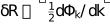 , which is typically a few tenths of an ångström. As a consequence, the analysis of experimental EXAFS can yield accurate local geometrical and vibrational properties, i.e. distances and their fluctuations
  ), once good approximations of the phase shifts and λk are known. Indeed, the availability of accurate theoretical phase shifts revolutionized the analysis of EXAFS (Rehr et al., 1991), obviating the need for empirical standards.
In the remainder of this chapter we summarize these theoretical advances, focusing on the key approximations that are needed for a quantitative theory of EXAFS. The derivation of the theory is presented in two sections: Section 2 describes the formal theory of XAS and Section 3 describes the real-space multiple-scattering expansion (Rehr & Albers, 2000; Lee & Pendry, 1975; Ashley & Doniach, 1975; Schaich, 1973) and describes the Rehr–Albers scattering-matrix method (Rehr & Albers, 1990) which enables efficient EXAFS calculations of EXAFS amplitudes, phase shifts and multiple-scattering contributions. The remaining Section 4 summarizes the current theory of many-body effects in EXAFS, including Debye–Waller factors (Vila et al., 2007; Crozier et al., 1988; Dalba & Fornasini, 1997; Frenkel & Rehr, 1993), the self-energy and mean free path (Beni & Platzman, 1976; Kas et al., 2007), and inelastic losses and multi-electron excitations (Campbell et al., 2002; Rehr et al., 1991; Natoli et al., 1990).
It is useful to begin the derivation with the formally exact many-body expression for XAS based on Fermi's golden rule (Campbell et al., 2002),  where |0〉 and |F〉 denote many-body ground and excited states with energies E0 and EF, respectively, and D is the interaction of the electrons with the X-ray field. As it stands, calculations of XAS using equation (2) are impractical, as they require a summation over the final many-body states |F〉 spanning many hundreds of eV. Thus, practical theories of EXAFS and XANES necessitate a reduction to an effective, independent particle theory, which builds in the key many-body effects (Sébilleau et al., 2018). Various methods have been proposed for this purpose (Sébilleau et al., 2018; Rehr & Albers, 2000; Rehr et al., 2009; Natoli et al., 1990). The approximations used in practice must also respect a number of physical considerations. Although the distinction between EXAFS and XANES is not precise, the crossover between these regimes roughly corresponds to the plasmon energy ωp. This energy characterizes the onset of the inelastic losses, and is typically about 10–20 eV in all materials at normal densities.
Accordingly, we define the EXAFS regime to be the part of the spectrum above about ωp of an absorption edge where inelastic losses are substantial. Conversely, we define the XANES regime as the part of the spectrum between the absorption edge and about ωp, where these effects are relatively small. Physically these losses can be described in terms of the electron self-energy Σ(E), which is both energy-dependent and complex-valued. The self-energy plays the role of a dynamically screened exchange–correlation potential for excited states, analogous to the static exchange–correlation potential of ground-state density-functional theory (DFT). The imaginary part of Σ(E) determines the mean free path of electrons in a material and becomes significant only in the EXAFS above ωp (see Fig. 1).
![[Figure 1]](/figures/qy5002fig1thm.gif)
|
Real and imaginary parts of the on-shell, quasi-particle self-energy relative to the value at the Fermi energy Δ(E) = Σ(E) − Σ(EF). Note that the self-energy is approximately real-valued and weakly energy-dependent at low energies, but becomes increasingly important and lossy beyond about 20–30 eV in the EXAFS regime. |
Consequently, EXAFS is a short-range order phenomenon and only probes the environment of an absorbing atom within a few mean free paths. The real part of Σ(E) is also important, generally increasing with energy corresponding to the steady decrease in the exchange–correlation interaction for unoccupied states, as shown in Fig. 1. This behaviour results in systematic shifts of the fine-structure peaks compared with those calculated with ground-state, for example DFT, potentials, and consequently significant phase-shift corrections. Hence, an accurate treatment of Σ(E) is crucial to a quantitative theory of EXAFS (Rehr & Albers, 2000; Rehr et al., 2009). Because Σ(E) is complex, the quasi-particle final-state Hamiltonian is non-Hermitian, and a scattering-based or Green's function-based framework is also preferable for theoretical calculations, as conventional approaches for ground-state or XANES calculations in terms of Gaussian or plane-wave orbitals become inapplicable for EXAFS. In contrast, inelastic losses are small or negligible in the XANES regime. There the mean free path is much longer and limited primarily by the core-hole lifetime Γ, a constant that depends on both the core level and the atomic number of the absorbing atom.
In contrast, XANES is sensitive to the long-range structure in a material, and its behaviour reflects the projected density of final states at an absorbing atom, including broadened band-structure or molecular-state features. The fact that ωp (which is typically 10–20 eV) is generally large compared with the Fermi energy EF (which is typically a few eV) at normal densities implies that kinetic energy effects dominate the physics in the EXAFS regime, with several consequences. In particular, chemical effects, as reflected in the Hartree potential, are relatively small, so full-potential effects are not crucial. However, self-consistency is important to determine EF and the partial occupation numbers in the occupied states. Secondly, the centrifugal barrier (i.e. turning point) for electron scattering is small compared with atomic dimensions and hence the scattering potential is largely spherical and atomic-like. Thus, the spherical `muffin-tin' potential is a good approximation for calculations of EXAFS amplitudes and phases. Likewise, scattering t-matrices tL = tlδmm′ are diagonal in an angular momentum basis L = (lm). Vibrational effects also become increasingly important in the EXAFS regime, leading to an exponential damping of the fine structure with increasing temperature and photoelectron energy. In contrast, vibrational effects are often negligible in XANES. Finally, the many-body reduction factor  reflects the importance of multi-electron excitations in EXAFS and depends on physics beyond the independent-particle approximation. Based on these considerations, the derivation of EXAFS theory consists of three steps (Campbell et al., 2002).
(i) The first step describes the production of the photoelectron by photoabsorption from a particular core state |c〉 of an absorbing atom at site R0 in terms of the embedded atomic X-ray absorption cross-section μ0(ω). This step is characterized by atomic dipole matrix elements 〈c|d|LR0〉 between the core level and the embedded atomic wavefunctions ZL(r) = RkL(r)YL(r), which must be calculated in the presence of a screened core hole. The operator d is the interaction with the X-ray field and is usually approximated by a dipole operator, and L = (κ, m) denotes the final-state total relativistic angular momentum J = L + S indices which build in spin degrees of freedom of the absorbing atom: κ = l for j = l − 1/2 and κ = −(l + 1) for j = l + 1/2. The final-state angular momentum l differs by ±1 from the initial core level lc due to dipole selection rules, and the higher angular momentum state l = lc + 1 dominates the cross section. Relativistic effects are essential in calculations of the embedded atomic cross sections in EXAFS due to the importance of spin–orbit coupling, and hence an all-electron Dirac relativistic approach (Ankudinov et al., 1996; Zhou et al., 2017; Ebert, 1996) is important for EXAFS, especially for heavy atoms. With the spherical approximation for the potentials, the matrix-element calculation separates into a radial integral and angular momentum factors obtained from Clebsch–Gordan coefficients.
(ii) The second step describes the propagation of the photoelectron within the solid, and leads to an independent-particle (or quasi-particle) approximation for the core-level XAS proportional to the atomic cross section: μ(1)(ω) = μ0(ω)[1 + χ(ω)]. For EXAFS, this step generally entails curved-wave electron-scattering processes with very large angular momenta l ≃ kR/2, typically of 20 or higher for EXAFS spectra up to about 1000 eV above the threshold (Gurman et al., 1986). Curved-wave effects yield substantial amplitude and phase corrections to plane-wave scattering amplitudes and are essential to a quantitative description of EXAFS. With an appropriate self-energy, this step also builds the mean-free path damping terms exp(−2R/λk). Finally, by averaging 〈μ(1)(ω)〉 over a thermal ensemble of atomic positions, vibrational damping and disorder can also be included in terms of path-dependent Debye–Waller factors  , as discussed further in Section 4 below.
(iii) The third step describes inelastic losses and multi-electron excitations that accompany the photoexcitation process. These excitations correspond to electron–hole pairs, plasmons etc. They include both intrinsic excitations due to the sudden creation of the core hole and extrinsic excitations due to losses during propagation, as well as interference terms (Campbell et al., 2002; Kas et al., 2016). Typically, these effects lead to corrections to the amplitudes and phases of the order of 10–20%. While not negligible and often treated phenomenologically in terms of a constant many-body amplitude factor  , these corrections can now be estimated. Formally, the treatment of these losses entails corrections to the independent-particle approximation. The net effect can be represented in terms of an energy-dependent particle–hole `spectral function' A(ω, ω′) defined in terms of a particle–hole Green's function, i.e. A(ω, ω′) ≃ |Im Gck(ω′)| for a given core level c and photoelectron wavenumber k. Typically, A(ω, ω′) consists of a sharp `quasi-particle' peak with a spread proportional to the inverse mean free path, together with additional satellite peaks at excitation energies which further broaden and shift the spectrum while conserving the overall spectral weight, as discussed in Section 3 below.
The combination of steps (i) and (ii) yields a quasi-particle approximation to the XAS μ(1)(ω), which provides a good basis for practical EXAFS simulations and analysis. In this approach, the EXAFS is calculated using an independent-particle Fermi's golden rule within the ΔSCF approximation, i.e. with the quasi-particle final states |f〉 obtained with the final-state Hamiltonian h′ = −½∇2 + ν′ + Σ(E), where the Hartree potential ν′ includes a screened core hole at the absorption site,
Since quadrupole terms are only important in the near-edge region, the interaction with the X-ray field d is often approximated by the dipole operator d = ɛ · r, where ɛ is the X-ray polarization, P is the projection operator onto unoccupied quasi-particle states in order to approximate orthogonality effects, and ɛi and ɛf are the energies of the initial and final quasi-particle states, respectively. For simplicity, below we will assume that d implicitly includes the projection operator P. Although X-ray polarization is implicit in equation (3), practical calculations are usually carried out using a polarization average, which is appropriate for most aperiodic and polycrystalline materials. Alternatively, one can define an absorption tensor  with Cartesian operators di and dj, which is useful for polarized materials and relativistic electron energy loss spectroscopy (Vinson et al., 2011). Compared with the many-body Fermi golden rule, the quasi-particle expression in equation (3) is a huge simplification. Nevertheless, the summation over quasi-particle states remains a computational bottleneck at EXAFS energies. Indeed, the summation can only be carried out practically at low energies (i.e. in the XANES regime) or for small or highly symmetric systems. On the other hand, most systems of interest lack perfect symmetry, and the presence of the core-hole potential spoils crystal translation symmetry even in periodic structures. Consequently, it turns out to be preferable to re-express the XAS μ(1)(ω) in terms of the photoelectron Green's function (or one-electron propagator) G(E) in real space, where E = ω + Ei is the photoelectron energy. Green's function methods are discussed in more detail in Kas, Rehr et al. (2024). As seen from the spectral representation of the Green's function
  , the Green's function itself implicitly sums over all single-particle final states, and its imaginary part corresponds to the density of states. Thus, the golden rule can be expressed exactly as a single nonlocal matrix element of G(E) for a given final state:
The Green's function approach turns out to be advantageous for practical calculations in many respects. As noted above, vibrational damping and disorder can be incorporated in μ(1) formally via a configurational average over the atomic positions R. This leads to path-dependent Debye–Waller factors, as discussed in more detail in Section 3 below. Since energy is just a parameter, this approach parallelizes naturally (Zhou et al., 2017) and can be applied to spectra over a broad energy range applicable to both EXAFS and XANES. Finally, the addition of inelastic losses in step (iii) can be incorporated ex post facto as an energy-dependent convolution over the excitation energies ω′, yielding a convenient representation of the many-body XAS as (Kas et al., 2016; Rehr et al., 1991)
The derivation of the EXAFS equation is based on the MS path expansion for the Green's function, which is the real-space analogue of the Korringa–Kohn–Rostoker (KKR) approach for band structure in k-space. This approach is referred to as real-space multiple scattering (RSMS) theory, as summarized below (Rehr & Albers, 2000; Lee & Pendry, 1975; Ashley & Doniach, 1975). An analysis given by Schaich (1973) shows how the approach interpolates between single scattering and full multiple scattering as the number of terms in the expansion is increased. The starting point is a formal separation of the potential into contributions from `scattering potentials' vR localized on each atomic site R,
Here, v′(r) is the Hartree potential of the final state, including a screened core hole, and Σ(E) is the energy-dependent self-energy of the photoelectron. In the EXAFS regime, these potentials can be regarded as spherical, i.e. with a `muffin-tin approximation'. With this separation and the approximation of local spherical symmetry at each site, the propagator is also separable (Rehr & Albers, 2000),  where r and r′ are in cells centred at R and R′, and ZL(r) is the regular solution of the radial Dirac equation (Ankudinov et al., 1996; Zhou et al., 2017; Ankudinov & Rehr, 1997) for angular momentum L and energy E. Thus, the expression for XAS can be reduced to a calculation of atomic-like dipole matrix elements ML = 〈c|d|R0L〉 and matrix elements of the propagator G(r, r′, E) in an angular momentum and site basis |LR〉, as given by
Here, L denotes the angular momentum variables, while (interchangeably) the photoelectron energy is characterized by its energy E and the photon frequency ω or wavenumber k. The relativistic generalization (Ankudinov & Rehr, 1997) is almost identical in form, but with relativistic angular momentum indices L = (κ, m) in order to include spin-dependence (Ankudinov & Rehr, 1997). Relativistic corrections are essential in the production step to incorporate spin–orbit interactions, which can be large in the atomic cores and important for the transition-matrix elements and L-shell EXAFS in heavy atoms. However, relativity only has weak effects on the propagation of the photoelectron in the EXAFS regime, where spin is conserved and a nonrelativistic scattering theory that conserves spin is applicable. In the FEFF code (see Kas, Vila et al., 2024), relativistic effects and spin–orbit corrections of the initial states are treated to high accuracy using a relativistic all-electron Dirac–Fock prescription (Ankudinov & Rehr, 1997). The calculation of the scattering potentials at each site simplifies for electrons even of moderate energy above about 10 eV, where the scattering depends strongly on the density in the core of an atom. Thus, spherical symmetry of the muffin-tin approximation is usually an excellent approximation in the EXAFS regime. However, self-consistency is important to obtain accurate estimates of the threshold (or Fermi energy E0) and fractional occupation numbers of the valence states.
Within RSMS theory the propagator can be separated as GLRL′R′(E) = Gc + Gsc, i.e. in terms of intra-atomic contributions from the central atom Gc and multiple-scattering contributions from the surroundings Gsc. As a result, the XAS can be factored exactly into an atomic-like background and scattering terms as thus defining the X-ray absorption fine structure (XAFS) χ(ω). Therefore, the spectral behaviour of the XAS depends on a relatively smooth atomic-like (i.e. embedded atom) background absorption μ0(ω) and the fine structure χ(ω) due to scattering:
  . Since the atomic cross section μ0(ω) varies smoothly with energy, these results are consistent with the experimental definition of the normalized EXAFS χ(ω) = [μ(ω) − μ0(ω)]/Δμ0, where Δμ0 is the jump in the experimental atomic background absorption at the threshold. Formally, the propagator matrix GLL′(E) can be expressed as a sum over all MS paths that a photoelectron can take going away from the absorbing atom and back, and thus gives rise to the real-space multiple-scattering path expansion
 where G0 is set to zero when R = R′ and
  is the scattering T-matrix. Here, the successive terms represent single, double, triple etc. scattering processes, and δl and δl′ are partial wave phase shifts. As noted above, this expansion converges rapidly for EXAFS with of the order of 102 paths. Remarkably, the sum sometimes converges reasonably well in XANES, particularly in isotropic systems or in systems with a short core-hole lifetime as in deep core levels of heavy elements. However, due to the large matrix dimension of GLR,L′R′(E), calculations with path expansion can only be carried out for a few low-order MS paths (Di Cicco, 1995). To overcome this bottleneck, an efficient approximation was devised based on the Rehr–Albers (RA) scattering-matrix formalism (Rehr & Albers, 1990). The RA approach is based on a separable representation of the free propagator G0(E) and yields curved-wave calculations of the effective scattering amplitude feff. The MS expansion can be reformulated as a full multiple scattering (FMS) expression or as a sum over MS paths as in equation (1), as outlined below.
Although the path-expansion method sometimes converges poorly for XANES, the geometric series for Gsc can be summed formally to all orders via matrix inversion, yielding the FMS Green's function (Rehr & Albers, 2000; Ankudinov et al., 1998)
Since the matrices in this equation are represented in a site and angular momentum basis |L, R〉, the rank of the matrix to be inverted is N(l + 1)2, where N is the number of atoms in the cluster and l is the maximum angular momentum of an expansion in generalized spherical harmonics. However, matrix inversion is computationally expensive for large order, since the time taken to invert typically scales as the cube of the rank of the matrix. Therefore, practical calculations limit the cluster size and truncate the sum over angular momentum states. Nevertheless, cluster sizes of up to ∼1000 atoms can be treated on modern computers, which is adequate for approximate calculations of XANES in most materials. In addition, reasonable accuracy requires lmax ≃ kmaxRmt + locc, where locc is the largest angular momentum of the occupied states and  . For this reason, one can safely set the maximum angular momentum in XANES to about 4 or 5. In the intermediate energy regime, Lanczos techniques can be used (Jorissen et al., 2010; Ankudinov et al., 2002) and calculations can be performed efficiently on parallel computers (Rehr et al., 2009). However, at higher energies in the EXAFS regime, matrix inversion of such large-rank matrices becomes computationally impractical. Although equation (11) with the quasi-particle approximation builds in self-energy effects, a serious limitation of FMS calculations with equation (11) is the difficulty of including Debye–Waller factors. As a rough approximation, however, one can replace G0 with G0 =
  , which builds in the correct Debye–Waller factors for near-neighbour scattering, but ignores displacement–displacement correlations at higher order.
The FMS Green's function can also be used to calculate the total electron density (Iwasawa et al., 2017), which is useful in the self-consistency loop. The density is given by an integral over the local density of states, i.e.  where EF is the Fermi energy. At finite temperature a Fermi function must be introduced with a chemical potential fixed to enforce charge neutrality. Thus, the Green's function and its expansion in a scattering-state basis naturally replaces the orbitals used in standard density-functional theory codes. As a consequence, the ground-state density and potential with a Kohn–Sham Hamiltonian can be solved self-consistently (Van Bokhoven & Lamberti, 2016). Self-consistency of the densities and potentials in EXAFS is important for determining the Fermi energy and is crucial for XANES calculations. For example, if an initial guess of the Fermi energy is too high, edge and pre-edge peaks are missing. Self-consistency and shifts in the Fermi energy due to disorder also play a role in chemical shifts, which are important in systems with multiple, physically unique absorbing sites, such as nanoparticles on a support.
One of the major advances in EXAFS theory for practical calculations has been the development of the Rehr–Albers scattering-matrix (RA) approach (Rehr & Albers, 1990), which overcomes the serious difficulties of quantitative, high-order multiple-scattering calculations. The RA approach uses energy-independent rotation matrices and a rapidly convergent separable representation of the propagator in which the angular and energy-dependent parts of the propagator are treated separately, approximated independently via a rapidly converging series. In addition, this representation permits a direct connection to the EXAFS equation, with the simple replacement of the scattering amplitude in the SSL equation with an effective scattering amplitude feff. In particular, the site and angular momentum matrix elements of the free propagator can be written in a separable, dimensionless form as (Rehr & Albers, 1990)
Here, γ is an expansion index and Y and  are generalized spherical harmonics which converge rapidly in powers of 1/(k|R − R′|). This separation allows one to sum all contributions to a given path involving angular momentum (L, γ), yielding an expression for the scattering factor at each atom in terms of low-order matrices
  , which define the effective scattering amplitudes feff in equation (1) from equations (21) and (22) in Rehr & Albers (1990), i.e.
  for an n-leg path where Fi are the scattering matrices (indices suppressed) at site i, ρi = kRi is the spherical wave factor from path leg Ri and M is a termination matrix. As a consequence of the product structure of equation (14), MS paths become strongly damped with increasing k and R, even while the number of MS paths increases with increasing path length (Fig. 2). The magnitude and phase of each path is determined by the scattering amplitudes and phase shifts for a given atom and reflect the inner-shell atomic structure characteristic of that atom. Curved-wave corrections are substantial in feff, with corrections to the phase of order l(l + 1)/kR for each partial wave contribution. The RA separable representation provides an enormous speed-up in calculations of EXAFS, enabling practical calculations for arbitrary systems. Moreover, only a small subset of MS paths (typically of the order of 102) are important, and the most important terms can be selected by filtering all possible paths using approximate calculations (for example with plane-wave scattering amplitudes). Consequently, this approach allows one to converge the MS path expansion to high accuracy in the EXAFS regime, thus providing a practical solution of the multiple-scattering formulation of EXAFS. This last step completes our derivation of the EXAFS equation and its approximation to high accuracy.
![[Figure 2]](/figures/qy5002fig2thm.gif)
|
EXAFS χ(k) and its phase-corrected Fourier transform |
 = FT[
= FT[ show the radii of the first eight shells of atoms.
In this final section, we briefly discuss how the many-body effects in the theory can now be calculated from first principles without any adjustable parameters (Rehr et al., 2009). These include quasi-particle effects (self-energies and mean free paths), vibrational damping and inelastic losses due to multi-electron excitations. A discussion of advanced methods for treating these effects is given in Kas, Rehr et al. (2024).
The effects of thermal and structural disorder lead to strong exponential damping of the fine structure with increasing energy and thus are of crucial importance in EXAFS (Vila et al., 2007; Crozier et al., 1988; Dalba & Fornasini, 1997; Frenkel & Rehr, 1993). This damping is dominated by an EXAFS Debye–Waller factor  , where
  is the mean-square relative displacement (MSRD) of the near-neighbour bonds and typically varies inversely with the local bond strength. More precisely, the MSRD or
  for a path R is defined by the thermal average,
 where R and
  are the instantaneous and mean path lengths, respectively. Higher moments of the pair distribution function are sometimes important, especially in temperature-dependent investigations of XAS. One of the key theoretical developments in the theory of vibrational damping in XAFS is the cumulant expansion, which yields an efficient parameterization of thermal and configurational disorder (Crozier et al., 1988; Dalba & Fornasini, 1997; Frenkel & Rehr, 1993) in terms of a few moments or cumulants σ(n) of the pair distribution function. Formally, this expansion yields a complex Debye–Waller factor
  in Gsc, which contributes both to the amplitude and the phase of the XAFS.
The thermal contributions to σ2 can often be fitted to a correlated Debye model (Rehr & Albers, 2000). Corrections to the dominant second cumulant involve anharmonicity. The first cumulant σ(1) is the net thermal expansion, while the third cumulant σ(3) characterizes the asymmetry or skew of the pair distribution function. These odd-order contributions can strongly affect the phase of the fine structure, especially at high energy, giving a contribution 2kσ(1) − 4k3σ(3)/3 + …. Relations between the cumulants have also been derived (Vila et al., 2007; Crozier et al., 1988; Dalba & Fornasini, 1997; Frenkel & Rehr, 1993) which show, to leading order in the anharmonicity coupling parameter k3, that σ(1) ∝ σ2(T) and σ(3) is related to σ2(T). The third cumulant is important in bond-distance determinations and in interpretations of thermal expansion. If the third cumulant is neglected in the analysis, the bond distances obtained from EXAFS typically appear unphysically short. Improved treatments of XAFS Debye–Waller factors have recently been developed which go beyond the correlated Debye approximation. They are described in more detail in de Groot (2024).
Ab initio calculations of Debye–Waller factors are now also possible (Rehr et al., 2009). In the quasi-harmonic approximation, the average can be computed formally as a sum over vibrational or phonon eigenmodes. However, it is more efficient to avoid eigenmode calculations and recast the expression for  in terms of the projected vibrational density of states ρR(ω) or VDOS using a Debye integral (Rehr et al., 1978),
 where μR is the reduced mass for path R. Calculations of ρR(ω) can be obtained using Lanczos methods, without the necessity of determining the eigenmodes explicitly. Fig. 3 shows typical results obtained with this approach. Further details of this advanced method are given in Kas, Rehr et al. (2024). The effects of static disorder can be included by an additive term
  , which can be estimated, for example, by a configurational average with DFT/MD calculations of structure.
![[Figure 3]](/figures/qy5002fig3thm.gif)
Two crucial differences between ground-state electronic structure and excited states in core-level spectra are (i) the need for an energy-dependent self-energy Σ(E) to replace the exchange–correlation functional as in DFT and (ii) the need for a screened core hole. The self-energy is essentially a dynamically screened Hartree–Fock exchange interaction, which is the analogue of the exchange–correlation potential Vxc of DFT. The real part of the self-energy varies by about 10 eV over XAS energies comparable to the DFT potential for occupied states and slowly turns off in the classical limit, while the imaginary part is negative and increases to about 5 eV at high energies. The imaginary part accounts for (extrinsic) final-state broadening and can be expressed in terms of an inelastic mean free path (IMFP; Van Bokhoven & Lamberti, 2016) and the core-hole lifetime Γ,
Values of Γ for all atoms and edges are tabulated and are therefore obtained from a lookup table; for heavy atoms and deep core levels they are typically several eV, but for light atoms and shallow levels they are much smaller than an eV. The real part of Σ(E) accounts for systematic shifts in XAS peak positions compared with those calculated with DFT, leading to a stretching of the energy scale at low energies by about 10%. One of the key developments in practical XAS codes is an efficient algorithm for the calculation of Σ(E) based on the GW approximation of Hedin (Koide et al., 2014). For example, FEFF and several other XAS codes by default typically use a local density approximation for Σ(E) based on the plasmon-pole dielectric constant. This approximation works well for EXAFS and reduces to the ground-state exchange–correlation potential near the threshold. However, the plasmon-pole self-energy tends to overestimate losses in the XANES. This deficiency can be overcome by using a many-pole model, as discussed by Kas et al. (2007, 2022).
In addition to the mean free path, satellites in the spectral function due to inelastic losses are responsible for the many-body amplitude factor  and can be incorporated in terms of a convolution of the spectrum with an effective spectral function (Campbell et al., 2002; Kas et al., 2016) as in equation (3). The effect of the convolution in this exact expression for the XAS is to average the one-electron XAS over the spectral function, so that μ = 〈μ0〉(1 + 〈χR〉). Since the atomic absorption μ0 is smoothly varying, the average 〈μ0〉 ≈ μ0 has little effect. Here, χR ≃ Im[exp(2ikr)] is the XAFS contribution for a given path. Averaging χR over the quasi-particle peak then gives rise to a damping factor exp(−2R/λk) from the mean free path, while the broad satellite structure in the spectral function gives an additional factor denoted by
  which is only weakly dependent on R,
Since the fine structure for a given path of length R has an oscillatory behaviour ∼exp(2ikR), the main effect is a many-body reduction in the XAFS amplitude (Rehr et al., 1978), χR ≃  , where
This quantity has both real and imaginary parts, contributing an amplitude-reduction factor  as well as a phase Φ and is roughly constant over the EXAFS regime, as illustrated in Fig. 4. Since the phase shift is nearly constant, it does not contribute a significant error in distance determinations. Physically, the mean free path term is dominated by extrinsic losses, while
  is dominated by intrinsic losses. A more detailed analysis shows that this factorization is most appropriate at high energies in the EXAFS regime. Near the edge, one expects interference terms to suppress these effects and hence the energy dependence of these contributions to be important.
![[Figure 4]](/figures/qy5002fig4thm.gif)
|
EXAFS many-body amplitude-reduction ( |
 ) and phase (
 is nearly constant and is about 0.9 over a wide range of energies.
Funding information
This work was supported primarily through the US DOE Office of Science BES Grant DE-FG02-97ER45623; recent extensions are supported by the Theory Institute for Materials and Energy Spectroscopies (TIMES) at SLAC, which is funded by the US DOE Office of Science BES, Division of Materials Sciences and Engineering under contract DE-AC02-76SF00515.
References
 Ahmed, S. I., Aquilanti, G., Novello, N., Olivi, L., Grisenti, R. & Fornasini, P. (2013). J. Chem. Phys. 139, 164512.Google ScholarAnkudinov, A. L., Bouldin, C. E., Rehr, J. J., Sims, J. & Hung, H. (2002). Phys. Rev. B, 65, 104107.Google ScholarAnkudinov, A. L., Ravel, B., Rehr, J. J. & Conradson, S. D. (1998). Phys. Rev. B, 58, 7565–7576.Google ScholarAnkudinov, A. L. & Rehr, J. J. (1997). Phys. Rev. B, 56, R1712–R1716.Google ScholarAnkudinov, A. L., Zabinsky, S. I. & Rehr, J. J. (1996). Comput. Phys. Commun. 98, 359–364.Google ScholarAshley, C. A. & Doniach, S. (1975). Phys. Rev. B, 11, 1279–1288.Google ScholarBeni, G. & Platzman, P. M. (1976). Phys. Rev. B, 14, 1514–1518.Google ScholarBinsted, N., Campbell, J. W., Gurman, S. J. & Stephenson, P. C. (1991). EXCURVE. SERC Daresbury Laboratory, Warrington, United Kingdom.Google ScholarBourke, J. D. (2024). Int. Tables Crystallogr. I, ch. 6.7, 758–763
.Google ScholarBourke, J. D., Chantler, C. T. & Joly, Y. (2016). J. Synchrotron Rad. 23, 551–559.Google ScholarCampbell, L. W., Hedin, L., Rehr, J. J. & Bardyszewski, W. (2002). Phys. Rev. B, 65, 064107.Google ScholarChantler, C. T. & Creagh, D. C. (2024). Int. Tables Crystallogr. I, ch. 2.1, 21–40
.Google ScholarCrozier, E. D., Rehr, J. J. & Ingalls, R. (1988). X-ray Absorption: Principles, Applications, Techniques of EXAFS, SEXAFS, and XANES, edited by D. C. Koningsberger & R. Prins, pp. 373–442. New York: WIley.Google ScholarDalba, G. & Fornasini, P. (1997). J. Synchrotron Rad. 4, 243–255.Google ScholarDi Cicco, A. (1995). Physica B, 208–209, 125–128.Google ScholarEbert, H. (1996). Rep. Prog. Phys. 59, 1665–1735.Google ScholarFeiters, M. C., Strange, R. W. & Binstead, N. (2024). Int. Tables Crystallogr. I, ch. 6.5, 744–751
.Google ScholarFilipponi, A., Di Cicco, A. & Natoli, C. R. (2024). Int. Tables Crystallogr. I, ch. 6.12, 787–790
.Google ScholarFilipponi, A., Natoli, C. R. & Di Cicco, A. (2024). Int. Tables Crystallogr. I, ch. 6.11, 782–786
.Google ScholarFrenkel, A. I. & Rehr, J. J. (1993). Phys. Rev. B, 48, 585–588.Google ScholarGroot, F. de (2024). Int. Tables Crystallogr. I, ch. 2.4, 55–59
.Google ScholarGurman, S. J., Binsted, N. & Ross, I. (1986). J. Phys. C Solid State Phys. 19, 1845–1861.Google ScholarIwasawa, Y., Asakura, K. & Tada, M. (2017). XAFS Techniques for Catalysts, Nanomaterials, and Surfaces. Cham: Springer.Google ScholarJorissen, K., Rehr, J. J. & Verbeeck, J. (2010). Phys. Rev. B, 81, 155108.Google ScholarKas, J. J., Rehr, J. J. & Curtis, J. B. (2016). Phys. Rev. B, 94, 035156.Google ScholarKas, J. J., Rehr, J. J. & Vila, F. D. (2024). Int. Tables Crystallogr. I, ch. 2.10, 107–113
.Google ScholarKas, J. J., Sorini, A. P., Prange, M. P., Cambell, L. W., Soininen, J. A. & Rehr, J. J. (2007). Phys. Rev. B, 76, 195116.Google ScholarKas, J. J., Vila, F. D. & Rehr, J. J. (2024). Int. Tables Crystallogr. I, ch. 6.8, 764–769
.Google ScholarKoide, A., Fujikawa, T. & Ichikuni, N. (2014). J. Electron Spectrosc. Relat. Phenom. 195, 375–381.Google ScholarKoningsberger, D. C. & Prins, R. (1986). X-ray Absorption: Principles, Applications, Techniques of EXAFS, SEXAFS and XANES. New York: Wiley.Google ScholarLee, P. A. & Pendry, J. B. (1975). Phys. Rev. B, 11, 2795–2811.Google ScholarNatoli, C. R. M., Benfatto, C., Brouder, C., López, M. F. R. & Foulis, L. (1990). Phys. Rev. B, 42, 1944–1968.Google ScholarRehr, J. J. & Albers, R. C. (1990). Phys. Rev. B, 41, 8139–8149.Google ScholarRehr, J. J. & Albers, R. C. (2000). Rev. Mod. Phys. 72, 621–654.Google ScholarRehr, J. J., Kas, J. J., Prange, M. P., Sorini, A. P., Takimoto, Y. & Vila, F. (2009). C. R. Phys. 10, 548–559.Google ScholarRehr, J. J., Stern, E. A., Martin, R. L. & Davidson, E. R. (1978). Phys. Rev. B, 17, 560–565.Google ScholarRehr, J. J., Mustre de Leon, J., Zabinsky, S. I. & Albers, R. C. (1991). J. Am. Chem. Soc. 113, 5135–5140.Google ScholarSayers, D. E., Stern, E. A. & Lytle, F. W. (1971). Phys. Rev. Lett. 27, 1204–1207.Google ScholarSchaich, W. L. (1973). Phys. Rev. B, 8, 4028–4032.Google ScholarSébilleau, D., Hatada, K. & Ebert, H. (2018). Multiple Scattering Theory for Spectroscopies. Cham: Springer.Google ScholarStern, E. A. (1974). Phys. Rev. B, 10, 3027–3037.Google ScholarStumm von Bordwehr, R. (1989). Ann. Phys. Fr. 14, 377–465.Google ScholarVan Bokhoven, J. A. & Lamberti, C. (2016). X-ray Absorption and X-ray Emission Spectroscopy: Theory and Applications. Chichester: John Wiley & Sons.Google ScholarVila, F. D., Rehr, J. J., Rossner, H. H. & Krappe, H. J. (2007). Phys. Rev. B, 76, 014301.Google ScholarVinson, J., Rehr, J. J., Kas, J. J. & Shirley, E. L. (2011). Phys. Rev. B, 83, 115106.Google ScholarZabinsky, S. I., Rehr, A., Ankudinov, A., Albers, R. C. & Eller, M. J. (1995). Phys. Rev. B, 52, 2995–3009.Google ScholarZhou, Z., Kas, J. J., Rehr, W. C. & Ermler, W. C. (2017). At. Data Nucl. Data Tables, 114, 262–280.Google Scholar
Ahmed, S. I., Aquilanti, G., Novello, N., Olivi, L., Grisenti, R. & Fornasini, P. (2013). J. Chem. Phys. 139, 164512.Google ScholarAnkudinov, A. L., Bouldin, C. E., Rehr, J. J., Sims, J. & Hung, H. (2002). Phys. Rev. B, 65, 104107.Google ScholarAnkudinov, A. L., Ravel, B., Rehr, J. J. & Conradson, S. D. (1998). Phys. Rev. B, 58, 7565–7576.Google ScholarAnkudinov, A. L. & Rehr, J. J. (1997). Phys. Rev. B, 56, R1712–R1716.Google ScholarAnkudinov, A. L., Zabinsky, S. I. & Rehr, J. J. (1996). Comput. Phys. Commun. 98, 359–364.Google ScholarAshley, C. A. & Doniach, S. (1975). Phys. Rev. B, 11, 1279–1288.Google ScholarBeni, G. & Platzman, P. M. (1976). Phys. Rev. B, 14, 1514–1518.Google ScholarBinsted, N., Campbell, J. W., Gurman, S. J. & Stephenson, P. C. (1991). EXCURVE. SERC Daresbury Laboratory, Warrington, United Kingdom.Google ScholarBourke, J. D. (2024). Int. Tables Crystallogr. I, ch. 6.7, 758–763
.Google ScholarBourke, J. D., Chantler, C. T. & Joly, Y. (2016). J. Synchrotron Rad. 23, 551–559.Google ScholarCampbell, L. W., Hedin, L., Rehr, J. J. & Bardyszewski, W. (2002). Phys. Rev. B, 65, 064107.Google ScholarChantler, C. T. & Creagh, D. C. (2024). Int. Tables Crystallogr. I, ch. 2.1, 21–40
.Google ScholarCrozier, E. D., Rehr, J. J. & Ingalls, R. (1988). X-ray Absorption: Principles, Applications, Techniques of EXAFS, SEXAFS, and XANES, edited by D. C. Koningsberger & R. Prins, pp. 373–442. New York: WIley.Google ScholarDalba, G. & Fornasini, P. (1997). J. Synchrotron Rad. 4, 243–255.Google ScholarDi Cicco, A. (1995). Physica B, 208–209, 125–128.Google ScholarEbert, H. (1996). Rep. Prog. Phys. 59, 1665–1735.Google ScholarFeiters, M. C., Strange, R. W. & Binstead, N. (2024). Int. Tables Crystallogr. I, ch. 6.5, 744–751
.Google ScholarFilipponi, A., Di Cicco, A. & Natoli, C. R. (2024). Int. Tables Crystallogr. I, ch. 6.12, 787–790
.Google ScholarFilipponi, A., Natoli, C. R. & Di Cicco, A. (2024). Int. Tables Crystallogr. I, ch. 6.11, 782–786
.Google ScholarFrenkel, A. I. & Rehr, J. J. (1993). Phys. Rev. B, 48, 585–588.Google ScholarGroot, F. de (2024). Int. Tables Crystallogr. I, ch. 2.4, 55–59
.Google ScholarGurman, S. J., Binsted, N. & Ross, I. (1986). J. Phys. C Solid State Phys. 19, 1845–1861.Google ScholarIwasawa, Y., Asakura, K. & Tada, M. (2017). XAFS Techniques for Catalysts, Nanomaterials, and Surfaces. Cham: Springer.Google ScholarJorissen, K., Rehr, J. J. & Verbeeck, J. (2010). Phys. Rev. B, 81, 155108.Google ScholarKas, J. J., Rehr, J. J. & Curtis, J. B. (2016). Phys. Rev. B, 94, 035156.Google ScholarKas, J. J., Rehr, J. J. & Vila, F. D. (2024). Int. Tables Crystallogr. I, ch. 2.10, 107–113
.Google ScholarKas, J. J., Sorini, A. P., Prange, M. P., Cambell, L. W., Soininen, J. A. & Rehr, J. J. (2007). Phys. Rev. B, 76, 195116.Google ScholarKas, J. J., Vila, F. D. & Rehr, J. J. (2024). Int. Tables Crystallogr. I, ch. 6.8, 764–769
.Google ScholarKoide, A., Fujikawa, T. & Ichikuni, N. (2014). J. Electron Spectrosc. Relat. Phenom. 195, 375–381.Google ScholarKoningsberger, D. C. & Prins, R. (1986). X-ray Absorption: Principles, Applications, Techniques of EXAFS, SEXAFS and XANES. New York: Wiley.Google ScholarLee, P. A. & Pendry, J. B. (1975). Phys. Rev. B, 11, 2795–2811.Google ScholarNatoli, C. R. M., Benfatto, C., Brouder, C., López, M. F. R. & Foulis, L. (1990). Phys. Rev. B, 42, 1944–1968.Google ScholarRehr, J. J. & Albers, R. C. (1990). Phys. Rev. B, 41, 8139–8149.Google ScholarRehr, J. J. & Albers, R. C. (2000). Rev. Mod. Phys. 72, 621–654.Google ScholarRehr, J. J., Kas, J. J., Prange, M. P., Sorini, A. P., Takimoto, Y. & Vila, F. (2009). C. R. Phys. 10, 548–559.Google ScholarRehr, J. J., Stern, E. A., Martin, R. L. & Davidson, E. R. (1978). Phys. Rev. B, 17, 560–565.Google ScholarRehr, J. J., Mustre de Leon, J., Zabinsky, S. I. & Albers, R. C. (1991). J. Am. Chem. Soc. 113, 5135–5140.Google ScholarSayers, D. E., Stern, E. A. & Lytle, F. W. (1971). Phys. Rev. Lett. 27, 1204–1207.Google ScholarSchaich, W. L. (1973). Phys. Rev. B, 8, 4028–4032.Google ScholarSébilleau, D., Hatada, K. & Ebert, H. (2018). Multiple Scattering Theory for Spectroscopies. Cham: Springer.Google ScholarStern, E. A. (1974). Phys. Rev. B, 10, 3027–3037.Google ScholarStumm von Bordwehr, R. (1989). Ann. Phys. Fr. 14, 377–465.Google ScholarVan Bokhoven, J. A. & Lamberti, C. (2016). X-ray Absorption and X-ray Emission Spectroscopy: Theory and Applications. Chichester: John Wiley & Sons.Google ScholarVila, F. D., Rehr, J. J., Rossner, H. H. & Krappe, H. J. (2007). Phys. Rev. B, 76, 014301.Google ScholarVinson, J., Rehr, J. J., Kas, J. J. & Shirley, E. L. (2011). Phys. Rev. B, 83, 115106.Google ScholarZabinsky, S. I., Rehr, A., Ankudinov, A., Albers, R. C. & Eller, M. J. (1995). Phys. Rev. B, 52, 2995–3009.Google ScholarZhou, Z., Kas, J. J., Rehr, W. C. & Ermler, W. C. (2017). At. Data Nucl. Data Tables, 114, 262–280.Google Scholar

