|
International
Tables for Crystallography Volume I X-ray absorption spectroscopy and related techniques Edited by C. T. Chantler, F. Boscherini and B. Bunker © International Union of Crystallography 2024 |
International Tables for Crystallography (2024). Vol. I. ch. 9.1, pp. 1059-1067
https://doi.org/10.1107/S1574870721003785 Chapter 9.1. X-ray absorption spectroscopy definitionsaSchool of Physics, University of Melbourne, Parkville, Victoria 3010, Australia The definitions given in this chapter were developed by a Working Group of the Commission on XAFS of the International Union of Crystallography (IUCr), and now form part of the IUCr's Online Dictionary of Crystallography at https://dictionary.iucr.org . The aims of the project were to identify ambiguous or incorrect usage of XAFS expressions in the scientific literature and to propose currently used definitions that could eventually be improved through open debate. Keywords: X-ray absorption spectroscopy (XAS); X-ray absorption fine structure (XAFS); absorption edge; absorption coefficient; mass attenuation coefficient; linear attenuation coefficient; cross section; extended X-ray absorption fine structure (EXAFS); multi-electron excitations; absorption threshold; selection rules; secondary-process detection; X-ray emission spectroscopy (XES); inelastic X-ray scattering (IXS); X-ray excited optical luminescence (XEOL); high-energy-resolution fluorescence detection (HERFD). |
More than 2000 papers concerning X-ray absorption techniques are published every year. In 2009, the Commission on XAFS (CXAFS) of the International Union of Crystallography (IUCr) created a Working Group on XAFS Nomenclature to identify ambiguous or incorrect usage of XAFS expressions in the scientific literature. Our objective was not to formulate `perfect' definitions, but to propose currently used definitions that could eventually be improved through open debate. To ensure a clear connection between CXAFS and IXAS (The International X-ray Absorption Society), both communities were represented in the membership of the Working Group: P. Glatzel (CXAFS and IXAS, Germany), C. T. Chantler (CXAFS, Australia), A. M. Molenbroek (CXAFS, Denmark), M. Newville (IXAS, USA), J. Rehr (Theory, USA), Tsun-Kong Sham (IXAS, Theory, Canada) and R. Strange (Biology, UK). The proposed definitions were then reviewed by the seven members of the Advisory Committee: C. Brouder (France), D. Creagh (Australia), J. Garcia (Spain), C. Natoli (Italy), J. Penner-Hahn (USA), R. Sarangi (USA) and E. I. Solomon (USA). The members of Working Group and the Advisory Committee were experimentalists and/or theoreticians having a physical or chemical or chemical–physical background. These different backgrounds resulted in the description of the same phenomenon with different approaches and different terminology. For example, the item `absorption threshold', which is currently used by all XAFS experts, was considered tricky to define by nearly all Working Group and Advisory Committee members. Consequently, several definitions, reflecting theoretical or experimental approaches, have been proposed. The definitions below now form part of the IUCr's Online Dictionary of Crystallography at https://dictionary.iucr.org .
Definition: X-ray absorption spectroscopy (XAS) is a technique for measuring the linear absorption coefficient μ(E) of a substance as a function of the incident photon energy E in the X-ray regime. This technique is element- and orbital-specific and determines the local atomic and electronic structure of matter. XAS conventionally includes techniques of XAFS, which in turn includes both XANES and EXAFS. An XAS spectrum may also be obtained using fluorescence, electron yield and scattering processes indirectly (i.e. without directly measuring the absorption of X-rays).
See also: Extended X-ray absorption fine structure (EXAFS) (Section 8 ); X-ray absorption fine structure (XAFS) (Section 2).
Definition: X-ray absorption fine structure (XAFS) is the modulation of the absorption coefficient at and above an absorption edge of an element due to its chemical state and the structure of its immediate surroundings. XAFS is commonly divided into the `near-edge' region (XANES or NEXAFS) which extends to ∼50 eV above the absorption edge and the `extended' region (EXAFS) that displays oscillations in the absorption coefficient extending from ∼50 eV above the absorption edge.
The distinction in usage for XANES (X-ray absorption near-edge spectroscopy) and NEXAFS (near-edge X-ray absorption fine structure) is historical. Generally, XANES is used for hard X-ray edges (∼1 keV and above), while NEXAFS is used for soft X-ray edges. Spectral features that occur before the rise of the main absorption edge are referred to as `pre-edge' features, associated with transitions to bound states.
The extended X-ray absorption fine structure (EXAFS) region contains modulation of the absorption coefficient that can be interpreted in terms of photoelectron scattering.
In relation to the (linear) absorption coefficient, the XAFS is defined as  where μ(E) is the linear absorption coefficient (measured or calculated) and μ0(E) a smooth background as calculated in the absence of scattering or fit (e.g. a spline fit) etc.
The XAFS is often practically defined as where μ(E) is either measured or calculated and Δμ(E) is either the jump in absorption at the edge or a reference background that simulates the edge and a smooth atomic-like background [see International Tables for Crystallography, Volume C (2006), Sections 4.2.3
(Creagh, 2006a), 4.2.4
(Creagh & Hubbell, 2006) and 4.2.6
(Creagh, 2006b)].
where μ(E) is either measured or calculated and Δμ(E) is either the jump in absorption at the edge or a reference background that simulates the edge and a smooth atomic-like background [see International Tables for Crystallography, Volume C (2006), Sections 4.2.3
(Creagh, 2006a), 4.2.4
(Creagh & Hubbell, 2006) and 4.2.6
(Creagh, 2006b)].
See also: Absorption coefficient (Section 4); absorption edge (Section 3); extended X-ray absorption fine structure (EXAFS) (Section 8).
Definition: An absorption edge is the energy at which there is a sharp rise (discontinuity) in the (linear) absorption coefficient of X-rays by an element, which occurs when the energy of the photon corresponds to the energy of a shell of the atom (K, LI, LII, LIII etc., corresponding to the creation of electron holes in the 1s, 2s, 2p1/2, 2p3/2 etc. atomic subshells).
Associated with this transition is the absorption threshold (Section 11) characterized by the corresponding energy E0.
Examples: For gallium: λK = 1.1958 Å, λLI = 9.5446 Å, λLII = 10.8414 Å, λLIII = 11.1038 Å. For arsenic: λK = 1.0448 Å, λLI = 8.1195 Å, λLII = 9.1187 Å, λLIII = 9.3617 Å.
See also: Absorption threshold (Section 11); Fermi level (Section 10); Section 4.2.3
of International Tables for Crystallography, Volume C (Creagh, 2006a).
Definition: The X-ray mass absorption coefficient, [μ/ρ](E) or [μ/ρ]pe(E), follows the Beer–Lambert law for a parallel beam of photons of energy E in which the transmitted photon intensity I(t) is related to the incoming photon intensity I0 such that where t is the thickness of a uniform sample and the density ρ is usually given in g cm−3. The mass absorption coefficient is labelled as such because the absorption exponent is linear in the mass per unit area ρt, otherwise known as the integrated column density through a sample. Use of μ for this term is not recommended because it is highly ambiguous and dimensionally inconsistent. The subscript pe emphasizes that this is the photoelectric mass absorption coefficient rather than the mass attenuation coefficient, which of course does not obey the Beer–Lambert law. Note also that it is rare for SI units to be used in texts on absorption spectroscopy.
The X-ray linear absorption coefficient, μ(E) or μpe(E), follows I(t) = I0 exp(−μt), with units of length−1 (conventionally cm−1). μ is the product of the density ρ (g cm−3) and the mass absorption coefficient [μ/ρ] (cm2 g−1).
It is sometimes convenient to describe the decrease in the beam intensity in terms of the absorption length: the thickness of the material in question at which the beam intensity has fallen to (1/e) of the incident beam intensity; that is, when μt = 1, or when 63% of the flux is absorbed. In soft X-ray spectroscopy one absorption length can be some tens of nanometres, while typical values in hard X-ray spectroscopy are micrometres or millimetres. μ depends on the energy, E, of the incoming photon and the elemental composition of the sample. The XAFS technique measures the variations in μ(E).
Historical note: Early references are Bouguer (1729), Lambert (1760) and Beer (1852).
Note that all these preceded the discovery of X-rays, and were based on visible optics. From Johnston (2001), p. 18: `The logarithm of the quantity of light received is inversely [meaning multiplied by −1] proportional to the thickness (Bouguer's law) and to the chemical composition (Beer's law) of an absorbing material, and the quantity of light to the cosine of the angle of incidence of the illuminated sample (Lambert's law)'.
See also: linear attenuation coefficient (Section 6); mass attenuation coefficient (Section 5).
Definition: The mass attenuation coefficient in cm2 g−1 can be written as a sum of separated photoelectric mass absorption coefficients [μ/ρ]pe and coherent [σ/ρ]coh and incoherent [σ/ρ]incoh scattering contributions: or equivalently
 It is recommended that [μ/ρ]tot be used to distinguish this from the mass absorption coefficient [μ/ρ]pe (Section 4) as they are both commonly presented as [μ/ρ].
The last two contributions are angle-dependent. Note that while absorptive processes are linear (see absorption coefficient, Section 4), coherent scattering (and incoherent scattering) are not linear and hence the attenuation coefficient does not obey the Beer–Lambert law.
The mass attenuation coefficient is conventionally given by the symbol [μ/ρ] = σ/(uA), where σ is the cross section in barns per atom (1 barn = 10−24 cm2), u is the atomic mass unit and A is the relative atomic mass of the target element (i.e. in a.m.u.; the mass relative to 12 for carbon-12).
Where a material is composed of i separate layers, the total absorption is given by the sum Sometimes mass fractions are used as an approximation for a mixture, assuming that each atomic scatterer is independent.
See also: Absorption coefficient; cross section; linear attenuation coefficient.
Definition: The linear attenuation coefficient μ(E), or preferably μtot(E) in cm−1, is a measure of the photon beam attenuation by a material due to absorption and scattering processes and hence differs from the absorption coefficient, which is a measure of beam attenuation due to absorption processes only.
μtot(E) is given by where ρ is the density of the material in g cm−3.
History: Coefficients for converting between these units are given by many authors (Cohen & Taylor, 1987; Creagh & McAuley, 1992; Chantler, 1995).
See also: Absorption coefficient (Section 4); mass attenuation coefficient (Section 5).
Definition: Cross section is a measure of the probability of interaction between the incident photons with the material via photoabsorption or scattering processes. It is the effective area that will yield a transition process for a perpendicularly incident flux of one particle per unit area. The total interaction cross section σtot is usually represented as a sum over the individual photon interaction cross sections (per atom): (following standard tabulations) or
  [as used in International Tables for Crystallography, Volume C (2006)].
The components are, in order, the coherent scattering cross section, the incoherent scattering cross section, the photoelectric absorption cross section, the nuclear (coherent) pair-production cross section, the nuclear incoherent (or triplet) cross section and the photonuclear cross section. These cross sections are conventionally given in barns per atom (1 barn = 10−28 m2 = 100 fm2). For most crystallographic applications the energy range of interest is 3–200 keV, where the photoelectric, coherent and incoherent cross sections are dominant, in which case equations (4) and (5) from Section 5 are fully appropriate. (Note that many texts and publications use `Compton scattering' and `inelastic scattering' for incoherent scattering; and many use `elastic scattering' for coherent scattering. These are not quite synonymous, but are often used interchangeably. Specifically, coherent scattering includes Rayleigh scattering, Bragg–Laue scattering and thermal diffuse scattering, which have coefficients varying by many orders of magnitude; and also note especially that thermal diffuse scattering is often categorized as either elastic scattering or inelastic scattering. See other sections of this volume for further details.) The three corresponding nuclear cross sections are minor across the range 3–200 keV, but become dominant from 1–10 MeV. (See also nuclear Thomson scattering, which is very minor across all energy ranges.) It should be noted that some of the cross sections can be in phase. Where there is significant coherence, the scattering amplitudes add vectorially, and this can contribute more than the summation of the cross sections. When coherences are high, partitioning into separate cross sections is no longer appropriate.
The atomic form factor can be represented as the sum of the angle-dependent component, and the anomalous real and imaginary energy-dependent components (the latter two are also referred to as the dispersive or resonant contributions):  The imaginary component of the atomic form factor Im(f) = f′′ (in electrons per atom) = f2 (used by Henke et al., 1993) is directly related to the atomic photoabsorption cross section given as σpe or μpe in different references:
  where re is the Bohr electron radius, c is the speed of light and h is Planck's constant (Chantler, 2000). The Kramers–Kronig relation expresses causality and determines the real component of the (atomic) form factor in terms of the imaginary component:
 where E = ℏω is the photon energy,
  is the energy above the electron binding energy of the intermediate (bound or continuum) state, and P represents the Cauchy principal value. Fundamental constants and conversion factors are given (for example) by Chantler (1995).
In measurements as in XAFS, the flux is often measured before, I(0), and after, I(t), the sample of thickness t (in cm). The Beer–Lambert law suggests: In practice fluxes must be corrected for background signal, normalization and scattering, following
 where the subscript s refers to the intensity measured with a sample in the path of the beam and the subscript b refers to the intensity measured without a sample in the path of the beam (correcting, for example, for air attenuation and window effects). The subscript u refers to the upstream detector or monitor, while the subscript d refers to the downstream detector. D refers to the dark current or the electronic noise for either the upstream or downstream detectors. This formula does not explicitly correct for the scattering components, and is valid for the absorption cross section [e.g. Chantler et al. (2001), de Jonge et al. (2005)].
To derive the mass absorption coefficient (or equivalent linear coefficients) including backscattering and correcting for harmonics, further corrections are sometimes important. For central X-ray energies, the photoelectric absorption is often dominant and hence this can be a useful approximation. However, many measurements of XAFS use fluorescence, and the normalization is further complicated by self-absorption, and in particular there is no clean I(t) measurement.
See also: Absorption coefficient (Section 4); linear attenuation coefficient (Section 6); mass attenuation coefficient (Section 5).
Definition: Extended X-ray absorption fine structure (EXAFS) is the portion of XAFS spectra well above an absorption edge – typically starting ∼50 eV above the absorption edge. EXAFS can be interpreted as due to scattering of the photoelectron ejected from the absorbing atom by the photoelectric effect. The photoelectron will scatter from surrounding atoms and a portion of it will return coherently to the absorbing atom still in its excited state (before the hole in the core electron level has been refilled). The amplitude of the scattered photoelectron at the absorbing atom will modify the probability of creating a photoelectron, and so the probability of X-ray absorption.
EXAFS can be modelled with the EXAFS equation:
 where k is the photoelectron wavenumber, E is the X-ray energy, E0 is the energy of the absorption edge and me is the electron mass. Note that k is really the `photoelectron momentum index' and differs from the physical momentum (see Rehr & Albers, 2000). The normalized value of χ(k) is dimensionless, because the (standard) expression above has F in units of 1/k (i.e. length). Other definitions for F being dimensionless (as a form factor or scattering amplitude) have (kR)2 in the denominator to maintain consistency of units.
The sum in the EXAFS equation is most simply over shells of atoms of a particular type j and at similar distances from the origin of the initial photoelectron. Then Nj is the coordination number, Rj is the interatomic distance, and  represents the mean-square disorder in the distance for the jth shell. Fj is the photoelectron (back)scattering amplitude and Φj(k) is the corresponding (back)scattering phase for the jth atomic shell.
  is an amplitude-reduction factor accounting for relaxation of the absorbing atom due to the presence of the empty core level and multi-electron excitations. λj(k) is the photoelectron inelastic mean free path, which has a strong dependence upon k, and has values in the range of 1 to 100 Å over the XAFS regime.
The crude approximation of Φj(k) ≈ −2a0k (a0 is the Bohr radius) works for many systems and causes peaks for a particular shell in the Fourier transform of χ(k) to be shifted ∼0.5 Å below the actual interatomic distance. Both Fj(k) and Φj(k) depend upon the atomic number Z of the scattering atom, and have nonlinear dependence on k.
The  term is often referred to as the EXAFS isotropic or effective Debye–Waller factor, including thermal vibration and static disorder. The sum over shells and use of
  in the standard EXAFS equation can be generalized to an integral over the partial pair distribution function g(R) in which one atom is always the absorbing atom.
The sum in the EXAFS equation can be generalized to be over photoelectron scattering paths instead of shells of atoms. This formalism allows the inclusion of multiple scattering paths for the photoelectron, which can give important contributions in many systems. The interpretation of many components of the EXAFS equation are then slightly modified, so that Rj is then half the path length, and Fj(k) and Φj(k) become the (multiple) scattering amplitude and phase shift for the entire path.
The EXAFS equation allows the numerical determination of the local structural parameters Nj and Rj, and  knowing the scattering amplitude Fj(k) and Φj(k) for a small number (typically 1 to 10) of shells or paths. It breaks down at low k (the XANES region) as the 1/k term increases, λj(k) increases, the disorder terms do not strongly dampen the EXAFS, and the EXAFS picture of single-particle scattering is no longer a good approximation.
History: The history is reviewed by Lytle (1999) and Stumm von Bordwehr (1989). EXAFS scattering theory: Sayers et al. (1971) developed a quantitative parametrization of the central EXAFS region from the Kronig short-range-order theory. Their EXAFS equation has become standard for much current work; an extensive review (Rehr & Albers, 2000) covers significant developments of the scattering perspective, especially in terms of theoretical calculations for EXAFS used in quantitative analysis and the inclusion of spherical outgoing photoelectron waves. This is central to many of the chapters of this volume, hence many further details are provided across this volume.
See also: Absorption edge (Section 3); multi-electron excitations (Section 9); X-ray absorption fine structure (XAFS) (Section 2).
Definition: The assignment of a spectral feature as multi-electron excitation depends on the level of theory, i.e. how the electronic states are described. A general definition can be stated as follows: If there exists no one-electron operator that gives a matrix element unequal to zero between the reference state and an excited state, the latter must be multi-electron in nature. The reference state is in most cases the ground state of the system. Some spectral features in XAFS are commonly denoted multi-electron spectral features and referred to as `shake-up', `shake-down' and `shake-off' excitations. The amplitude-reduction factor  in the EXAFS equation is included to consider multi-electron excitations.
The Fermi level is also known as the Fermi energy. Two definitions are proposed; the first concentrates on a general formal definition while the second focuses on theoretical convergence for use by XAS users and programs.
(1) In an independent-particle approach to the description of a fermion system (i.e. particles obeying Pauli's exclusion principle), the Fermi level is the energy value lying between the highest occupied level and the lowest unoccupied level, usually defined as their average. If the energy-level spectrum is a continuum (or almost a continuum) the three levels coincide. In a many-body approach, the Fermi level is the energy necessary for adding or subtracting a particle from the system. This definition encompasses the non-interacting case.
Like all energy states, the Fermi level is measured from the vacuum level. In XAS spectra the Fermi level is below or at the first allowed transition, depending on the system and the absorption edge.
(2) In X-ray absorption spectroscopy (XAS), the Fermi energy dictates possible pre-edge features and explains the possibility or impossibility of open scattering channels adding to the near-edge structure. When theoretical formalisms compute the reference Fermi energy, crucial for the XANES region, the convergence of the complete quantum-mechanical system is an absolute requirement, whether atomic, cluster, or periodic boundary conditions are used. The lack of convergence for theoretical formalisms can at this time lead to systematic errors in the determination of the Fermi energy and corresponding pre-edge structure of the order of 1–10 eV in the X-ray regime and should be considered carefully as this affects the interpretation of XAFS and XANES.
Definition: In the literature there is much confusion, even in modern papers, concerning the definition of the absorption threshold. The absorption threshold should indicate the first allowed transition in an absorption spectrum. Many definitions are used in common parlance. In practice, they yield very different values in common analysis. We present and comment upon the most commonly used:
(1) The energy at which the open continuum channel for photoelectric absorption becomes available, producing a continuum photoelectron. This has an exact value from theory, subject to convergence issues (see Fermi energy, Section 10).
(2) A (higher) energy at which a secondary (two-step) photoionization channel becomes energetically possible (`shake-up', `shake-off'; see multi-electron excitations, Section 9); in general this is more challenging to compute theoretically, and is less easily separable in conventional XAS experimental data, but can be investigated incisively in resonant inelastic X-ray scattering (RIXS), X-ray fluorescence spectroscopy (XFS) and related spectroscopies.
(3) Experimentally, the absorption threshold is sometimes defined as the inflection point in the first derivative of the experimental edge spectrum (the point of maximum slope on the rising edge for a particular subshell); this is a convenient marker for experimentalists but (a) it is source- (beamline-) and bandwidth-dependent; (b) it is affected by pre-edge structure and the Fermi level (Section 10) owing to potential contributions from bound–bound channels; and (c) the experimental edge may contain two or more such inflection points, and the determination depends upon instrumental resolution.
(4) Experimentally, the absorption threshold is sometimes defined as the point exactly 50% of the jump ratio from the background absorption (from other shells, including scattering) to the peak absorption coefficient of the XANES spectrum, defined either by the clear maximum or by the smooth line representing the background to be subtracted in the determination of χ(k) [see X-ray absorption fine structure (XAFS) (Section 2)]; this is a problematic measure, since it depends upon beamline-dependent effects [(3) above], and a wide variety of different predictions of the `true background level' μ0 above the edge (see XAFS).
(5) Computationally, an absorption threshold is defined for XAFS fitting (and occasionally XANES fitting) as E0, which is considered either as an arbitrary fitting coefficient or the starting point of the k transform, which in turn generates the Fourier transform for the XAFS structure χ(k); as the latter, it should be defined as per (1) above; as the former, this will often yield a function of r and errors in E0 of the order of 10 eV or more, which can result in bond-length errors of the order of 0.02 Å or more.
Both computationally and experimentally, the energy axis is often not defined except in a relative sense, so that inconsistencies between the implementations of these definitions are at this point relatively common.
Definition: Selection rules refer to the conditions under which the quantum mechanical transition matrix elements for a process are different from zero (and hence the process is allowed), due to constraints derived from the symmetry properties of the states involved and those of the transition operator. Since the set of symmetries for a quantum system form a group, one can classify the transformation properties of the states (eigenfunctions) and the transition operator according to the irreducible representations of the group itself. In such a case the Wigner–Eckart theorem dictates the conditions for the process to occur (see any standard text on group theory).
In the most common example for transition theory, if we classify the system states (eigenfunctions) according to the full rotation group and expand the transition operator in multipoles as  then the angular part of the matrix element will be proportional to
  where J = L + S (j = l + s) in a Russell–Saunders coupling scheme. Therefore, from addition of angular momenta and the fact that the transition operator does not affect the spin, we derive
  which provide a set of selection rules in this case. Jf = 0 to Ji = 0 transitions are forbidden by the above rule, since the lowest multipole operator (dipole radiation) is a vector (l = 1; ml = ±1, 0). Conditions on symmetries include those relating to parity, orbital angular momentum quantum number, spin quantum number, (multi-)polarity of the photon field causing the transition, polarization of the photon field causing the transition etc. For summation of angular momenta, such as for molecular levels, for hyperfine structure including nuclear angular momenta or for coupling within Russell–Saunders, j–j or mixed schemes, a vector-triangle summation must generally be followed as above, which provides most selection rules. Different polarizations have different selection rules, so an edge or XAFS spectrum using (polarized) synchrotron radiation will have a different shape and structure depending upon whether the incident X-ray field is linearly polarized, circularly polarized or partially polarized.
Electric dipole transition is only the dominant lowest-order transition coupling, tending to be dominant for low energies or low-Z elements (even in compounds). However, for such elements as transition metals, higher-order terms including electric quadrupole radiation and magnetic dipole radiation become stronger and have complementary selection rules for atomic, molecular and condensed-matter quantum systems. Higher-order radiation is crucial for the interpretation of Kα spectra satellites, for continuum photoionization amplitudes and XAFS and absorption edges, and for pre-edge features.
History: In widespread tabulations of coefficients of photoelectric cross sections for atomic systems [see International Tables for Crystallography, Volume C (2006), Sections 4.2.3
(Creagh, 2006a), 4.2.4
(Creagh & Hubbell, 2006) and 4.2.6
(Creagh, 2006b); FFAST in the USA (Chantler, 1995, 2000; Chantler et al., 2005); and XCOM (Scofield, 1973; Berger & Hubbell, 1987, 1999; Hubbell, 1969; Hubbell et al., 1986, 1974; or Hubbell & Øverbø, 1979)], some authors have clarified the significance in the computations of dipole, higher-order or `all-order' computations.
Definition: It is experimentally often favourable to use methods other than transmission detection to obtain the linear attenuation coefficient μpe(E) or μ(E). This requires recording a signal that arises from a process that occurs with a probability that is proportional to μpe. This can be the direct photoemission channel. The core hole that is created in the photoabsorption process decays with a lifetime τ. The energy that is released in the decay or secondary process can either be carried by an outgoing electron (e.g. the Auger effect, yielding potential for Auger electron detection or spectroscopy) or a photon (fluorescence). Weak processes, such as excitations of phonons, are neglected here. Detection of the outgoing electrons of all kinetic energies is called total electron yield (TEY) measurement or spectroscopy and that of all photons of all energies is called total fluorescence yield (TFY) measurement or spectroscopy.
If the secondary-process detection is realized with an energy- or wavelength-dispersive instrument it is possible to further discriminate between the decay channels, e.g. only the Kα fluorescence lines. The techniques are then referred to as partial yield detection. An instrumental resolution in the secondary-process detection that is of the order of the core-hole lifetime broadening or even below may enable one to observe resonance phenomena in the decay channel (e.g. resonant inelastic X-ray scattering, resonant Auger spectroscopy).
Detection of the intensity of a secondary process as a function of the incident energy that is tuned across an absorption edge may be proportional to μpe to sufficient accuracy. This assumption is the prerequisite for all secondary-process detection schemes that aim to measure the absorption cross section. This may be a good approximation when the dominant decay channel is chosen for the secondary-process detection, for example, the fluorescence lines in the hard X-ray range when not detected in high-resolution mode (fluorescence-detected absorption spectroscopy).
Electron yield detection is surface-sensitive owing to the short mean free path of the electrons.
Definition: Detection of the X-rays that are emitted from the sample with an instrumental energy bandwidth that is of the order of the core-hole lifetime broadening. XES can be performed by taking advantage of various modes of core-hole creation, the most common being photoexcitation, but ion/electron bombardment and radioactive isotopes (K-capture decay) have also been used. XES following photoexcitation is a second-order optical process that is theoretically treated using the Kramers–Heisenberg equation. XES thus includes high-energy-resolution X-ray fluorescence spectroscopy (e.g. Kβ spectroscopy), resonant X-ray emission spectroscopy (RXES) and resonant inelastic X-ray scattering (RIXS).
In the hard X-ray regime, instruments based on perfect crystal Bragg optics are used to analyse the emitted X-rays. Common geometries are Rowland or von Hamos. Applications of XES include electronic structure studies (e.g. chemical characterization) but also spectral sharpened XAFS [see high-energy-resolution fluorescence detection (HERFD), Section 17] and range-extended EXAFS. The instrumentation for XES provides the possibility to perform X-ray Raman spectroscopy.
Definition: A scattered photon may transfer some of its energy to the sample. The transferred energy can excite the atomic lattice (phonons), single electrons or an ensemble of electrons (collective excitations). IXS considers the energy and the momentum of an incoming and a scattered (emitted) photon. The difference is the energy and momentum transfer, respectively. An IXS process can occur after nonresonant or resonant X-ray excitation.
X-ray Raman scattering (XRS) is nonresonant inelastic scattering of X-rays from core electrons. It is analogous to Raman scattering, which is a widely used tool in optical spectroscopy, with the difference being that the wavelengths of the exciting photons fall in the X-ray regime and the corresponding excitations are from deep-core electrons. The process is in principle analogous to X-ray absorption, but the energy transfer plays the role of the X-ray photon energy in X-ray absorption. XRS can be used to measure absorption edges of low-Z elements using hard X-rays.
The cross section of nonresonant inelastic X-ray scattering is  with (dσ/dΩ)Th being the Thomson cross section, which signifies that the scattering is that of electromagnetic waves from electrons. The physics of the system under study is buried in the dynamic structure factor S(q, E), which is a function of momentum transfer q and energy transfer E. The dynamic structure factor contains all nonresonant electronic excitations, including not only the core-electron excitations observed in XRS but also e.g. plasmons (the collective fluctuations of valence electrons) and Compton scattering. At small momentum transfer q = k − k′ the XRS signal is proportional to the X-ray absorption cross section. A large momentum transfer allows access to transition-matrix elements of higher order, e.g. quadrupole transitions.
Resonant inelastic X-ray scattering (RIXS) or resonant X-ray emission spectroscopy (RXES) is frequently used to study the electronic structure. It requires the incident energy to be close to an absorption edge. It is possible to distinguish between two cases of resonant scattering:
(1) A fluorescence line can be measured after resonant excitation. This is referred to as resonant X-ray emission spectroscopy (RXES) or direct RIXS. In a one-electron picture one could refer to this process as a spectator decay: the photoexcited electron remains in a bound, previously unfilled orbital and an electron from a filled orbital decays to fill the core hole.
(2) The photoexcited electron decays to fill the core hole (participator decay). The modification of the Coulomb potential due to photoexcitation and decay may give rise to an excited final state, i.e. the system does not return to its ground state. The final state excitation can be local (e.g. d–d excitation), including the ligand (charge-transfer excitation) or higher coordination spheres and/or the long-range order of the system (plasmons, magnons, orbitons). The technique is often referred to as (indirect) resonant inelastic X-ray scattering (RIXS).
The general usage in the literature does not strictly distinguish between the two cases.
RIXS/RXES is a second-order process that is theoretically described (Kotani & Shin, 2001) by the Kramers–Heisenberg equation: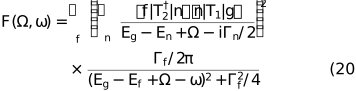 with the ground (g), intermediate (n) and final (f) state electron wavefunctions, their energies Eg, En and Ef, the lifetime broadenings Γn and Γf (full width at half maximum) as well as the transition operators T1 and T2 for absorption and emission of an X-ray photon, respectively.
  is the conjugate transpose of T2. The difference between the incident and emitted X-ray energy is the energy transfer Ω − ω. The Kramers–Heisenberg equation is often simplified by neglecting interference effects, multi-electron excitations and/or the angular dependence.
RIXS allows spectra to be recorded broadened only by Γf and not Γn. In most cases it holds that Γn > Γf and RIXS thus enables the observation of spectral features with sharper line width than for an absorption spectrum. The method requires that the instrumental energy bandwidth is sufficiently small.
See also: X-ray absorption spectroscopy (XAS) (Section 1); high-energy-resolution fluorescence detection (HERFD) (Section 17).
Definition: X-ray excited optical luminescence is an X-ray photon in/optical photon out technique. It concerns the conversion of the X-ray energy absorbed by the system to optical photons, often involving multi-step cascade processes. XEOL is often used together with XANES/NEXAFS to provide site specificity, which in turn can help reveal the electronic structure and optical properties of the system of interest.
XEOL can be studied in the time domain if a pulsed X-ray source is used. It is possible to use the time structure of a synchrotron-radiation source to study the decay dynamics of a system via various optical de-excitation pathways. This technique is called time-resolved X-ray excited optical luminescence.
See also: Secondary-process detection (Section 13); XANES/NEXAFS (Section 2).
Definition: High-energy-resolution fluorescence detection (HERFD) requires measurement of the fluorescence lines with an instrumental energy bandwidth of the order of or below the core-hole lifetime broadening of the absorption edge (see XES, Section 14). A HERFD-XAS experiment measures the intensity of the fluorescence line as a function of the incident energy (fluorescence-detected XAS, secondary-process detection) and may yield spectral features with line broadenings that are smaller than the lifetime broadening of the core-hole excited state of absorption. HERFD has to be understood within the framework of resonant X-ray emission spectroscopy (RXES). A HERFD-XAS spectrum may present a good approximation to the absorption cross section with reduced lifetime broadening. This is, however, not necessarily the case and has to be carefully verified.
See also: Inelastic X-ray scattering (IXS) (Section 15); secondary-process detection (Section 13).
Acknowledgements
We are especially grateful to Isabella Ascone for her direct leadership of this endeavour over several years as Chair of the Commission on XAFS, and would like to thank all our colleagues for their valuable contributions. The Working Group is indebted to the members of the Advisory Committee listed at the start of this chapter, and to F. Neese, F. de Groot, A. Kotani and S. Huotari for their advice on some of the definitions. We also thank Y. Joly for stimulating discussions and Brian McMahon for his help in finalising the versions of the definitions given in the Online Dictionary.
References
 Beer, A. (1852). Ann. Phys. Chem. 162, 78–88.Google ScholarBerger, M. J. & Hubbell, J. H. (1987). XCOM: Photo cross sections on a personal computer. Report NBSIR 87-3597. National Institute of Standards and Technology, Gaithersburg, USA.Google ScholarBerger, M. J. & Hubbell, J. H. (1999). XCOM: Photon Cross Sections Database, Web Version 1.2. National Institute of Standards and Technology, Gaithersburg, USA. http://physics.nist.gov/xcom
.Google ScholarBouguer, P. (1729). Essai d'Optique sur la Graduation de la Lumière. Paris: Jombert.Google ScholarChantler, C. T. (1995). J. Phys. Chem. Ref. Data, 24, 71–643.Google ScholarChantler, C. T. (2000). J. Phys. Chem. Ref. Data, 29, 597–1056. Google ScholarChantler, C. T., Olsen, K., Dragoset, R. A., Chang, J., Kishore, A. R., Kotochigova, S. A. & Zucker, D. S. (2005). X-Ray Form Factor, Attenuation and Scattering Tables (version 2.1). National Institute of Standards and Technology, Gaithersburg, USA. http://physics.nist.gov/ffast
. [Originally published as Chantler (2000) and Chantler (1995).]Google ScholarChantler, C. T., Tran, C. Q., Barnea, Z., Paterson, D., Cookson, D. J. & Balaic, D. X. (2001). Phys. Rev. A, 64, 062506.Google ScholarCohen, E. R. & Taylor, B. N. (1987). Rev. Mod. Phys. 59, 1121–1148. Google ScholarCreagh, D. C. (2006a). International Tables for Crystallography, Volume C, Mathematical, Physical and Chemical Tables, 1st online edition, edited by E. Prince, Section 4.2.3, pp. 213–220, https://doi.org/10.1107/97809553602060000592
.Google ScholarCreagh, D. C. (2006b). International Tables for Crystallography, Volume C, Mathematical, Physical and Chemical Tables, 1st online edition, edited by E. Prince, Section 4.2.6, pp. 241–258, https://doi.org/10.1107/97809553602060000592
.Google ScholarCreagh, D. C. & Hubbell, J. H. (2006). International Tables for Crystallography, Volume C, Mathematical, Physical and Chemical Tables, 1st online edition, edited by E. Prince, Section 4.2.4, pp. 220–229, https://doi.org/10.1107/97809553602060000592
.Google ScholarCreagh, D. C. & McAuley, W. J. (1992). International Tables for Crystallography, Volume C, Mathematical, Physical and Chemical Tables, 1st ed., edited by A. J. C. Wilson, ch. 4.2. Dordrecht: Kluwer.Google Scholarde Jonge, M. D., Tran, C. Q., Chantler, C. T., Barnea, Z., Dhal, B. B., Cookson, D. J., Lee, W.-K. & Mashayekhi, A. (2005). Phys. Rev. A, 71, 032702.Google ScholarHenke, B. L., Gullikson, E. M. & Davis, J. C. (1993). At. Data Nucl. Data Tables, 54, 181–342.Google ScholarHubbell, J. H. (1969). Phonon cross sections, attenuation coefficients, and energy absorption coefficients from 10 keV to 100 GeV. Report NRDS-NBS29. National Institute of Standards and Technology, Gaithersburg, USA.Google ScholarHubbell, J. H., Gerstenberg, H. M. & Saloman, E. B. (1986). Bibliography of photon total cross section (attenuation coefficient) measurements 10 eV to 13.5 GeV. Report NBSIR 86-3461. National Institute of Standards and Technology, Gaithersburg, USA.Google ScholarHubbell, J. H., McMaster, W. H., Del Grande, N. K. & Mallett, J. H. (1974). International Tables for X-ray Crystallography, Vol. IV, edited by J. A. Ibers & W. C. Hamilton, pp. 47–70. Birmingham: Kynoch Press.Google ScholarHubbell, J. H. & Øverbø, I. (1979). J. Phys. Chem. Ref. Data, 8, 69–106.Google ScholarInternational Tables for Crystallography (2006). Volume C, Mathematical, Physical and Chemical Tables, 1st online edition, edited by E. Prince, https://doi.org/10.1107/97809553602060000103
.Google ScholarJohnston, S. F. (2001). A History of Light and Colour Measurement. London: CRC Press.Google ScholarKotani, A. & Shin, S. (2001). Rev. Mod. Phys. 73, 203–246.Google ScholarLambert, J. H. (1760). Photometria sive Mensura et Gradibus Luminus, Colorum et Umbrae. Augsburg.Google ScholarLytle, F. W. (1999). J. Synchrotron Rad. 6, 123–134.Google ScholarRehr, J. J. & Albers, R. C. (2000). Rev. Mod. Phys. 72, 621–654.Google ScholarSayers, D. E., Stern, E. A. & Lytle, F. W. (1971). Phys. Rev. Lett. 27, 1204–1207.Google ScholarScofield, J. H. (1973). Theoretical photoionization cross sections from 1 to 1500 keV. Report UCRL-51326. Lawrence Livermore National Laboratory, Livermore, USA.Google ScholarStumm von Bordwehr, R. (1989). Ann. Phys. Fr. 14, 377–465.Google Scholar
Beer, A. (1852). Ann. Phys. Chem. 162, 78–88.Google ScholarBerger, M. J. & Hubbell, J. H. (1987). XCOM: Photo cross sections on a personal computer. Report NBSIR 87-3597. National Institute of Standards and Technology, Gaithersburg, USA.Google ScholarBerger, M. J. & Hubbell, J. H. (1999). XCOM: Photon Cross Sections Database, Web Version 1.2. National Institute of Standards and Technology, Gaithersburg, USA. http://physics.nist.gov/xcom
.Google ScholarBouguer, P. (1729). Essai d'Optique sur la Graduation de la Lumière. Paris: Jombert.Google ScholarChantler, C. T. (1995). J. Phys. Chem. Ref. Data, 24, 71–643.Google ScholarChantler, C. T. (2000). J. Phys. Chem. Ref. Data, 29, 597–1056. Google ScholarChantler, C. T., Olsen, K., Dragoset, R. A., Chang, J., Kishore, A. R., Kotochigova, S. A. & Zucker, D. S. (2005). X-Ray Form Factor, Attenuation and Scattering Tables (version 2.1). National Institute of Standards and Technology, Gaithersburg, USA. http://physics.nist.gov/ffast
. [Originally published as Chantler (2000) and Chantler (1995).]Google ScholarChantler, C. T., Tran, C. Q., Barnea, Z., Paterson, D., Cookson, D. J. & Balaic, D. X. (2001). Phys. Rev. A, 64, 062506.Google ScholarCohen, E. R. & Taylor, B. N. (1987). Rev. Mod. Phys. 59, 1121–1148. Google ScholarCreagh, D. C. (2006a). International Tables for Crystallography, Volume C, Mathematical, Physical and Chemical Tables, 1st online edition, edited by E. Prince, Section 4.2.3, pp. 213–220, https://doi.org/10.1107/97809553602060000592
.Google ScholarCreagh, D. C. (2006b). International Tables for Crystallography, Volume C, Mathematical, Physical and Chemical Tables, 1st online edition, edited by E. Prince, Section 4.2.6, pp. 241–258, https://doi.org/10.1107/97809553602060000592
.Google ScholarCreagh, D. C. & Hubbell, J. H. (2006). International Tables for Crystallography, Volume C, Mathematical, Physical and Chemical Tables, 1st online edition, edited by E. Prince, Section 4.2.4, pp. 220–229, https://doi.org/10.1107/97809553602060000592
.Google ScholarCreagh, D. C. & McAuley, W. J. (1992). International Tables for Crystallography, Volume C, Mathematical, Physical and Chemical Tables, 1st ed., edited by A. J. C. Wilson, ch. 4.2. Dordrecht: Kluwer.Google Scholarde Jonge, M. D., Tran, C. Q., Chantler, C. T., Barnea, Z., Dhal, B. B., Cookson, D. J., Lee, W.-K. & Mashayekhi, A. (2005). Phys. Rev. A, 71, 032702.Google ScholarHenke, B. L., Gullikson, E. M. & Davis, J. C. (1993). At. Data Nucl. Data Tables, 54, 181–342.Google ScholarHubbell, J. H. (1969). Phonon cross sections, attenuation coefficients, and energy absorption coefficients from 10 keV to 100 GeV. Report NRDS-NBS29. National Institute of Standards and Technology, Gaithersburg, USA.Google ScholarHubbell, J. H., Gerstenberg, H. M. & Saloman, E. B. (1986). Bibliography of photon total cross section (attenuation coefficient) measurements 10 eV to 13.5 GeV. Report NBSIR 86-3461. National Institute of Standards and Technology, Gaithersburg, USA.Google ScholarHubbell, J. H., McMaster, W. H., Del Grande, N. K. & Mallett, J. H. (1974). International Tables for X-ray Crystallography, Vol. IV, edited by J. A. Ibers & W. C. Hamilton, pp. 47–70. Birmingham: Kynoch Press.Google ScholarHubbell, J. H. & Øverbø, I. (1979). J. Phys. Chem. Ref. Data, 8, 69–106.Google ScholarInternational Tables for Crystallography (2006). Volume C, Mathematical, Physical and Chemical Tables, 1st online edition, edited by E. Prince, https://doi.org/10.1107/97809553602060000103
.Google ScholarJohnston, S. F. (2001). A History of Light and Colour Measurement. London: CRC Press.Google ScholarKotani, A. & Shin, S. (2001). Rev. Mod. Phys. 73, 203–246.Google ScholarLambert, J. H. (1760). Photometria sive Mensura et Gradibus Luminus, Colorum et Umbrae. Augsburg.Google ScholarLytle, F. W. (1999). J. Synchrotron Rad. 6, 123–134.Google ScholarRehr, J. J. & Albers, R. C. (2000). Rev. Mod. Phys. 72, 621–654.Google ScholarSayers, D. E., Stern, E. A. & Lytle, F. W. (1971). Phys. Rev. Lett. 27, 1204–1207.Google ScholarScofield, J. H. (1973). Theoretical photoionization cross sections from 1 to 1500 keV. Report UCRL-51326. Lawrence Livermore National Laboratory, Livermore, USA.Google ScholarStumm von Bordwehr, R. (1989). Ann. Phys. Fr. 14, 377–465.Google Scholar

