|
International
Tables for Crystallography Volume I X-ray absorption spectroscopy and related techniques Edited by C. T. Chantler, F. Boscherini and B. Bunker © International Union of Crystallography 2024 |
International Tables for Crystallography (2024). Vol. I. ch. 2.14, pp. 139-146
https://doi.org/10.1107/S1574870722001604 Chapter 2.14. Thermal effects on EXAFSaDepartment of Physics, University of Trento, Via Sommarive 14, 38123 Trento-Povo, Italy The effects of weak atomic vibrations on extended X-ray absorption fine-structure (EXAFS) spectra are discussed from a phenomenological perspective. Attention is focused on single-scattering paths and in particular on the first-shell contribution, in terms of bond expansion, parallel and perpendicular mean-square relative displacements, and distribution asymmetry. The main differences with respect to Bragg diffraction are stressed. Some theoretical methods that have been developed to simulate thermal effects on EXAFS are reviewed. Keywords: EXAFS; thermal expansion; Debye–Waller factors. |
A single photoelectron, with a time of flight (∼10−16 s) much shorter than the period of atomic vibrations (∼10−12 s), samples an instantaneous scattering path length. An EXAFS spectrum resulting from the behaviour of a large number of photoelectrons is the sum of the contributions of all relevant single-scattering (SS) and multiple-scattering (MS) paths,  , where 〈…〉 represents the average over all possible vibrational and structural configurations for each path.
In practice, the most common approach consists of considering the photoelectrons as sampling a one-dimensional distribution ρpath(r) of lengths for each scattering path. The position, width and shape of the ρ(r) distributions depend on the intensity of the zero-point and thermal vibrational motion of atoms, and can be modified by the presence of structural disorder.
The damping of the EXAFS spectra χ(k) resulting from the effect of vibrational and structural disorder has been taken into account in the harmonic approximation through a Debye–Waller-like factor exp(−2k2σ2) since the initial pioneering work (Sayers et al., 1971 ; Stern et al., 1975, 1980; Ashley & Doniach, 1975; Lee & Pendry, 1975; Gurman & Pendry, 1976), where the factor σ2 corresponds to the variance of a Gaussian distribution ρ(r).
The limits of the harmonic approximation were discovered quite early on (Eisenberger & Brown, 1979), leading to more refined expressions for ρ(r) corresponding to peculiar physical models (Boyce et al., 1977; Crozier & Seary, 1980; Crozier et al., 1988; Filipponi & Di Cicco, 1995). For relatively small degrees of thermal and structural disorder, the EXAFS function can be parametrized in terms of the leading cumulants of the distribution of distances (Bunker, 1983; Crozier et al., 1988), with the second cumulant corresponding to the harmonic Debye–Waller exponent σ2.
In this chapter, attention is focused on the effects of thermal disorder (including zero-point vibrations) on the single-scattering paths and on its treatment by the cumulant approach. A thorough understanding of thermal effects on EXAFS can facilitate data-analysis procedures and the detection of structural disorder, provide original information on the local dynamics and clarify the meaning of the structural parameters obtained from EXAFS, in particular in comparison with Bragg diffraction.
The EXAFS signal for a single-scattering path (one coordination shell) is expressed, within the plane-wave approximation, as (Stern et al., 1975; Crozier et al., 1988)  Here, P(r, λ) = ρ(r)exp(−2r/λ)/r2 is an effective distribution of distances which takes into account the decreasing ability of the photoelectron to sample the real distribution ρ(r) as the distance r increases, owing to the effect of both the spherical nature of its wavefunction and the finite mean free path λ. If curved-wave effects are non-negligible, the scattering amplitude also weakly depends on r, and f(k, π, r) should be taken under the integral of equation (1). A thorough treatment of disorder effects on curved-wave EXAFS can be found in Brouder (1988).
The distribution of distances cannot be obtained by a simple Fourier transform of the EXAFS signal. For moderate degrees of disorder, the integral appearing in equation (1) can be expanded as a power series of the wavenumber k (Bunker, 1983),  where Cn are the cumulants of the effective distribution P(r, λ). The EXAFS signal can be parametrized in terms of the cumulants of the effective distribution as
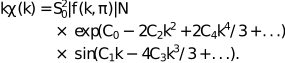 Odd and even cumulants characterize the phase and the amplitude of the EXAFS signal χ(k), respectively. The cumulant method is presented at some length in Fornasini (2024) and in Appendix 2 of Bunker (2010); there, the connection between the cumulants Cn of the effective distribution and the cumulants
  of the real distribution is also established: in general, only the difference between the first cumulants
  and C1 is non-negligible,
  = C1 + 2C2(1/C1 + 1/λ), and the corresponding transformation is included in most data-analysis packages. The strengths and limitations of the cumulant approach are also discussed in Fornasini (2024) and references therein.
In the following, we directly consider the cumulants of the real distribution.  and
and  are the mean and the variance of the real distribution ρ(r), respectively. Higher order cumulants quantify the deviation of the distribution from the Gaussian shape; in particular, the third cumulant
  characterizes the distribution asymmetry and the fourth cumulant
  describes the symmetric deviations from the Gaussian shape. The values of the cumulants characterize the effect of atomic vibrations and possibly of structural disorder.
The effects of thermal and structural disorder on multiple-scattering (MS) paths have been taken into account by a number of researchers according to different approaches (Alberding & Crozier, 1983; Boland & Baldeschwieler, 1984; Benfatto et al., 1989; Loeffen & Pettifer, 1996; Poiarkova & Rehr, 1999; Rehr & Albers, 2000).
An EXAFS experiment samples a one-dimensional distribution of distances for each scattering path. In the one-dimensional model, the vibrational properties of the absorber–backscatterer atomic pair are connected to a pair potential energy, which is conveniently expanded in powers of the displacement u = r − r0 with respect to the position r0 of the potential minimum, 
The distribution ρ(r) is connected to the Hamiltonian H = T + V(r) of the atomic pair by the quantum relation  where w = exp(−βH)/Tr[exp(−βH)] is the statistical density operator, Pr = |r〉〈r| are the projectors on the |r〉 states, En and φn are the Hamiltonian eigenvalues and eigenfunctions, respectively, and β = 1/kBT.
For sufficiently high temperatures, the classical approximation holds: 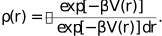
When, for weak vibrational disorder, the distribution of distances is characterized by its leading cumulants, it is useful to express the temperature dependence of the cumulants in terms of the force constants of the pair potential (equation 2).
In the classical approximation, the cumulants can be evaluated (Stern et al., 1991) as  where A1 = r, A2 = (r − 〈r〉)2 and so on. One finds
 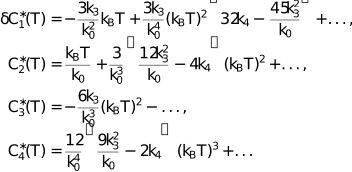 To first order, the bond expansion
  and the second cumulant
  linearly depend on temperature, and the third and fourth cumulants are proportional to T2 and T3, respectively. The classical approximation cannot reproduce the low-temperature behaviour, where quantum effects are non-negligible. It can however give significant results on the anharmonicity effects at relatively high temperatures (Tranquada & Ingalls, 1983; Dalba & Fornasini, 1997).
The quantum approach is based on a perturbative expansion of the density matrix, where the anharmonic terms are considered as a small perturbation to the harmonic Hamiltonian. This approach was first proposed by Frenkel & Rehr (1993) for the thermal expansion and the third cumulant. The second-order calculation of the first four cumulants was made by Yokoyama (1999) and an extension to higher orders has been made by Haug et al. (2008). We list here only the main results; for more details, see the original papers and the review by Fornasini & Grisenti (2015).
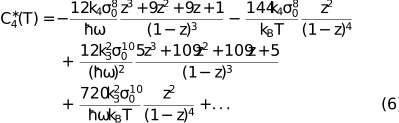
Let ω = (k0/μ)1/2,  and z = exp(−βℏω), where μ is the reduced mass. To first order, the bond expansion (in the one-dimensional model) is
  The second cumulant is
 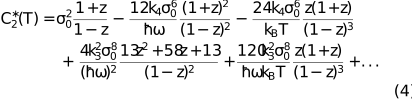 The first-order term corresponds to the harmonic approximation, where
  is the zero-point value; the higher-order anharmonic contributions depend on k3, k4, ….
Again to first order, the third cumulant is  where
where  is the zero-point value.
An example of the difference between the classical and quantum first-order approximations to the first three cumulants of the two-atomic molecule Br2 is shown in Fig. 1.
![[Figure 1]](/figures/qy5020fig1thm.gif)
By comparing equation (3) with the first terms of equations (4) and (5), one finds (Frenkel & Rehr, 1993) that, to first order, the ratio  corresponds to the bond expansion
  of the one-dimensional model.
Only for two-atomic molecular gases does the one-dimensional model have a direct application (Stern et al., 1979; Yokoyama et al., 1996). For many-atomic molecules and condensed systems, the relationship between the three-dimensional structure and the one-dimensional model and its cumulants is not direct.
In many-atomic systems, the distribution ρ(r) can be affected by structural disorder, in addition to vibrational disorder. Even when only vibrational disorder is present, the potential energy V(r) associated with the distribution ρ(r) is an effective potential energy, which depends on the statistically averaged behaviour of all of the atoms of the system (Mustre de Leon et al., 1992) and has to be distinguished both from the single-pair potential energy and from the total potential energy defined in a 3N-dimensional configurational space.
To clarify the relation between the EXAFS cumulants and the vibrational properties of many-atomic systems, it is convenient to refer to the relative atomic displacements.
Let R be the distance between the average positions of the absorber and backscatterer atoms (a and b, respectively), and let ua and ub be their instantaneous displacements with respect to the average positions. The instantaneous interatomic distance r is  It is convenient to consider the projection of the relative displacement Δu along the bond direction Δu∥ and in the perpendicular plane Δu⊥,
  where the short-hand notations Δu2 and
  correspond to (Δu)2 and
  , respectively.
For a single-scattering path, the second cumulant is  where b labels the N backscattering atoms of the coordination shell. One can easily show that
  where the leading contribution is the parallel MSRD
  ; the second contribution is proportional to the variance of the distribution of the
  values and is generally negligible (Fornasini et al., 2001).
The parallel MSRD can be decomposed as  (Beni & Platzman, 1976): the first two terms are the independent mean-square displacements, which can be calculated from the atomic displacement parameters of X-rays or neutron diffraction, while the third term depends on the correlation of the motion of absorber and backscatterer atoms. A convenient measure of correlation is (Booth et al., 1995; Jeong et al., 1999)
  where φ∥ = 0 corresponds to a completely uncorrelated motion and φ∥ = 1 and φ∥ = −1 correspond to atomic motions perfectly in phase and out of phase, respectively.
The correlation is generally quite strong for the first coordination shell: φ∥ ≃ 0.8 for a number of tetrahedral semiconductors and φ∥ ≃ 0.4 for close-packed f.c.c. metals; the correlation is significantly weaker for the outer coordination shells and φ → 0 when the interatomic distance increases (Fornasini & Grisenti, 2015; Jeong et al., 1999).
In the harmonic approximation, the parallel MSRD of any system can be expressed as (Crozier et al., 1988) 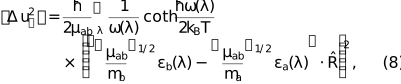 where the sum is over all normal modes λ of the mass-adjusted dynamical matrix
  where
where  is the total potential energy of the system, ω(λ) and ɛ(λ) are eigenfrequencies and normalized eigenvectors of the dynamical matrix and μab is the reduced mass of the a–b pair.
In crystals, the translational symmetry allows one to substitute the diagonalization of the dynamical matrix (equation 9) with the diagonalization of a convenient sample of Fourier-transformed 3n × 3n dynamical matrices, where n is the number of atoms per primitive cell. Accordingly, 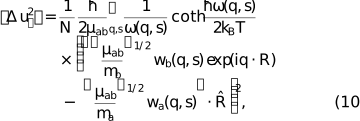 where the normal modes are labelled by wavevector q and branch index s and w(q, s) are the corresponding eigenvectors.
It is worth noting that the contribution of a pair of atoms to the MSRDs depends on the phase relations between the eigenvectors of each normal mode as well as on the projections of the eigenvector difference in the bond direction. Since different dynamical matrices can exist, sharing the same eigenfrequencies but with different eigenvectors (Cochran, 1971), the reproduction of the experimental MSRDs obtained from EXAFS represents a peculiar test for dynamical theories.
Equations (8) and (10) are of little practical use in EXAFS analyses. The vibrational contribution to the second cumulant  is often fitted to simple phenomenological models.
In the correlated Debye model (Beni & Platzman, 1976; Böhmer & Rabe, 1979; Sevillano et al., 1979; Greegor & Lytle, 1979),  m is the average mass of the a–b pair and the Debye frequency ωD is the only free parameter, corresponding to a Debye temperature ΘD = ℏωD/kB. The quantity qD is the radius of a Debye sphere,
 where Va is the real-space volume per atom.
Equation (11) is an extension of the Debye model for atomic vibrations in crystallography (Willis & Pryor, 1975): the second term in square brackets takes into account the effect of correlation due to the inter-cell phase relation exp(iq · R) in equation (10). The physical significance of the correlated Debye model is more obvious for close-packed crystals with one atom per primitive cell (primitive crystals), for which the EXAFS Debye temperatures are similar for different coordination shells and are comparable to the Debye temperatures from other experimental techniques; it is questionable for non-primitive crystals (Fornasini & Grisenti, 2015).
In the Einstein model (Sevillano et al., 1979) the effect of all normal modes on the absorber–backscatterer atomic pair is described in terms of a single oscillator. The Einstein expression of the parallel MSRD corresponds to the first term of equation (4) and can alternatively be expressed as 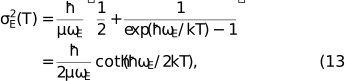 where μ is the reduced mass of the a–b pair; the Einstein model is intrinsically correlated. The best-fitting frequencies ωE = 2πνE of different coordination shells generally differ even for primitive crystals. An effective parallel force constant
  is associated with the frequency ωE = ω∥, which represents a measure of the effective interaction strength.
At high temperatures  (the classical approximation). For T = 0,
  (the zero-point contribution). The Einstein model best fitting the second cumulant of the first shell of copper in shown in Fig. 1 together with the corresponding classical approximation.
The Debye and Einstein models are useful to parametrize the vibrational contribution to the MSRD of a given atomic pair. Besides, deviations of experimental MSRD values from the models are helpful in detecting different contributions to disorder. Temperature-independent structural disorder, for example due to distorted coordination shells, generally leads to a constant positive contribution to the MSRD in addition to the temperature-dependent value of the vibrational models. Deviations of the temperature dependence from that of the vibrational models can suggest the presence of phase transitions or of temperature-dependent structural disorder.
The third and fourth cumulants obtained from the EXAFS analysis of many-atomic systems can be fitted by the one-dimensional models presented in Section 3.2. In Fig. 1, the quantum and classical models that best fit the third cumulant of the first shell of copper are shown.
If the third and fourth cumulants are measured as a function of temperature with sufficient accuracy, one can separate the harmonic and anharmonic contributions to the second cumulant (parallel MSRD) corresponding to the first and the other terms of equation (4), respectively. The effect of anharmonicity is a progressive decrease in the frequency of relative vibrations when the temperature increases. From the logarithmic derivative of the frequency with respect to the bond expansion, a constant-pressure bond Grüneisen parameter (GP) γb,p has been evaluated for CdTe (Fornasini & Grisenti, 2015). From pressure-dependent EXAFS measurements on CdTe, a constant-temperature bond GP γb,T has been obtained and found to be significantly smaller than γb,p (Fornasini et al., 2018).
The inadequacy of the one-dimensional model in dealing with many-atomic systems mainly affects the interatomic distance and thermal expansion. The first EXAFS cumulant directly measures the average interatomic distance (the bond distance for the first coordination shell) and is connected to the distance R between the average atomic positions, as measured by Bragg scattering, by (Lagarde, 1985; Dalba et al., 1995; Stern, 1997) The bond distance 〈r〉 is larger than the crystallographic distance R owing to the effect of perpendicular vibrations (Busing & Levy, 1964; Willis & Pryor, 1975). Accurate EXAFS measurements of the bond expansion
  are now routinely performed (Filipponi & Di Cicco, 1995; Dalba et al., 1999; Yokoyama & Eguchi, 2011). In some cases, it has been possible to evaluate the temperature dependence of the coefficient of bond expansion (Fornasini & Grisenti, 2014). For a review, see Fornasini et al. (2017) and references therein.
For many-atomic systems the bond expansion  is different from the quantity a defined in equation (7): the bond expansion cannot be accounted for solely by the anharmonicity of the effective pair potential energy, and an additional temperature dependence of the minimum position of the effective pair potential energy has to be considered. Such a potential shift has been detected experimentally and has been confirmed by theoretical simulations (a Beccara & Fornasini, 2008; Sanson, 2010). To summarize, in diatomic molecules the bond expansion δ〈r〉 is completely determined by the distribution asymmetry, while in many-atomic systems the contributions of asymmetry and potential shift are comparable for nearest-neighbour distances and the potential shift neatly prevails for outer-shell distances.
The perpendicular MSRD  can be calculated by inverting equation (14), provided that R is known from Bragg scattering measurements and assuming that the vibrations are isotropic within the plane perpendicular to the bond. Correlated Debye and Einstein models can be fitted to the perpendicular MSRD (Vaccari & Fornasini, 2006). The parallel and perpendicular Debye or Einstein frequencies are generally different. The perpendicular Einstein frequency can be connected to an effective perpendicular force constant
  . The parallel and perpendicular effective force constants k∥ and k⊥ should not be confused with the force constants of lattice dynamical models; for a discussion, see Abd el All et al. (2012).
In general, the degree of correlation is different for parallel and perpendicular MSRDs; as a consequence, the ellipsoids of relative absorber–backscatterer motion are generally anisotropic, even when the thermal ellipsoids of single atoms are isotropic. A measure of anisotropy is given by the ratio of the parallel to perpendicular effective force constants, ξ = (k∥/k⊥)1/2. For perfectly isotropic relative vibrations ξ = 1. The anisotropy is very weak for the close-packed structure of copper (ξ ≃ 1.08). For a number of tetrahedral semiconductors, ξ values of between 1.7 and 2.46 have been found; larger degrees of anisotropy have been found in some framework structures. For a review, see Fornasini et al. (2017).
Quantum statistical methods can be considered as an extension of the procedures developed for the one-dimensional model to many-atomic systems. They can rely on perturbative approaches, which are suitable for weak anharmonicity, or on effective potential path-integral approaches, which are suitable for strong anharmonicity.
In Fujikawa & Miyanaga (1993) a general method is presented for calculating the first four cumulants in the plane-wave approximation in terms of eigenfrequencies and eigenvectors of normal modes. The method is based on the finite-temperature many-body perturbation theory for anharmonic crystals by use of the temperature Green's function (Barron & Klein, 1974). Taking into account cubic and quartic anharmonicity, some general qualitative properties of cumulants are obtained. The method was applied to monatomic and diatomic one-dimensional chains in Miyanaga & Fujikawa (1994), where the nearest-neighbour interaction is described by a Morse potential whose power expansion is limited to the quartic term. Some attempts have also been performed for f.c.c. crystals (Katsumata et al., 2001).
For strongly anharmonic systems, a real-space approach based on the finite-temperature path-integral method (Feynman, 1972) has been developed (Fujikawa et al., 1997), in which by introducing a local effective potential that takes into account quantum fluctuations, a classical-like connection is established between potential energy and distance distribution. This method has been applied to asymmetric double-well potentials by Nitta et al. (2006).
Using a simpler phenomenological approach, Van Hung & Rehr (1997) derived an anharmonic correlated model for the effective potential, taking into account the interaction of absorber and backscatterer atoms with their nearest neighbours via a Morse potential; the method was applied to calculations for copper and nickel (Van Hung & Fornasini, 2007) and for zinc and cadmium (Van Hung, Tien et al., 2014), and was extended to silicon and germanium using Stillinger–Weber potentials (Van Hung, Thang et al., 2014).
The cumulants can be evaluated by sampling a configurational space obtained by molecular-dynamics (MD) or Monte Carlo (MC) sampling. MC simulations based on empirical pair potentials have been performed by Yokoyama et al. (1997) on solid krypton in the temperature range 24–43 K. Classical MD based on empirical pair potentials has been used by Edwards et al. (1997) to calculate the cumulants of copper and by Sanson to calculate the cumulants of germanium (Sanson, 2010) and of CdSe (Sanson, 2011). Classical MD and MC simulations cannot reproduce the low-temperature quantum behaviour of cumulants. To overcome this difficulty, a Beccara and coworkers (a Beccara et al., 2003; a Beccara & Fornasini, 2008) performed path-integral Monte Carlo (PIMC) sampling of the thermal configurations of copper. PIMC sampling is based on the sampling of the thermal density matrix after it has been transformed into the convolution of P matrices each with an effective temperature P times higher, corresponding to P copies of the system linked together by a harmonic potential. The resulting probability distribution is sampled by means of appropriate generalized Metropolis algorithms. For the first shell, very good agreement was obtained with the experimental bond expansion and third cumulant as well as the parallel and perpendicular MSRDs. Beyond the first shell, where the analysis of experimental data is severely limited by MS effects, PIMC simulations allowed the independent determination of the bond thermal expansion, of the shift of the maximum of the distribution of distances and of the third cumulant.
An approach for calculating the Debye–Waller (DW) factors in the harmonic approximation for aperiodic systems has been proposed by Poiarkova & Rehr (1999) based on the equation of motion (EM) method, which involves a Fourier transform of the time dependence of the molecular dynamics. The approach has been used to calculate the DW factor of multiple-scattering (MS) paths in a 459-atom spherical cluster of copper, in a 147-atom spherical cluster of germanium and in the complex organic structure of zinc tetraimidazole. In all cases, valence force-field (VFF) models were chosen to parametrize the interaction potential energy.
Ab initio calculations based on density-functional theory (DFT) have been performed for several molecules by Dimakis & Bunker (1998, 2006). A first-principles approach to calculate the force constants for various systems within the quasi-harmonic approximation using DFT has been developed by Vila et al. (2007), who critically compared different approximations of the exchange–correlation potential. A good agreement with available experimental data has been found for the parallel MSRD of the first four shells of copper, germanium and GaAs, as well as for the first-shell perpendicular MSRD, the bond expansion and the third cumulant of copper. The ratio of perpendicular to parallel MSRD has also been found to be in agreement with the experimental value for germanium. An ab initio EM approach has been developed by Vila et al. (2012) to evaluate the DW factors while avoiding the explicit calculation of phonon modes. The method is based on DFT MD calculations of displacement–displacement time-correlation functions.
References
 Abd el All, N., Dalba, G., Diop, D., Fornasini, P., Grisenti, R., Mathon, O., Rocca, F., Thiodjio Sendja, B. & Vaccari, M. (2012). J. Phys. Condens. Matter, 24, 115403.Google Scholara Beccara, S., Dalba, G., Fornasini, P., Grisenti, R., Pederiva, F., Sanson, A., Diop, D. & Rocca, F. (2003). Phys. Rev. B, 68, 140301.Google Scholara Beccara, S. & Fornasini, P. (2008). Phys. Rev. B, 77, 172304.Google ScholarAlberding, N. & Crozier, E. D. (1983). Phys. Rev. B, 27, 3374–3382.Google ScholarAshley, C. A. & Doniach, S. (1975). Phys. Rev. B, 11, 1279–1288.Google ScholarBarron, T. H. K. & Klein, M. L. (1974). Dynamical Properties of Solids, Vol. 1, edited by G. K. Horton & A. A. Maradudin, pp. 391–450. Amsterdam: North-Holland.Google ScholarBenfatto, M., Natoli, C. R. & Filipponi, A. (1989). Phys. Rev. B, 40, 9626–9635.Google ScholarBeni, G. & Platzman, P. M. (1976). Phys. Rev. B, 14, 1514–1518.Google ScholarBöhmer, W. & Rabe, P. (1979). J. Phys. C Solid State Phys. 12, 2465–2474.Google ScholarBoland, J. J. & Baldeschwieler, J. D. (1984). J. Chem. Phys. 80, 3005–3015.Google ScholarBooth, C. H., Bridges, F., Bauer, E. D., Li, G. G., Boyce, J. B., Claeson, T., Chu, C. W. & Xiong, Q. (1995). Phys. Rev. B, 52, R15745–R15748.Google ScholarBoyce, J. B., Hayes, T. M., Stutius, W. & Mikkelsen, J. C. Jr (1977). Phys. Rev. Lett. 38, 1362–1365.Google ScholarBrouder, C. (1988). J. Phys. C Solid State Phys. 21, 5075–5086.Google ScholarBunker, G. (1983). Nucl. Instrum. Methods Phys. Res. 207, 437–444.Google ScholarBunker, G. (2010). Introduction to XAFS. Cambridge University Press.Google ScholarBusing, W. R. & Levy, H. A. (1964). Acta Cryst. 17, 142–146.Google ScholarCochran, W. (1971). Acta Cryst. A27, 556–559.Google ScholarCrozier, E. D., Rehr, J. J. & Ingalls, R. (1988). X-ray Absorption, edited by D. C. Koningsberger & R. Prins, pp. 373–442. New York: John Wiley & Sons.Google ScholarCrozier, E. D. & Seary, A. J. (1980). Can. J. Phys. 58, 1388–1399.Google ScholarDalba, G. & Fornasini, P. (1997). J. Synchrotron Rad. 4, 243–255.Google ScholarDalba, G., Fornasini, P., Gotter, R. & Rocca, F. (1995). Phys. Rev. B, 52, 149–157.Google ScholarDalba, G., Fornasini, P., Grisenti, R. & Purans, J. (1999). Phys. Rev. Lett. 82, 4240–4243.Google ScholarDimakis, N. & Bunker, G. (1998). Phys. Rev. B, 58, 2467–2475.Google ScholarDimakis, N. & Bunker, G. (2006). Biophys. J. 91, L87–L89.Google ScholarEdwards, A. B., Tildesley, D. J. & Binsted, N. (1997). Mol. Phys. 91, 357–369.Google ScholarEisenberger, P. & Brown, G. S. (1979). Solid State Commun. 29, 481–484.Google ScholarFeynman, R. P. (1972). Statistical Mechanics. Reading: Benjamin.Google ScholarFilipponi, A. & Di Cicco, A. (1995). Phys. Rev. B, 51, 12322–12336.Google ScholarFornasini, P. (2024). Int. Tables Crystallogr. I, ch. 5.11, 683–686
.Google ScholarFornasini, P., a Beccara, S., Dalba, G., Grisenti, R., Sanson, A., Vaccari, M. & Rocca, F. (2004). Phys. Rev. B, 70, 174301.Google ScholarFornasini, P. & Grisenti, R. (2014). J. Chem. Phys. 141, 164503.Google ScholarFornasini, P. & Grisenti, R. (2015). J. Synchrotron Rad. 22, 1242–1257.Google ScholarFornasini, P., Grisenti, R., Dapiaggi, M., Agostini, G. & Miyanaga, T. (2017). J. Chem. Phys. 147, 044503.Google ScholarFornasini, P., Grisenti, R., Irifune, T., Shinmei, T., Mathon, O., Pascarelli, S. & Rosa, A. D. (2018). J. Phys. Condens. Matter, 30, 245402.Google ScholarFornasini, P., Monti, F. & Sanson, A. (2001). J. Synchrotron Rad. 8, 1214–1220.Google ScholarFrenkel, A. I. & Rehr, J. J. (1993). Phys. Rev. B, 48, 585–588.Google ScholarFujikawa, T. & Miyanaga, T. (1993). J. Phys. Soc. Jpn, 62, 4108–4122.Google ScholarFujikawa, T., Miyanaga, T. & Suzuki, T. (1997). J. Phys. Soc. Jpn, 66, 2897–2906.Google ScholarGreegor, R. B. & Lytle, F. W. (1979). Phys. Rev. B, 20, 4902–4907.Google ScholarGurman, S. J. & Pendry, J. B. (1976). Solid State Commun. 20, 287–290.Google ScholarHaug, J., Chassé, A., Schneider, R., Kruth, H. & Dubiel, M. (2008). Phys. Rev. B, 77, 184115.Google ScholarHuber, K. P. & Herzberg, G. (1979). Molecular Spectra and Molecular Structure IV: Constants of Diatomic Molecules. New York: Van Nostrand Reinhold.Google ScholarJeong, I. K., Proffen, T., Mohiuddin-Jacobs, F. & Billinge, S. J. L. (1999). J. Phys. Chem. A, 103, 921–924.Google ScholarKatsumata, H., Miyanaga, T., Yokoyama, T., Fujikawa, T. & Ohta, T. (2001). J. Synchrotron Rad. 8, 226–228.Google ScholarLagarde, P. (1985). Amorphous Solids and the Liquid State, edited by N. H. March, R. A. Street & M. Tosi, pp. 365–394. New York: Plenum Press.Google ScholarLee, P. A. & Pendry, J. B. (1975). Phys. Rev. B, 11, 2795–2811.Google ScholarLoeffen, P. W. & Pettifer, R. F. (1996). Phys. Rev. Lett. 76, 636–639.Google ScholarMiyanaga, T. & Fujikawa, T. (1994). J. Phys. Soc. Jpn, 63, 1036–1052.Google ScholarMustre de Leon, J., Conradson, S. D., Batistić, I., Bishop, A. R., Raistrick, I. D., Aronson, M. C. & Garzon, F. H. (1992). Phys. Rev. B, 45, 2447–2457.Google ScholarNitta, K., Miyanaga, T. & Fujikawa, T. (2006). J. Phys. Soc. Jpn, 75, 054603.Google ScholarPoiarkova, A. V. & Rehr, J. J. (1999). Phys. Rev. B, 59, 948–957.Google ScholarRehr, J. J. & Albers, R. C. (2000). Rev. Mod. Phys. 72, 621–654.Google ScholarSanson, A. (2010). Phys. Rev. B, 81, 012304.Google ScholarSanson, A. (2011). J. Phys. Condens. Matter, 23, 315401.Google ScholarSayers, D. E., Stern, E. A. & Lytle, F. W. (1971). Phys. Rev. Lett. 27, 1204–1207.Google ScholarSevillano, E., Meuth, H. & Rehr, J. J. (1979). Phys. Rev. B, 20, 4908–4911.Google ScholarStern, E. A. (1997). J. Phys. IV Fr. 7, 137–140.Google ScholarStern, E. A., Bunker, B. A. & Heald, S. M. (1980). Phys. Rev. B, 21, 5521–5539.Google ScholarStern, E. A., Heald, S. M. & Bunker, B. (1979). Phys. Rev. Lett. 42, 1372–1375.Google ScholarStern, E. A., Līvņš, P. & Zhang, Z. (1991). Phys. Rev. B, 43, 8850–8860.Google ScholarStern, E. A., Sayers, D. E. & Lytle, F. W. (1975). Phys. Rev. B, 11, 4836–4846.Google ScholarTranquada, J. M. & Ingalls, R. (1983). Phys. Rev. B, 28, 3520–3528.Google ScholarVaccari, M. & Fornasini, P. (2006). J. Synchrotron Rad. 13, 321–325.Google ScholarVan Hung, N. & Fornasini, P. (2007). J. Phys. Soc. Jpn, 76, 084601.Google ScholarVan Hung, N. & Rehr, J. J. (1997). Phys. Rev. B, 56, 43–46.Google ScholarVan Hung, N., Thang, C. S., Toan, N. C. & Hieu, H. K. (2014). Vacuum, 101, 63–66.Google ScholarVan Hung, N., Tien, T. S., Duc, N. B. & Vuong, D. Q. (2014). Mod. Phys. Lett. B, 28, 1450174.Google ScholarVila, F. D., Lindahl, V. E. & Rehr, J. J. (2012). Phys. Rev. B, 85, 024303.Google ScholarVila, F. D., Rehr, J. J., Rossner, H. H. & Krappe, H. J. (2007). Phys. Rev. B, 76, 014301.Google ScholarWillis, B. T. M. & Pryor, A. W. (1975). Thermal Vibrations in Crystallography. Cambridge University Press.Google ScholarYokoyama, T. (1999). J. Synchrotron Rad. 6, 323–325.Google ScholarYokoyama, T. & Eguchi, K. (2011). Phys. Rev. Lett. 107, 065901.Google ScholarYokoyama, T., Kobayashi, K., Ohta, T. & Ugawa, A. (1996). Phys. Rev. B, 53, 6111–6122.Google ScholarYokoyama, T., Ohta, T. & Sato, H. (1997). Phys. Rev. B, 55, 11320–11329.Google Scholar
Abd el All, N., Dalba, G., Diop, D., Fornasini, P., Grisenti, R., Mathon, O., Rocca, F., Thiodjio Sendja, B. & Vaccari, M. (2012). J. Phys. Condens. Matter, 24, 115403.Google Scholara Beccara, S., Dalba, G., Fornasini, P., Grisenti, R., Pederiva, F., Sanson, A., Diop, D. & Rocca, F. (2003). Phys. Rev. B, 68, 140301.Google Scholara Beccara, S. & Fornasini, P. (2008). Phys. Rev. B, 77, 172304.Google ScholarAlberding, N. & Crozier, E. D. (1983). Phys. Rev. B, 27, 3374–3382.Google ScholarAshley, C. A. & Doniach, S. (1975). Phys. Rev. B, 11, 1279–1288.Google ScholarBarron, T. H. K. & Klein, M. L. (1974). Dynamical Properties of Solids, Vol. 1, edited by G. K. Horton & A. A. Maradudin, pp. 391–450. Amsterdam: North-Holland.Google ScholarBenfatto, M., Natoli, C. R. & Filipponi, A. (1989). Phys. Rev. B, 40, 9626–9635.Google ScholarBeni, G. & Platzman, P. M. (1976). Phys. Rev. B, 14, 1514–1518.Google ScholarBöhmer, W. & Rabe, P. (1979). J. Phys. C Solid State Phys. 12, 2465–2474.Google ScholarBoland, J. J. & Baldeschwieler, J. D. (1984). J. Chem. Phys. 80, 3005–3015.Google ScholarBooth, C. H., Bridges, F., Bauer, E. D., Li, G. G., Boyce, J. B., Claeson, T., Chu, C. W. & Xiong, Q. (1995). Phys. Rev. B, 52, R15745–R15748.Google ScholarBoyce, J. B., Hayes, T. M., Stutius, W. & Mikkelsen, J. C. Jr (1977). Phys. Rev. Lett. 38, 1362–1365.Google ScholarBrouder, C. (1988). J. Phys. C Solid State Phys. 21, 5075–5086.Google ScholarBunker, G. (1983). Nucl. Instrum. Methods Phys. Res. 207, 437–444.Google ScholarBunker, G. (2010). Introduction to XAFS. Cambridge University Press.Google ScholarBusing, W. R. & Levy, H. A. (1964). Acta Cryst. 17, 142–146.Google ScholarCochran, W. (1971). Acta Cryst. A27, 556–559.Google ScholarCrozier, E. D., Rehr, J. J. & Ingalls, R. (1988). X-ray Absorption, edited by D. C. Koningsberger & R. Prins, pp. 373–442. New York: John Wiley & Sons.Google ScholarCrozier, E. D. & Seary, A. J. (1980). Can. J. Phys. 58, 1388–1399.Google ScholarDalba, G. & Fornasini, P. (1997). J. Synchrotron Rad. 4, 243–255.Google ScholarDalba, G., Fornasini, P., Gotter, R. & Rocca, F. (1995). Phys. Rev. B, 52, 149–157.Google ScholarDalba, G., Fornasini, P., Grisenti, R. & Purans, J. (1999). Phys. Rev. Lett. 82, 4240–4243.Google ScholarDimakis, N. & Bunker, G. (1998). Phys. Rev. B, 58, 2467–2475.Google ScholarDimakis, N. & Bunker, G. (2006). Biophys. J. 91, L87–L89.Google ScholarEdwards, A. B., Tildesley, D. J. & Binsted, N. (1997). Mol. Phys. 91, 357–369.Google ScholarEisenberger, P. & Brown, G. S. (1979). Solid State Commun. 29, 481–484.Google ScholarFeynman, R. P. (1972). Statistical Mechanics. Reading: Benjamin.Google ScholarFilipponi, A. & Di Cicco, A. (1995). Phys. Rev. B, 51, 12322–12336.Google ScholarFornasini, P. (2024). Int. Tables Crystallogr. I, ch. 5.11, 683–686
.Google ScholarFornasini, P., a Beccara, S., Dalba, G., Grisenti, R., Sanson, A., Vaccari, M. & Rocca, F. (2004). Phys. Rev. B, 70, 174301.Google ScholarFornasini, P. & Grisenti, R. (2014). J. Chem. Phys. 141, 164503.Google ScholarFornasini, P. & Grisenti, R. (2015). J. Synchrotron Rad. 22, 1242–1257.Google ScholarFornasini, P., Grisenti, R., Dapiaggi, M., Agostini, G. & Miyanaga, T. (2017). J. Chem. Phys. 147, 044503.Google ScholarFornasini, P., Grisenti, R., Irifune, T., Shinmei, T., Mathon, O., Pascarelli, S. & Rosa, A. D. (2018). J. Phys. Condens. Matter, 30, 245402.Google ScholarFornasini, P., Monti, F. & Sanson, A. (2001). J. Synchrotron Rad. 8, 1214–1220.Google ScholarFrenkel, A. I. & Rehr, J. J. (1993). Phys. Rev. B, 48, 585–588.Google ScholarFujikawa, T. & Miyanaga, T. (1993). J. Phys. Soc. Jpn, 62, 4108–4122.Google ScholarFujikawa, T., Miyanaga, T. & Suzuki, T. (1997). J. Phys. Soc. Jpn, 66, 2897–2906.Google ScholarGreegor, R. B. & Lytle, F. W. (1979). Phys. Rev. B, 20, 4902–4907.Google ScholarGurman, S. J. & Pendry, J. B. (1976). Solid State Commun. 20, 287–290.Google ScholarHaug, J., Chassé, A., Schneider, R., Kruth, H. & Dubiel, M. (2008). Phys. Rev. B, 77, 184115.Google ScholarHuber, K. P. & Herzberg, G. (1979). Molecular Spectra and Molecular Structure IV: Constants of Diatomic Molecules. New York: Van Nostrand Reinhold.Google ScholarJeong, I. K., Proffen, T., Mohiuddin-Jacobs, F. & Billinge, S. J. L. (1999). J. Phys. Chem. A, 103, 921–924.Google ScholarKatsumata, H., Miyanaga, T., Yokoyama, T., Fujikawa, T. & Ohta, T. (2001). J. Synchrotron Rad. 8, 226–228.Google ScholarLagarde, P. (1985). Amorphous Solids and the Liquid State, edited by N. H. March, R. A. Street & M. Tosi, pp. 365–394. New York: Plenum Press.Google ScholarLee, P. A. & Pendry, J. B. (1975). Phys. Rev. B, 11, 2795–2811.Google ScholarLoeffen, P. W. & Pettifer, R. F. (1996). Phys. Rev. Lett. 76, 636–639.Google ScholarMiyanaga, T. & Fujikawa, T. (1994). J. Phys. Soc. Jpn, 63, 1036–1052.Google ScholarMustre de Leon, J., Conradson, S. D., Batistić, I., Bishop, A. R., Raistrick, I. D., Aronson, M. C. & Garzon, F. H. (1992). Phys. Rev. B, 45, 2447–2457.Google ScholarNitta, K., Miyanaga, T. & Fujikawa, T. (2006). J. Phys. Soc. Jpn, 75, 054603.Google ScholarPoiarkova, A. V. & Rehr, J. J. (1999). Phys. Rev. B, 59, 948–957.Google ScholarRehr, J. J. & Albers, R. C. (2000). Rev. Mod. Phys. 72, 621–654.Google ScholarSanson, A. (2010). Phys. Rev. B, 81, 012304.Google ScholarSanson, A. (2011). J. Phys. Condens. Matter, 23, 315401.Google ScholarSayers, D. E., Stern, E. A. & Lytle, F. W. (1971). Phys. Rev. Lett. 27, 1204–1207.Google ScholarSevillano, E., Meuth, H. & Rehr, J. J. (1979). Phys. Rev. B, 20, 4908–4911.Google ScholarStern, E. A. (1997). J. Phys. IV Fr. 7, 137–140.Google ScholarStern, E. A., Bunker, B. A. & Heald, S. M. (1980). Phys. Rev. B, 21, 5521–5539.Google ScholarStern, E. A., Heald, S. M. & Bunker, B. (1979). Phys. Rev. Lett. 42, 1372–1375.Google ScholarStern, E. A., Līvņš, P. & Zhang, Z. (1991). Phys. Rev. B, 43, 8850–8860.Google ScholarStern, E. A., Sayers, D. E. & Lytle, F. W. (1975). Phys. Rev. B, 11, 4836–4846.Google ScholarTranquada, J. M. & Ingalls, R. (1983). Phys. Rev. B, 28, 3520–3528.Google ScholarVaccari, M. & Fornasini, P. (2006). J. Synchrotron Rad. 13, 321–325.Google ScholarVan Hung, N. & Fornasini, P. (2007). J. Phys. Soc. Jpn, 76, 084601.Google ScholarVan Hung, N. & Rehr, J. J. (1997). Phys. Rev. B, 56, 43–46.Google ScholarVan Hung, N., Thang, C. S., Toan, N. C. & Hieu, H. K. (2014). Vacuum, 101, 63–66.Google ScholarVan Hung, N., Tien, T. S., Duc, N. B. & Vuong, D. Q. (2014). Mod. Phys. Lett. B, 28, 1450174.Google ScholarVila, F. D., Lindahl, V. E. & Rehr, J. J. (2012). Phys. Rev. B, 85, 024303.Google ScholarVila, F. D., Rehr, J. J., Rossner, H. H. & Krappe, H. J. (2007). Phys. Rev. B, 76, 014301.Google ScholarWillis, B. T. M. & Pryor, A. W. (1975). Thermal Vibrations in Crystallography. Cambridge University Press.Google ScholarYokoyama, T. (1999). J. Synchrotron Rad. 6, 323–325.Google ScholarYokoyama, T. & Eguchi, K. (2011). Phys. Rev. Lett. 107, 065901.Google ScholarYokoyama, T., Kobayashi, K., Ohta, T. & Ugawa, A. (1996). Phys. Rev. B, 53, 6111–6122.Google ScholarYokoyama, T., Ohta, T. & Sato, H. (1997). Phys. Rev. B, 55, 11320–11329.Google Scholar

