|
International
Tables for Crystallography Volume I X-ray absorption spectroscopy and related techniques Edited by C. T. Chantler, F. Boscherini and B. Bunker © International Union of Crystallography 2024 |
International Tables for Crystallography (2024). Vol. I. ch. 2.16, pp. 155-162
https://doi.org/10.1107/S1574870722001616 Chapter 2.16. X-ray linear dichroism: dependence of XAFS on the orientation of the sample with respect to the incoming radiationaInstitute of Physics, Czech Academy of Sciences, Cukrovarnická 10, 162 53 Praha 6, Czech Republic The probability that an X-ray photon will be absorbed by exciting a core electron depends on the orientation of the sample with respect to the incoming radiation. The probability of transitions allowed by the dipole selection rule depends on the polarization vector of the incoming radiation, whereas the probability of transitions allowed by the quadrupole selection rule additionally depends on the direction from which the radiation arrives. Angle-dependent or polarized X-ray absorption spectra contain more information than orientationally averaged spectra. The extra information obtained in angle-dependent spectra can be beneficial for investigating the local structure around the photoabsorber. Systems in which this is especially convenient include complicated geological materials, biological systems, impurities in the bulk and adsorbates on surfaces. From a purely theoretical point of view, polarized spectra present a much more stringent test of the theory than unpolarized spectra; this can be helpful in deciding between different theoretical models (for example concerning the importance of many-body effects). Furthermore, the different angular dependence of dipole and quadrupole transitions can serve as the ultimate tool to distinguish between them. Keywords: polarized spectra; angle-dependent spectra; X-ray linear dichroism. |
The probability that an X-ray photon will be absorbed by exciting a core electron depends on the orientation of the sample with respect to the incoming radiation. Assuming that the sample is a monocrystal, the probability of transitions allowed by the dipole selection rule depends on the polarization vector  of the incoming radiation. The probability of transitions allowed by the quadrupole selection rule additionally depends on the direction
  from which the radiation arrives. The mutual orientation of the sample and of the
  vector can be changed either by selecting different polarization of the X-rays (i.e. by varying the
  vector) or by rotating the sample. The phrases `angle-dependent spectra' and `polarized spectra' are thus used interchangeably. The difference between spectra recorded using two perpendicular orientations of the polarization vector
  is often called X-ray linear dichroism (XLD).
In some cases the dichroic effects can be a nuisance. For example, if the sample is unintentionally textured one might unknowingly measure a polarized XAFS signal that, unlike the full orientationally averaged (unpolarized) spectrum, reflects only a partial section of the geometry. Here, we will focus on situations where one purposefully intends to exploit the dichroism. First of all, the angular dependence of XAFS can be used for a more detailed determination of the local structure around the photoabsorbing atom, because the information thus provided is more focused. Secondly, angle-dependent spectra provide a much more stringent test of the theory than unpolarized spectra; this can be helpful in deciding between different theoretical models (for example concerning the importance of many-body effects). Furthermore, the different angular dependence of dipole and quadrupole transitions can serve as the ultimate tool to distinguish between them.
This chapter is organized so that we first introduce a general formal framework and then illustrate the concepts and benefits of XLD with examples. The focus is on structural studies and on the need for cooperation between theory and experiment, especially in the near-edge region. Some attention will also be paid to situations in which analysis of the angular dependence of spectra helps in solving specific problems related to the electronic and magnetic structure. The equations describing angle-dependent dipole and quadrupole transitions are presented in Appendix A . We will assume that samples are nonmagnetic unless explicitly stated otherwise; the magnetic field itself can give rise to dichroic effects, but these are discussed in other chapters.
The dependence of the X-ray absorption cross section on the polarization vector  and wavevector q of the incoming radiation can be explicitly written as
  where the first summand accounts for the dipole transitions and the second summand accounts for the quadrupole transitions (see Appendix A for details). The equation of form (1) follows directly from Fermi's golden rule and can straightforwardly be used in calculations; the electronic structure-related terms
  and
and  can be evaluated in real or reciprocal space using methods described in other chapters of this volume.
The way the cross section σ changes if the sample rotates depends on the symmetry of the sample. If atoms of a given chemical type occupy more crystallographic sites, then the measured spectrum is the average of the signals from all relevant sites. The angular dependence of XAFS is thus determined by the point group of the crystal (and not just the local point group of the photoabsorber).
The components of the Cartesian tensors  ,
,  are not all independent of each other. To demonstrate how the crystal symmetry affects the angular dependence of the cross section σ, it is convenient to employ the concept of spherical tensors. A spherical tensor is a set of basis functions for an irreducible representation of the rotation group. Components of a spherical tensor of rank l transform as spherical harmonics Ylm (Brouder et al., 2008). Brouder (1990) applied this formalism to both the dipole and the quadrupole terms to obtain the angular dependence of the spectra explicitly. For cubic systems, the dipole transitions are isotropic. For systems which have a rotation axis of order greater than two, we have a pure dichroism (for dipole transitions), i.e. there are two independent spectral components and the dependence of the cross section on the angle θ between the rotation axis and the polarization vector can be described as
  For lower symmetries, there are either three, four or six independent dipole components and the cross section exhibits not only polar dependence but also azimuthal dependence (Brouder, 1990).
The number of independent quadrupole components varies from two to 15 according to the crystal symmetry (Brouder, 1990). In particular, quadrupole transitions are angle-dependent even for cubic systems; in such a case, the angular dependence of X-ray absorption near-edge structure (XANES) may serve as a telltale sign that quadrupole transitions are significant.
Sometimes one deals with systems that are only partially ordered, for example when attempting to quantify the texture of biological samples. In such a case it may be useful not to employ equation (4) but rather to resort to frameworks that have been designed specifically for systems with partial order (Dittmer & Dau, 1998).
In this section, we demonstrate how ab initio calculations of polarized spectra can be instrumental for studying the structure of certain classes of materials. We will highlight the use of the extra information contained in the angular dependence of XAFS.
An important intuitive concept in XANES analysis is the link between specific spectral features and small well defined structural units. Modelling the angular dependence of the spectra plays a prominent role in this respect. Analysis of the V K-edge spectrum of V2O5 serves as an illustrative example (Šipr et al., 1999): by comparing experimental spectra with spectra calculated for simple structural units, it was found that the dominant sharp peak at the onset of the spectrum for  is only formed if the nearest neighbourhood of the V atom is asymmetric and a very short V—O bond parallel to the
  direction is present at the same time (Fig. 1).
![[Figure 1]](/figures/qy5021fig1thm.gif)
|
Simulating essential features of polarized V K-edge spectra of V2O5 employing simple structural units, as performed by Šipr et al. (1999 |
The calculations of Šipr et al. (1999) relied on a real-space formalism. However, similar information can also be obtained when band-structure (reciprocal-space) methods are used. Cabaret et al. (2013) interpreted peaks in the polarized Ca K edge of CaC6 in terms of hybridization between orbitals associated with the photoabsorbing Ca atom and orbitals associated with neighbouring atoms. This information was then used as guidance for the analysis of spectra of Li–Ca intercalated graphite.
The additional information carried by the angular dependence of the spectra can be beneficial for investigating the structure of complicated bulk systems such as minerals or clays because in such a case there are many structural parameters to be fitted and any extra condition constraining them is welcome. The structure optimization proceeds along the same lines as for unpolarized spectra, but there are more data to fit. One example is the structural refinement of a fine-grained layer silicate: Garfield nontronite (Manceau et al., 1998). Here, angle-dependent extended X-ray absorption fine-structure (EXAFS) spectra measured at the Fe K edge were simulated by ab initio modelling to obtain information about the flattening angle of the Fe(O,OH)6 octahedra, about the cation distribution in the octahedral sheet and about the differentiation between di-octahedral and tri-octahedral structures. Modelling of angle-dependent polarized EXAFS was also crucial for studying the local environment of zinc sorbed in phyllomanganate birnesite (Manceau et al., 2002).
When X-ray absorption spectroscopy is used for structural studies the primary interest lies in the EXAFS region, because extracting the structural information from EXAFS is much more straightforward than from XANES. However, there are situations in which relying on EXAFS is not convenient and one has to turn to XANES. This happens, for example, for diluted systems where extracting EXAFS with a good signal-to-noise ratio is very difficult, while the more intensive XANES signal can be acquired relatively easily. Another situation where it may be useful to engage XANES is when one is interested in bond angles (apart from bond lengths).
One approach to obtain information about the local structure around the photoabsorber, which proved to be especially useful for biological systems, is best-fitting the experimental spectrum with XANES calculations for model structures. If angle-dependent spectra are available, there are more data to fit and hence the fitting procedure is more reliable. Application of this procedure to polarized Fe K-edge XANES of the iron protein carbonmonoxy myoglobin (MbCO) and of its photoproduct Mb*CO is demonstrated in Fig. 2. Distances as well as bond angles around the Fe atom were determined in this way (Della Longa et al., 2001).
![[Figure 2]](/figures/qy5021fig2thm.gif)
An additional increase in accuracy can be achieved if more techniques are combined. Arcovito et al. (2007) employed best-fitting of polarized XANES with X-ray diffraction to refine structural models of cyanomet sperm whale myoglobin.
Cooperation between measurement and modelling is needed to obtain information about the structure around doped impurities. This was demonstrated in the study of cobalt-doped ZnO by Ney et al. (2008). The comparison of experimental and theoretical Co K-edge XLD provides convincing proof that the Co atoms are located in zinc-substitutional sites (Fig. 3).
![[Figure 3]](/figures/qy5021fig3thm.gif)
The intensity of the pre-peak at the K edge of an orientationally averaged (powder) spectrum has commonly been used to distinguish between tetrahedral and octahedral coordination of transition-metal impurities. Namely, for tetrahedral coordination the hybridization of the semi-localized 3d atomic states of the impurity with the ligand states leads to states with a p symmetry with respect to the photoabsorber, giving rise to a sharp intense peak formed by dipole transitions. For an octahedral coordination this is not possible and the pre-peak can thus only be formed by less probable quadrupole transitions (Yamamoto, 2008). More detailed information, for example about possible distortions from the cubic symmetry, can be obtained by resorting to angle-dependent spectra. As an example one can mention a study of chromium impurities in an MgAl2O4 spinel, where it was found that while the pre-edge region of the orientationally averaged Cr K spectrum is not significantly affected by a trigonal distortion, the dichroic signal is quite sensitive to it (Juhin et al., 2008).
The dependence of the X-ray absorption spectrum on the direction of the polarization vector is especially strong at surfaces where the symmetry is substantially broken. This can be used to determine adsorption sites and bond lengths for adatoms and molecules on surfaces. Vvedensky et al. (1987) simulated polarized O K-edge XANES for c(2×2)O on Cu(100) assuming various adsorption sites and bond lengths to find that the O overlayer occupies hollow sites 0.7 Å above the copper surface (Fig. 4).
![[Figure 4]](/figures/qy5021fig4thm.gif)
A similar approach was employed by Nordlund et al. (2004) to determine the surface structure of a thin ice film grown on Pt(111). Here, the measured polarized O K-edge XANES was modelled by superposing the theoretical spectra of oriented molecular clusters to conclude that crystalline ice is terminated with a large abundance of isotropically distributed free OH groups and a distorted subsurface.
The previous section was devoted to an area in which the comparison of calculated and experimental angle-dependent XAFS is mostly used, namely studying the structures of materials. In this section, we will present some examples showing how analysing polarized XANES can be helpful in investigating the character of electronic transitions associated with particular spectral features.
Dipole transitions dominate over quadrupole transitions over practically the whole XAFS range, so the quadrupole transitions can usually be ignored. However, sometimes quadrupole transitions are important; for example, in the pre-edge region of spectra of transition-metal atoms at the K edge. This is because the K-edge quadrupole transitions are to the d states, the density of which is much higher in the respective energy region than the density of the p states (to which the dipole transitions occur). Deciding whether a spectral feature is of dipole or quadrupole nature is difficult; among other reasons, this is because theoretical calculations are especially challenging close to the edge, where effects due to the core hole, electron correlations and the nonspherical part of the potential can be significant. The ultimate answer may come from analysis of the angular dependence of the spectra, because depending on the setup this dependence can sometimes be quite different for dipole and quadrupole transitions.
This approach was first used for the analysis of the pre-peak in the Cu K-edge spectrum of the (creat)2CuCl4 complex (Hahn et al., 1982); see the left panel of Fig. 5 for the full angle-dependent spectrum. The symmetry of the CuCl4 complex can approximately be described by point group D4h, meaning that the dipole transitions should not exhibit any dependence on the azimuthal angle φ. Nevertheless, the experiment shows that the height of the pre-peak oscillates with a fourfold periodicity (right panel of Fig. 5), consistent with the angular dependence of the quadrupole transition for the respective symmetry (Brouder, 1990), 
![[Figure 5]](/figures/qy5021fig5thm.gif)
 is rotated around the crystal
 As mentioned in Section 2, quadrupole transitions can induce angular dependence in spectra of cubic systems where the dipolar transitions are fully isotropic. A comprehensive analysis of the angular dependence of the Fe K-edge spectrum of cubic pyrite (FeS2) was performed by Cabaret et al. (2001) for the whole XANES range. They demonstrated that the spectrum is indeed isotropic except for the pre-edge region, where the spectrum clearly contains a quadrupole component, in agreement with theory. Another instructive example is the Cr K-edge spectrum of an MgAl2O4:Cr3+ spinel. By combining the analysis of the experimental angular dependence of the pre-peak with ab initio and model multiplet calculations, Juhin et al. (2008) presented evidence for its quadrupole character. They also derived some general implications for studying the local geometry around the photoabsorbing atom by means of XLD.
A robust way to identify quadrupole transitions even for low-symmetry systems is to analyse spectra recorded with orientations of the sample and the X-ray beam such that the cross sections for dipole transitions are identical while the cross sections for quadrupole transitions differ. This approach was employed by Bocharov et al. (2001), who demonstrated in this way that the pre-peak in the Cu K-edge spectrum of monoclinic CuO has a quadrupole origin.
The extra information provided by polarized XAS becomes convenient if an accurate comparison between theory and experiment is required. This happens, for example, when one tries to identify many-body effects in the XANES. Initially this approach was adopted when studying molecular complexes, because accurate configuration–interaction calculations could be performed for these systems. By comparing the experimental angular dependence of the spectra with quantum-chemical calculations, many-body shake-down features were identified in the Cu K-edge spectra of a planar CuCl4 complex (Kosugi et al., 1984) and a linear CuCl2 complex (Yokoyama et al., 1986).
Another example in which comparison between experimental and theoretical angle-dependent spectra was used to demonstrate the presence of many-body effects is the study of the Cu K edge of CuO (Calandra et al., 2012). Here, the incorporation of many-body effects into theoretical spectra was achieved by first performing an ab initio calculation of a single-particle spectrum and then convoluting it with an experimental core-level photoemission spectrum to account for shake-up features. Comparisons of experimental angle-dependent spectra with calculations that either do or do not account for shake-up effects are shown in Fig. 6.
![[Figure 6]](/figures/qy5021fig6thm.gif)
The next level of sophistication is not just to show that many-body effects are present in the spectra but to employ spectroscopy to study the nature of these effects in greater detail. Juhin et al. (2010) analysed the polarized Co K-edge XANES of LiCoO2 to find that the screening of the Co 1s core hole is angle-dependent. In their approach, they combined the GGA+U description of the correlations among the d electrons with supercell calculations for a system with one 1s electron removed to account for core-hole effects.
Finally, let us mention an example in which investigating the angular dependence of XANES together with the angular dependence of the X-ray magnetic circular dichroism (XMCD) helps to understand the role of many-body effects not just in the spectra but also in the physical mechanism that determines the distance between the adatom and substrate. This was achieved by Sessi et al. (2014) when studying angle-dependent spectra for iron, cobalt, nickel and copper adatoms on graphene and graphite. By comparing experiments with model Hamiltonian calculations, they were able to assess the role of dispersive (van der Waals) forces in the physisorption or chemisorption of 3d adatoms.
Angle-dependent or polarized X-ray absorption spectra contain more information than orientationally averaged spectra. With regard to the calculations, there is no obstacle to accessing this extra information: the mathematical formulae for polarized and unpolarized spectra are practically identical, with the only differences being in the way that the matrix elements are evaluated, and the computational costs are the same. However, there may be practical problems on the experimental side stemming, for example, from the necessity of knowing the orientation of the sample with respect to the polarization vector and the wavevector very accurately.
Exploiting the angular dependence of the spectra can be beneficial for modelling the local structure around the photoabsorber, as demonstrated by the examples presented in this chapter. This can be especially true in the XANES region, which is important for the analysis of diluted systems (impurities, adsorbates), where acquiring a good EXAFS signal may be difficult.
From a purely theoretical point of view, polarized spectra present a much more stringent test of the theory than unpolarized spectra. Therefore, polarized XANES can be useful if one needs to check which effects need to be included for a proper description of the underlying physics (core hole, strong correlations between the electrons, nonsphericity of the potential …). It may be the case that a particular theoretical model leads to a more-or-less satisfactory agreement between the calculated and measured powder spectra but fails for polarized spectra.
Finally, the angular dependence can also be a useful ingredient when dealing primarily with topics other than structure. For example, the angular dependence of XMCD or of X-ray magnetic linear dichroism (XMLD) can provide the extra information needed to solve concrete problems in the magnetism of materials.
APPENDIX A
By relying on first-order perturbation theory, the effective cross section of the photoabsorption process (i.e. its probability per unit flux of incoming photons) can be written in SI units as  where e and m are the electron charge and mass, respectively, ɛ0 is the permittivity of vacuum, c is the speed of light, ω is the frequency of the incoming radiation, Ec is the energy of the core electron in state |φc〉 and ν labels a complete set of orthogonal state vectors |ψν〉 with energies Eν. The interaction Hamiltonian for incoming photons characterized by a polarization vector
  and momentum
  is
is 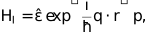 where r and p are electron position and momentum operators. The first term in the Taylor expansion of the exponential exp[(i/ℏ)q · r] is responsible for dipole transitions and the second term is responsible for quadrupole transitions. Equation (3) can be further transformed so that the cross section σ(s) for either dipole (s = dip) or quadrupole (s = qdr) transitions can be written as
  The subscript L stands for a pair (l, m), Lc = (lc, mc) characterizes the core level from which the photoelectron was ejected and the photoelectron wavevector k is determined by
The matrix  incorporates information about the positions of atoms and thus also about the orientation of the crystal. For a muffin-tin potential, which is employed in most XAFS calculations, the matrix
  is given by
 where the scattering-path operator matrix
  satisfies the `multiple-scattering equation'
  the free-electron propagator
  contains information about the positions
  of the atoms,
  and the single-site t-matrix is related to the phase shift via
  The subscript j labels individual atoms and the photoabsorbing atom is denoted by 0.
Detailed specification of the incoming radiation is contained in the single-site matrix  . For dipole transitions, one obtains
 The polarization vector
  enters via its Cartesian components
  . The radial part of the matrix element is
  where the radial part of the photoelectron wavefunction is normalized so that outside the muffin-tin sphere it is
  The angular part of the dipole matrix element is
  where
where  denotes the jth Cartesian component of the unit vector
  . For quadrupole transitions one has to take
  Here,
Here,  denotes the mth Cartesian component of the unit vector which determines the direction of incoming X-rays. The radial part of the matrix element is now
  and the angular part of the quadrupole matrix element is
  One can see from the expressions above that as the vectors
  and
and  occur only in the matrix elements
  and
and  , equation (4) can be easily recast into the form of equation (1).
To facilitate comparison with unpolarized spectra, we also present equations for the case in which an average over all orientations of the sample is taken. Then, instead of equation (8), we obtain and, instead of equation (11), we obtain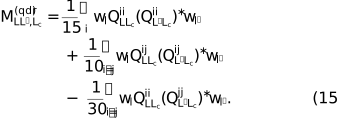
References
 Arcovito, A., Benfatto, M., Cianci, M., Hasnain, S. S., Nienhaus, K., Nienhaus, G. U., Savino, C., Strange, R. W., Vallone, B. & Della Longa, S. (2007). Proc. Natl Acad. Sci. USA, 104, 6211–6216.Google ScholarBocharov, S., Kirchner, T., Dräger, G., Šipr, O. & Šimůnek, A. (2001). Phys. Rev. B, 63, 045104.Google ScholarBrouder, C. (1990). J. Phys. Condens. Matter, 2, 701–738.Google ScholarBrouder, C., Juhin, A., Bordage, A. & Arrio, M.-A. (2008). J. Phys. Condens. Matter, 20, 455205.Google ScholarCabaret, D., Brouder, C., Arrio, M.-A., Sainctavit, P., Joly, Y., Rogalev, A. & Goulon, J. (2001). J. Synchrotron Rad. 8, 460–462.Google ScholarCabaret, D., Emery, N., Bellin, C., Hérold, C., Lagrange, P., Wilhelm, F., Rogalev, A. & Loupias, G. (2013). Phys. Rev. B, 87, 075108.Google ScholarCalandra, M., Rueff, J. P., Gougoussis, C., Céolin, D., Gorgoi, M., Benedetti, S., Torelli, P., Shukla, A., Chandesris, D. & Brouder, C. (2012). Phys. Rev. B, 86, 165102.Google ScholarDella Longa, S., Arcovito, A., Girasole, M., Hazemann, J. L. & Benfatto, M. (2001). Phys. Rev. Lett. 87, 155501.Google ScholarDittmer, J. & Dau, H. (1998). J. Phys. Chem. B, 102, 8196–8200.Google ScholarHahn, J., Scott, R., Hodgson, K., Doniach, S., Desjardins, S. & Solomon, E. (1982). Chem. Phys. Lett. 88, 595–598.Google ScholarJuhin, A., Brouder, C., Arrio, M.-A., Cabaret, D., Sainctavit, P., Balan, E., Bordage, A., Seitsonen, A. P., Calas, G., Eeckhout, S. G. & Glatzel, P. (2008). Phys. Rev. B, 78, 195103.Google ScholarJuhin, A., de Groot, F., Vankó, G., Calandra, M. & Brouder, C. (2010). Phys. Rev. B, 81, 115115.Google ScholarKosugi, N., Yokoyama, T., Asakura, K. & Kuroda, H. (1984). Chem. Phys. 91, 249–256.Google ScholarManceau, A., Chateigner, D. & Gates, P. W. (1998). Phys. Chem. Miner. 25, 347–365.Google ScholarManceau, A., Lanson, B. & Drits, V. A. (2002). Geochim. Cosmochim. Acta, 66, 2639–2663.Google ScholarNey, A., Ollefs, K., Ye, S., Kammermeier, T., Ney, V., Kaspar, T. C., Chambers, S. A., Wilhelm, F. & Rogalev, A. (2008). Phys. Rev. Lett. 100, 157201.Google ScholarNordlund, D., Ogasawara, H., Wernet, P., Nyberg, M., Odelius, M., Pettersson, L. & Nilsson, A. (2004). Chem. Phys. Lett. 395, 161–165.Google ScholarSessi, V., Stepanow, S., Rudenko, A. N., Krotzky, S., Kern, K., Hiebel, F., Mallet, P., Veuillen, J.-Y., Šipr, O., Honolka, J. & Brookes, N. B. (2014). New J. Phys. 16, 062001.Google ScholarŠipr, O., Šimůnek, A., Bocharov, S., Kirchner, T. & Dräger, G. (1999). Phys. Rev. B, 60, 14115–14127.Google ScholarVvedensky, D. D., Pendry, J. B., Döbler, U. & Baberschke, K. (1987). Phys. Rev. B, 35, 7756–7759.Google ScholarYamamoto, T. (2008). X-ray Spectrom. 37, 572–584.Google ScholarYokoyama, T., Kosugi, N. & Kuroda, H. (1986). Chem. Phys. 103, 101–109.Google Scholar

