|
International
Tables for Crystallography Volume A Space-group symmetry Edited by Th. Hahn © International Union of Crystallography 2006 |
International Tables for Crystallography (2006). Vol. A. ch. 8.1, pp. 720-722
Section 8.1.2. Spaces and motions
a
Institut für Kristallographie, Universität, D-76128 Karlsruhe, Germany |
Crystals are objects in the physical three-dimensional space in which we live. A model for the mathematical treatment of this space is the so-called point space, which in crystallography is known as direct or crystal space. In this space, the structures of finite real crystals are idealized as infinite perfect three-dimensional crystal structures (cf. Section 8.1.4 ). This implies that for crystal structures and their symmetries the surfaces of crystals as well as their defects and imperfections are neglected; for most applications, this is an excellent approximation.
The description of crystal structures and their symmetries is not as simple as it appears at first sight. It is useful to consider not only the above-mentioned point space but also to introduce simultaneously a vector space which is closely connected with the point space. Crystallographers are used to working in both spaces: crystal structures are described in point space, whereas face normals, translation vectors, Patterson vectors and reciprocal-lattice vectors are elements of vector spaces.
In order to carry out crystallographic calculations it is necessary to have a metrics in point space. Metrical relations, however, are most easily introduced in vector space by defining scalar products between vectors from which the length of a vector and the angle between two vectors are derived. The connection between the vector space  and the point space
  transfers both the metrics and the dimension of onto the point space in such a way that distances and angles in point space may be calculated.
The connection between the two spaces is achieved in the following way:
 of the vector space
  .
.The distance between two points P and Q in point space is given by the length  of the attached vector
  in vector space. In this expression,
  is the scalar product of with itself.
The angle determined by P, Q and R with vertex Q is obtained from  Here,
Here,  is the scalar product between
  and
and  . Such a point space is called an n-dimensional Euclidean space.
If we select in the point space an arbitrary point O as the origin, then to each point X of a unique vector  of is assigned, and there is a one-to-one correspondence between the points X of and the vectors of
  .
.
Referred to a vector basis  of , each vector x is uniquely expressed as
  or, using matrix multiplication,1
 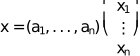 .
.
Referred to the coordinate system  of , Fig. 8.1.2.1, each point X is uniquely described by the column of coordinates
  Thus, the real numbers
  are either the coefficients of the vector x of or the coordinates of the point X of .
![[Figure 8.1.2.1]](/figures/Abfig8o1o2o1thm.gif) | Representation of the point X with respect to origin O by the vector |
 . The vector
  of
of  by the coefficients
  . The coordinate system
  of the point space
  consists of the point
 An instruction assigning uniquely to each point X of the point space an `image' point  , whereby all distances are left invariant, is called an isometry, an isometric mapping or a motion
  of . Motions are invertible, i.e., for a given motion
  , the inverse motion
  exists and is unique.
Referred to a coordinate system , any motion  may be described in the form
 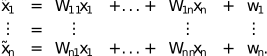 In matrix formulation, this is expressed as
  or, in abbreviated form, as
  , where
  , x and w are all
  columns and W is an
  square matrix. One often writes this in even more condensed form as
  , or
, or  ; here,
  is called the Seitz symbol.
A motion consists of a rotation part or linear part and a translation part. If the motion is represented by (W, w), the matrix W describes the rotation part of the motion and is called the matrix part of (W, w). The column w describes the translation part of the motion and is called the vector part or column part of (W, w). For a given motion, the matrix W depends only on the choice of the basis vectors, whereas the column w in general depends on the choice of the basis vectors and of the origin O; cf. Section 8.3.1
.
It is possible to combine the column and the matrix representing a motion into an  square matrix which is called the augmented matrix. The system of equations may then be expressed in the following form:
 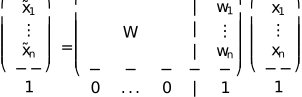 or, in abbreviated form, by
  . The augmentation is done in two steps. First, the column w is attached to the matrix and then the matrix is made square by attaching the
  row
row  . Similarly, the columns
  and have to be augmented to
  columns
  and
and  . The motion is now described by the one matrix
  instead of the pair (W, w).
If the motion is described by , the `inverse motion'  is described by
  , where
  . Successive application of two motions,
  and
and  , results in another motion
  :
:  with
with  .
.
This can be described in matrix notation as follows  and
and  with
with  or
or  with
with  .
.
It is a special advantage of the augmented matrices that successive application of motions is described by the product of the corresponding augmented matrices.
A point X is called a fixed point of the mapping if it is invariant under the mapping, i.e. 
In an n-dimensional Euclidean space , three types of motions can be distinguished:
 , where
  is called the
  ,
,  and improper motions if
  . Improper motions are called
  ;
;  and
and  ; and
; and  , where
 In Fig. 8.1.2.2, the relations between the different types of motions in  are illustrated. The diagram contains all kinds of motions except the identity mapping
  which leaves the whole space invariant and which is described by
  . Thus, it is simultaneously a special rotation (with rotation angle 0) and a special translation (with translation vector o).
![[Figure 8.1.2.2]](/figures/Abfig8o1o2o2thm.gif) | Relations between the different kinds of motions in E3; det l.p. = determinant of the linear part. The identity mapping does not fit into this scheme properly and hence has been omitted. |
So far, motions in point space have been considered. Motions give rise to mappings of the corresponding vector space onto itself. If maps the points  and
and  of onto
  and
and  , the vector
  is mapped onto the vector
  . If the motion in is described by , the vectors v of are mapped according to
  . In other words, of the linear and translation parts of the motion of , only the linear part remains in the corresponding mapping of (linear mapping). This difference between the mappings in the two spaces is particularly obvious for translations. For a translation
  with translation vector
  , no fixed point exists in , i.e. no point of is mapped onto itself by . In , however, any vector v is mapped onto itself since the corresponding linear mapping is the identity mapping.

