|
International
Tables for Crystallography Volume A Space-group symmetry Edited by M. I. Aroyo © International Union of Crystallography 2016 |
International Tables for Crystallography (2016). Vol. A. ch. 1.3, pp. 24-27
Section 1.3.2.4. Primitive and centred lattices
a
Radboud University Nijmegen, Faculty of Science, Mathematics and Computing Science, Institute for Mathematics, Astrophysics and Particle Physics, Postbus 9010, 6500 GL Nijmegen, The Netherlands |
The definition of a lattice as given in Section 1.3.2.1 states that a lattice consists precisely of the integral linear combinations of the vectors in a lattice basis. However, in crystallographic applications it has turned out to be convenient to work with bases that have particularly nice metric properties. For example, many calculations are simplified if the basis vectors are perpendicular to each other, i.e. if the metric tensor has all non-diagonal entries equal to zero. Moreover, it is preferable that the basis vectors reflect the symmetry properties of the lattice. By a case-by-case analysis of the different types of lattices a set of rules for convenient bases has been identified and bases conforming with these rules are called conventional bases. The conventional bases are chosen such that in all cases the integral linear combinations of the basis vectors are lattice vectors, but it is admitted that not all lattice vectors are obtained as integral linear combinations.
To emphasize that a basis has the property that the vectors of a lattice are precisely the integral linear combinations of the basis vectors, such a basis is called a primitive basis for this lattice.
If the conventional basis of a lattice is not a primitive basis for this lattice, the price to be paid for the transition to the conventional basis is that in addition to the integral linear combinations of the basis vectors one requires one or more centring vectors in order to obtain all lattice vectors. These centring vectors have non-integral (but rational) coordinates with respect to the conventional basis. The name centring vectors reflects the fact that the additional vectors are usually the centres of the unit cell or of faces of the unit cell spanned by the conventional basis.
Definition
Let  be linearly independent vectors in
  .
.
 .
. form a proper sublattice of
  ,
, 
 .
.
Typically, the basis is a conventional basis and in this case one often briefly says that a lattice  is a primitive lattice or a centred lattice without explicitly mentioning the conventional basis.
Example
A rectangular lattice has as conventional basis a vector  of minimal length and a vector
  of minimal length amongst the vectors perpendicular to . The resulting primitive lattice
  is indicated by the filled nodes in Fig. 1.3.2.3. Now consider the lattice having both the filled and the open nodes in Fig. 1.3.2.3 as its lattice nodes. One sees that
  ,
,  is a primitive basis for , but it is more convenient to regard
  as a centred lattice with respect to the basis
  with centring vector
  . The filled nodes then show the sublattice of , the open nodes are the translate
  and is the union
  .
.
![[Figure 1.3.2.3]](/figures/Acfig1o3o2o3thm.gif) | Primitive rectangular lattice (only the filled nodes) and centred rectangular lattice (filled and open nodes). |
Recalling that a lattice is in particular a group (with addition of vectors as operation), the sublattice spanned by the basis of a centred lattice is a subgroup of the centred lattice . Together with the zero vector  , the centring vectors form a set
  of coset representatives of relative to and the index [i] of in is s + 1. In particular, the sum of two centring vectors is, up to a vector in , again a centring vector, i.e. for centring vectors
  ,
,  there is a unique centring vector
  (possibly 0) such that
  for a vector
  .
.
The concepts of primitive and centred lattices suggest corresponding notions of primitive and centred unit cells. If is a primitive basis for the lattice , then the parallelepiped spanned by is called a primitive unit cell (or primitive cell); if spans a proper sublattice of index [i] in , then the parallelepiped spanned by is called a centred unit cell (or centred cell). Since translating a centred cell by translations from the sublattice covers the full space, the centred cell contains one representative from each coset of the centred lattice relative to . This means that the centred cell contains [i] lattice vectors of the centred lattice and due to this a centred cell is also called a multiple cell. As a consequence, the volume of the centred cell is [i] times as large as that of a primitive cell for .
For a conventional basis of the lattice , the parallelepiped spanned by  is called a conventional unit cell (or conventional cell) of . Depending on whether the conventional basis is a primitive basis or not, i.e. whether the lattice is primitive or centred, the conventional cell is a primitive or a centred cell.
Remark : It is important to note that the cell parameters given in the description of a crystallographic structure almost always refer to a conventional cell. When in the crystallographic literature the term `unit cell' is used without further attributes, in most cases a conventional unit cell (as specified by the cell parameters) is meant, which is a primitive or centred (multiple) cell depending on whether the lattice is primitive or centred.
Example (continued)
In the example of a centred rectangular lattice, the conventional basis  spans the centred unit cell indicated by solid lines in Fig. 1.3.2.4, whereas the primitive basis , spans the primitive unit cell indicated by dashed lines. One observes that the centred cell contains two lattice vectors,
  and
and  , whereas the primitive cell only contains the zero vector
  (note that due to the condition
  for the points in the unit cell the other vertices
  of the cell are excluded). The volume of the centred cell is clearly twice as large as that of the primitive cell.
![[Figure 1.3.2.4]](/figures/Acfig1o3o2o4thm.gif) | Primitive cell (dashed line) and centred cell (solid lines) for the centred rectangular lattice. |
Figures displaying the different primitive and centred unit cells as well as tables describing the metric properties of the different primitive and centred lattices are given in Section 3.1.2
.
Examples
 and
and  . As the name indicates, this basis is a primitive basis.
 which points to the centre of the conventional cell. If we denote the primitive cubic lattice by
  is the union of
  . Since
  , the ratio of the volumes of the centred and the primitive cell of the body-centred cubic lattice is 2.
 ,
,  ,
,  . With respect to this basis, the metric tensor of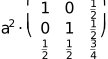
 ). However, it is more common to use a primitive basis with vectors of the same length and equal interaxial angles. Such a basis is
  ,
,  ,
,  (
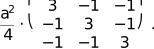
(
 ) is again the conventional basis
  ,
,  ,
,  which point to the centres of faces of the conventional cell.
 is the union of the primitive cubic lattice
  by the three centring vectors. The ratio of the volumes of the centred and the primitive cell of the face-centred cubic lattice is 4. In this case, the centring vectors actually form a primitive basis of
  ,
,  ,
,  (
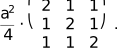
(
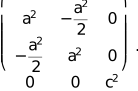
 is mapped to the points
  and
and  under the threefold rotation around the
  by lattice vectors of
  . This means that a centring vector of the form
  will result in a lattice which is invariant under the threefold rotation. Choosing
  as centring vector, the lattice generated by
  contains
  ,
,  and
and  . The coset representative
  is commonly replaced by
  and the centred lattice
  with centring vectors
  so obtained is called the
  ,
,  ,
,  . The metric tensor with respect to this basis is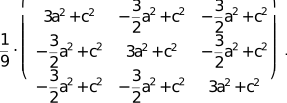
Remark
: In three-dimensional space , the conventional bases have been chosen in such a way that any isometry of a centred lattice maps the sublattice generated by the conventional basis to itself. This means that the matrices of the isometries of the lattice are not only integral with respect to a primitive basis, but also when written with respect to the conventional basis. The advantage of the conventional basis is that the matrices are much simpler.
In dimensions  , such a choice of a conventional basis is in general no longer possible. For example, one will certainly regard the standard orthonormal basis
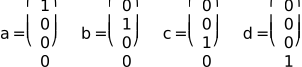 of the four-dimensional hypercubic lattice as a conventional basis. The body-centred lattice with centring vector
  is invariant under all the isometries of the hypercubic lattice, but the body-centred lattice itself allows isometries that do not leave the hypercubic lattice invariant. Thus, not all isometries of the body-centred lattice are integral with respect to the conventional basis of the hypercubic lattice.

