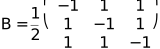
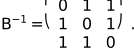
|
International
Tables for Crystallography Volume A Space-group symmetry Edited by M. I. Aroyo © International Union of Crystallography 2016 |
International Tables for Crystallography (2016). Vol. A. ch. 1.3, pp. 27-28
Section 1.3.2.5. Reciprocal lattice
a
Radboud University Nijmegen, Faculty of Science, Mathematics and Computing Science, Institute for Mathematics, Astrophysics and Particle Physics, Postbus 9010, 6500 GL Nijmegen, The Netherlands |
For crystallographic applications, a lattice  related to
  is of utmost importance. If the atoms are placed at the nodes of a lattice , then the diffraction pattern will have sharp Bragg peaks at the nodes of the reciprocal lattice
  . More generally, if the crystal pattern is invariant under translations from , then the locations of the Bragg peaks in the diffraction pattern will be invariant under translations from .
Definition
Let  be a lattice with lattice basis
  . Then the reciprocal basis
  is defined by the properties
  and
and which can conveniently be written as the matrix equation
This means that  is perpendicular to the plane spanned by
  and
and  and its projection to the line along
  has length
  . Analogous properties hold for
  and
and  .
.
The reciprocal lattice of is defined to be the lattice with lattice basis .
In three-dimensional space  , the reciprocal basis can be determined via the vector product. Assuming that
  form a right-handed system that spans a unit cell of volume V, the relation
  and the defining conditions
  ,
,  imply that
  . Analogously, one has
  and
and  .
.
The reciprocal lattice can also be defined independently of a lattice basis by stating that the vectors of the reciprocal lattice have integral scalar products with all vectors of the lattice: 
Owing to the symmetry  of the scalar product, the roles of the basis and its reciprocal basis can be interchanged. This means that
  , i.e. taking the reciprocal lattice
  of the reciprocal lattice results in the original lattice again.
Remark
: In parts of the literature, especially in physics, the reciprocal lattice is defined slightly differently. The condition there is that  if
if  and 0 otherwise and thus the reciprocal lattice is scaled by the factor 2π as compared to the above definition. By this variation the exponential function
  is changed to
  , which simplifies the formulas for the Fourier transform.
Example
Let be the lattice basis of a primitive cubic lattice. Then the body-centred cubic lattice  with centring vector
  is the reciprocal lattice of the rescaled face-centred cubic lattice
  , i.e. the lattice spanned by
  and the centring vectors
  ,
,  ,
,  .
.
This example illustrates that a lattice and its reciprocal lattice need not have the same type. The reciprocal lattice of a body-centred cubic lattice is a face-centred cubic lattice and vice versa. However, the conventional bases are chosen such that for a primitive lattice with a conventional basis as lattice basis, the reciprocal lattice is a primitive lattice of the same type. Therefore the reciprocal lattice of a centred lattice is always a centred lattice for the same type of primitive lattice.
The reciprocal basis can be read off the inverse matrix of the metric tensor  : We denote by
  the matrix containing the coordinate columns of
  with respect to the basis , so that
  etc. Recalling that scalar products can be computed by multiplying the metric tensor from the left and right with coordinate columns with respect to the basis , the conditions
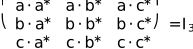 defining the reciprocal basis result in the matrix equation
  , since the coordinate columns of the basis with respect to itself are the rows of the identity matrix
  , and was just defined to contain the coordinate columns of . But
  means that
  and thus the coordinate columns of with respect to the basis are precisely the columns of the inverse matrix
  of the metric tensor .
From one also derives that the metric tensor  of the reciprocal basis is
  This means that the metric tensors of a basis and its reciprocal basis are inverse matrices of each other. As a further consequence, the volume
  of the unit cell spanned by the reciprocal basis is
  , i.e. the inverse of the volume of the unit cell spanned by .
Of course, the reciprocal basis can also be computed from the vectors  directly. If
  and
and  are the matrices containing as ith column the vectors and
  , respectively, then the relation defining the reciprocal basis reads as
  , i.e.
  . Thus, the reciprocal basis vector is the ith column of the transposed matrix of
  and thus the ith row of the inverse of the matrix containing the as columns.
The relations between the parameters of the unit cell spanned by the reciprocal basis vectors and those of the unit cell spanned by the original basis can either be obtained from the vector product expressions for , , or by explicitly inverting the metric tensor (e.g. using Cramer's rule). The latter approach would also be applicable in n-dimensional space. Either way, one finds 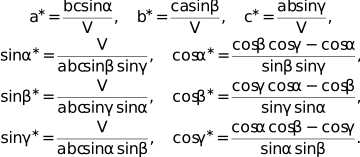
Examples

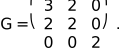
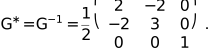


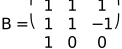
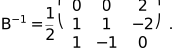
 has the vectors