|
International
Tables for Crystallography Volume A Space-group symmetry Edited by M. I. Aroyo © International Union of Crystallography 2016 |
International Tables for Crystallography (2016). Vol. A. ch. 1.3, pp. 28-29
Section 1.3.3.1. Point groups of space groups
a
Radboud University Nijmegen, Faculty of Science, Mathematics and Computing Science, Institute for Mathematics, Astrophysics and Particle Physics, Postbus 9010, 6500 GL Nijmegen, The Netherlands |
The multiplication rule for symmetry operations  shows that the mapping
  which assigns a space-group operation to its linear part is actually a group homomorphism, because the first component of the combined operation is simply the product of the linear parts of the two operations. As a consequence, the linear parts of a space group form a group themselves, which is called the point group of
  . The kernel of the homomorphism Π consists precisely of the translations
  , and since kernels of homomorphisms are always normal subgroups (cf. Section 1.1.6
![[link]](/graphics/greenarr.gif) ), the translation subgroup
), the translation subgroup  forms a normal subgroup of . According to the homomorphism theorem (see Section 1.1.6
), the point group is isomorphic to the factor group
forms a normal subgroup of . According to the homomorphism theorem (see Section 1.1.6
), the point group is isomorphic to the factor group  .
.
Definition
The point group  of a space group
  is the group of linear parts of operations occurring in . It is isomorphic to the factor group
  of by the translation subgroup .
When is considered with respect to a coordinate system, the operations of are simply 3 × 3 matrices.
The point group plays an important role in the analysis of the macroscopic properties of crystals: it describes the symmetry of the set of face normals and can thus be directly observed. It is usually obtained from the diffraction record of the crystal, where adding the information about the translation subgroup explains the sharpness of the Bragg peaks in the diffraction pattern.
Although we have already deduced that the translation subgroup  of a space group forms a normal subgroup in because it is the kernel of the homomorphism mapping each operation to its linear part, it is worth investigating this fact by an explicit computation. Let
  be a translation in and
  an arbitrary operation in , then one has
 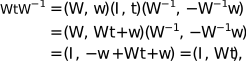 which is again a translation in , namely by
  . This little computation shows an important property of the translation subgroup with respect to the point group, namely that every vector from the translation lattice is mapped again to a lattice vector by each operation of the point group of .
Proposition.
Let be a space group with point group and translation subgroup and let  be the lattice of translations in . Then
  acts on the lattice
  , i.e. for every
  and
and  one has
  .
.
A point group that acts on a lattice is a subgroup of the full group of symmetries of the lattice, obtained as the group of orthogonal mappings that map the lattice to itself. With respect to a primitive basis, the group of symmetries of a lattice consists of all integral basis transformations that fix the metric tensor of the lattice.
Definition
Let be a three-dimensional lattice with metric tensor  with respect to a primitive basis
  .
.
 with
with  .
.
 acts on the coordinate columns of
 Since the isometries in the Bravais group of a lattice preserve distances, the possible images of the vectors in a basis are vectors of the same lengths as the basis vectors. But due to its discreteness, a lattice contains only finitely many lattice vectors up to a given length. This means that a lattice automorphism can only permute the finitely many vectors up to the maximum length of a basis vector. Thus, there can only be finitely many automorphisms of a lattice. This argument proves the following important fact:
Theorem. The Bravais group of a lattice is finite. As a consequence, point groups of space groups are finite groups.
As subgroups of the Bravais group of a lattice, point groups can be realized as integral matrix groups when written with respect to a primitive basis. For a centred lattice, it is possible that the Bravais group of a lattice contains non-integral matrices, because the centring vector is a column with non-integral entries. However, in dimensions two and three the conventional bases are chosen such that the Bravais groups of all lattices are integral when written with respect to a conventional basis.
Information on the Bravais groups of the primitive lattices in two- and three-dimensional space is displayed in Tables 1.3.3.1 and 1.3.3.2. The columns of the tables contain the names of the lattices, the metric tensor with respect to the conventional basis (with only the upper half given, the lower half following by the symmetry of the metric tensor), the Hermann–Mauguin symbol for the type of the Bravais group and generators of the Bravais group (given in the shorthand notation introduced in Section 1.2.2.1
and the corresponding Seitz symbols discussed in Section 1.4.2.2
).
| |||||||||||||||||||||||||||||||||


| ||||||||||||||||||||||||||||||||||||||||||||||||||||||||||||||||||
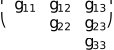


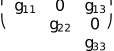


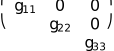


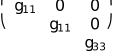


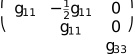


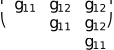


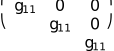

The finiteness and integrality of the point groups has important consequences. For example, it implies the crystallographic restriction that rotations in space groups of two- and three-dimensional space can only have orders 1, 2, 3, 4 or 6. On the one hand, an integral matrix clearly has an integral trace.1 But a matrix  with the property that
  can be diagonalized over the complex numbers and the diagonal entries have to be kth roots of unity, i.e. powers of
  . Since diagonalization does not change the trace, the sum of these kth roots of unity still has to be an integer and in particular these roots of unity have to occur in complex conjugate pairs. In dimension 2 this means that the two diagonal entries are complex conjugate and the only possible ways to obtain an integral trace are
  ,
,  ,
,  ,
,  and
and  . In dimension 3 the third diagonal entry does not have a complex conjugate partner, and therefore has to be
  . Thus the possible orders in dimension 3 are the same as in dimension 2.
A much stronger result was obtained by H. Minkowski (1887). He gave an explicit bound for the maximal power  of a prime p which can divide the order of an n-dimensional finite integral matrix group. In dimension 2 this theorem implies that the orders of the point groups divide 24 and in dimension 3 the orders of the point groups divide 48. The Bravais groups 4mm (of order 8) and 6mm (of order 12) of the square and hexagonal lattices in dimension 2 and the Bravais group
  (of order 48) of the cubic lattice in dimension 3 show that Minkowski's result is the best possible in these dimensions.
References
 Minkowski, H. (1887). Zur Theorie der positiven quadratischen Formen. J. Reine Angew. Math. 101, 196–202.Google Scholar

