|
International
Tables for Crystallography Volume D Physical properties of crystals Edited by A. Authier © International Union of Crystallography 2013 |
International Tables for Crystallography (2013). Vol. D. ch. 1.11, pp. 269-283
https://doi.org/10.1107/97809553602060000910 Chapter 1.11. Tensorial properties of local crystal susceptibilities
a
A. V. Shubnikov Institute of Crystallography, Leninsky pr. 59, Moscow 119333, Russia,bSteinmann Institut der Universität Bonn, Poppelsdorfer Schloss, Bonn, D-53115, Germany, and cFaculty of Physics, M. V. Lomonosov Moscow State University, Leninskie Gory, Moscow 119991, Russia With the advent of synchrotron radiation, non-magnetic and magnetic resonant X-ray diffraction has become an important tool in modern materials research, e.g. on electronic states of systems. Polarized X-rays are sensitive to the local environments of resonant scattering atoms and their partial structures. At energies close to an absorption edge of an absorbing element, in particular, `forbidden' reflections can be excited, which would be extinct in absence of local anisotropic X-ray susceptibility. Anisotropy of energy-dependent susceptibility is treated in terms of tensor atomic scattering factors, giving rise to tensor structure factors, so that the intensity and polarization of the scattered radiation depend not only on the energy and polarization of the incident radiation, but also on both the crystal symmetry and the site symmetry. Owing to the anisotropy, rotation of the crystal about the scattering vector (azimuthal rotation) becomes an additional important parameter of investigation. This chapter considers the treatment and potential of anisotropic resonant scattering, both in the absence and presence of magnetic scattering, and the impact of symmetry on local physical properties, particularly symmetry and physical phenomena that allow and restrict forbidden reflections as well as reflections caused by magnetic scattering. Keywords: X-ray susceptibility; resonant diffraction; forbidden reflections; X-ray magnetic scattering. |
The tensorial characteristics of macroscopic physical properties (as described in Chapters 1.3 , 1.4
and 1.6
–1.8
of this volume) are determined by the crystal point group, whereas the symmetry of local crystal properties, such as atomic displacement parameters (Chapter 1.9
) or electric field gradient tensors (Section 2.2.15
) are regulated by the crystal space group. In the present chapter, we consider further examples of the impact of symmetry on local physical properties, particularly both symmetry and physical phenomena that allow and restrict forbidden reflections excited at radiation energies close to X-ray absorption edges of atoms, and reflections caused by magnetic scattering.
, 1.4
and 1.6
–1.8
of this volume) are determined by the crystal point group, whereas the symmetry of local crystal properties, such as atomic displacement parameters (Chapter 1.9
) or electric field gradient tensors (Section 2.2.15
) are regulated by the crystal space group. In the present chapter, we consider further examples of the impact of symmetry on local physical properties, particularly both symmetry and physical phenomena that allow and restrict forbidden reflections excited at radiation energies close to X-ray absorption edges of atoms, and reflections caused by magnetic scattering.
We begin with the X-ray dielectric susceptibility, which expresses the response of crystalline matter to an incident X-ray wave characterized by its energy (frequency), polarization and wavevector. The response is a polarization of the medium, finally resulting in a scattered wave with properties generally different from the initial ones. Thus, the dielectric susceptibility plays the role of a scattering amplitude, which relates the scattered wave to the incident wave. This is the basis of the different approaches to X-ray diffraction theories presented in Chapters 1.2
and 5.1
of International Tables for Crystallography Volume B (2008). Here, we consider only elastic scattering, i.e. the energies of the incident and scattered waves are identical, and the X-ray susceptibility is assumed to comply with the periodicity of the crystalline matter.
It is important that the dielectric susceptibility is (i) a local crystal property and (ii) a tensor physical property, because it relates the polarization vectors of the incident and scattered radiation. Consequently, the symmetry of the tensor is determined by the symmetry of the crystal space group, rather than by that of the point group as in conventional optics. In the vast majority of X-ray applications, this tensor can reasonably be assumed to be given by the product of the unit tensor and a scalar susceptibility, which is proportional to the electron density plus exclusively energy-dependent dispersion corrections as considered in Section 4.2.6
of International Tables for Crystallography Volume C (2004). As a result of atomic wavefunction distortions caused by neighbouring atoms, these scalar dispersion corrections can also become anisotropic tensors, namely in the close vicinity (usually less than about 50 eV) of absorption edges of elements. For heavy elements, the anisotropy of the tensor atomic factor can exceed 20 e atom−1. Appropriate references to detailed descriptions of the phenomenon can be found in Brouder (1990), Materlik et al. (1994) and in Section 4.2.6
of Volume C (2004).
However, even if the anisotropy of the atomic factor is small, it can be crucial for some effects, for instance the excitation of so-called `forbidden' reflections, which vanish in absence of anisotropy. Indeed, the crystal symmetry imposes strong restrictions on the indices of possible (`allowed') reflections. The systematic reflection conditions for the different space groups and for special atomic sites in the unit cell are listed in International Tables for Crystallography Volume A
(Hahn, 2005). The resulting extinctions are due to (i) the translation symmetry of the non-primitive Bravais lattices, (ii) the symmetry elements of the space group (glide planes and/or screw axes) and (iii) special sites. The first kind cannot be violated. The other extinctions are obtained if the atomic scattering factor (as the Fourier transform of an independent atom/ion with spherically symmetric electron-density distribution) is an element-specific scalar that depends only on the scattering-vector length and the dispersion corrections. Then the intensities of extinct reflections generally vanish. These reflections are `forbidden', but for different physical reasons not all of their intensities are necessarily strictly zero. Such reflections can appear owing to an asphericity of (i) an atomic electron-density distribution caused by chemical bonding and/or (ii) atomic vibrations (Dawson, 1975) if the atom in question occupies a special site.
In contrast, an anisotropy of the atomic factor affects all reflections and can therefore violate general extinction rules related to glide planes and/or screw axes, i.e. symmetry elements with translation components, in nonsymmorphic space groups. Even a very small X-ray anisotropy can be quantitatively studied with this type of forbidden reflections, and yield information about electronic states of crystals or partial structures of resonant scatterers. This was first recognized by Templeton & Templeton (1980), and a detailed theory was developed only a few years later (Dmitrienko, 1983, 1984). The excitation of forbidden reflections caused by anisotropic anomalous scattering was first observed in an NaBrO3 crystal (Templeton & Templeton, 1985, 1986) and then studied for Cu2O (Eichhorn & Kirfel, 1988), TiO2 and MnF2 (Kirfel & Petcov, 1991), and for many other compounds with different crystal symmetries. Within the dipole approximation, a systematic compilation of `forbidden' reflection properties for all relevant space groups up to tetragonal symmetry and an application to partial-structure analysis followed (Kirfel et al., 1991; Kirfel & Petcov, 1992; Kirfel & Morgenroth, 1993; Morgenroth et al., 1994). Today, there are numerous surveys devoted to this well developed subject, and further details, applications and references can be found therein (Belyakov & Dmitrienko, 1989; Carra & Thole, 1994; Hodeau et al., 2001; Lovesey et al., 2005; Dmitrienko et al., 2005; Altarelli, 2006; Collins et al., 2007; Collins & Bombardi, 2010; Finkelstein & Dmitrienko, 2012). Forbidden reflections of the last type have also been observed (well before corresponding X-ray studies) in diffraction of Mössbauer radiation (Belyakov & Aivazyan, 1969; Belyakov, 1975; Champeney, 1979) and, at optical wavelengths, in the blue phases of chiral liquid crystals (Belyakov & Dmitrienko, 1985; Wright & Mermin, 1989; Seideman, 1990; Crooker, 2001). Similar phenomena have also been reported to exist in chiral smectic liquid crystals (Gleeson & Hirst, 2006; Barois et al., 2012) and, considering neutron diffraction, in crystals with local anisotropy of the magnetic susceptibility (Gukasov & Brown, 2010). All these latter findings are, however, beyond the scope of this chapter.
X-ray polarization phenomena similar to those in visible optics and spectroscopy (birefringence, linear and circular dichroism, the Faraday rotation) have been discussed since the beginning of the 20th century (Hart & Rodriques, 1981; Templeton & Templeton, 1980, 1982). Experimental studies and applications were mainly prompted by the development of synchrotrons and storage devices as sources of polarized X-rays (a historical overview can be found in Rogalev et al., 2006). In particular, for non-magnetic media, X-ray natural circular dichroism (XNCD) is used as a method for studying electronic states with mixed parity (Natoli et al., 1998; Goulon et al., 2003). Various kinds of X-ray absorption spectroscopies using polarized X-rays have been developed for magnetic materials; examples are XMCD (X-ray magnetic circular dichroism) (Schütz et al., 1987; Thole et al., 1992; Carra et al., 1993) and XMLD (X-ray magnetic linear dichroism) (Thole et al., 1986; van der Laan et al., 1986; Arenholz et al., 2006; van der Laan et al., 2008). X-ray magnetochiral dichroism (XM D) was discovered by Goulon et al. (2002) and is used as a probe of toroidal moment in solids. Sum rules connecting X-ray spectral parameters with the physical properties of the medium have also been developed (Thole et al., 1992; Carra et al., 1993; Goulon et al., 2003) for various kinds of X-ray spectroscopies and are widely used for applications. These types of X-ray absorption spectroscopies are not considered here, as this chapter is mainly devoted to X-ray tensorial properties observed in single-crystal diffraction.
Several different approaches can be used to determine the local susceptibility with appropriate symmetry. For illustration, we start with the simple but very important case of a symmetric tensor of rank 2 defined in the Cartesian system,  (in this case, we do not distinguish covariant and contravariant components, see Chapter 1.1
). From the physical point of view, such tensors appear in the dipole–dipole approximation (see Section 1.11.4).
(in this case, we do not distinguish covariant and contravariant components, see Chapter 1.1
). From the physical point of view, such tensors appear in the dipole–dipole approximation (see Section 1.11.4).
The most general expression for the tensor of susceptibility is exclusively restricted by the crystal symmetry, i.e.  must be invariant against all the symmetry operations
  of the given space group
  :
: where
where  is the matrix of the point operation (rotation or mirror reflection),
  , and
, and  is the associated vector of translation. The index
  indicates a transposed matrix, and summation over repeated indices is implied hereafter. To meet the above demand, it is obviously sufficient for to be invariant against all generators of the group .
There is a simple direct method for obtaining obeying equation (1.11.2.1): we can take an arbitrary second-rank tensor  and average it over all the symmetry operations :
 where
where  is the number of elements in the group . A small problem is that is infinite for any space group, but this can be easily overcome if we take as periodic and obeying the translation symmetry of the given Bravais lattice. Then the number of the remaining symmetry operations becomes finite (an example of this approach is given in Section 1.11.2.3).
In spite of its simplicity, equation (1.11.2.1) provides non-trivial restrictions on the tensorial structure factors of Bragg reflections. The sets of allowed reflections, listed in International Tables for Crystallography Volume A
(Hahn, 2005) for all space groups and for all types of atom sites, are based on scalar X-ray susceptibility. In this case, reflections can be forbidden (i.e. they have zero intensity) owing to glide-plane and/or screw-axis symmetry operations. This is because the scalar atomic factors remain unchanged upon mirror reflection or rotation, so that the contributions from symmetry-related atoms to the structure factors can cancel each other. In contrast, atomic tensors are sensitive to both mirror reflections and rotations, and, in general, the tensor atomic factors of symmetry-related atoms have different orientations in space. As a result, forbidden reflections can in fact be excited just due to the anisotropy of susceptibility, so that the selection rules for possible reflections change.
It is easy to see how the most general tensor form of the structure factors can be deduced from equation (1.11.2.1). The structure factor of a reflection with reciprocal-lattice vector  is proportional to the Fourier harmonics of the susceptibility. The corresponding relations (Authier, 2005, 2008) simply have to be rewritten in tensorial form:
 where
where  is the classical electron radius,
  is the X-ray wavelength and
  is the volume of the unit cell.
Considering first the glide-plane forbidden reflections, there may, for instance, exist a glide plane  perpendicular to the
  axis, i.e. any point
  is transformed by this plane into
  . The corresponding matrix of this symmetry operation changes the sign of ,
 and the translation vector into
  . Substituting (1.11.2.4) into (1.11.2.1) and exchanging the integration variables in (1.11.2.3), one obtains for the structure factors of reflections
 If
If  is scalar, i.e.
  , then
 for odd
  , hence
  vanishes. This is the well known conventional extinction rule for a glide plane, see International Tables for Crystallography Volume A
(Hahn, 2005). If, however, is a tensor, the mirror reflection
vanishes. This is the well known conventional extinction rule for a glide plane, see International Tables for Crystallography Volume A
(Hahn, 2005). If, however, is a tensor, the mirror reflection  changes the signs of the
  and
and  tensor components [as is also obvious from equation (1.11.2.5)]. As a result, the and components should not vanish for
  and the tensor structure factor becomes
 In general, the elements
  and
and  are complex, and it should be emphasized from the symmetry point of view that they are different and arbitrary for different
  and . However, from the physical point of view, they can be readily expressed in terms of tensor atomic factors, where only those chemical elements are relevant whose absorption-edge energies are close to the incident radiation energy (see below).
It is also easy to see that for the non-forbidden (= allowed) reflections  , the non-zero tensor elements are just those which vanish for the forbidden reflections:
 Here the result is mainly provided by the diagonal elements
  , but there is still an anisotropic part that contributes to the structure factor, as expressed by the off-diagonal element. In principle, the effect on the total intensity as well as the element itself can be assessed by careful measurements using polarized radiation.
For the screw-axis forbidden reflections, the most general form of the tensor structure factor can be found as before (Dmitrienko, 1983; see Table 1.11.2.1). Again, as in the case of the glide plane, for each forbidden reflection all components of the tensor structure factor are determined by at most two independent complex elements and . There may, however, exist further restrictions on these tensor elements if other symmetry operations of the crystal space group are taken into account. For example, although there are  screw axes in space group
  ,
,  and reflections
  remain forbidden because the lattice is body centred, and this applies not only to the dipole–dipole approximation considered here, but also within any other multipole approximation.
|
 ) and independent components of their tensorial structure factors
 ,
,  ,
,  . The direction of the


In Table 1.11.2.1, resulting from the dipole–dipole approximation, some reflections still remain forbidden. For instance, in the case of a  screw axis, there is no anisotropy of susceptibility in the plane due to the inevitable presence of the threefold rotation axis. For
  and
and  axes, the reflections with
  also remain forbidden because only dipole–dipole interaction (of X-rays) is taken into account, whereas it can be shown that, for example, quadrupole interaction permits the excitation of these reflections.
Let us consider in more detail the local tensorial properties of cubic crystals. This case is particularly interesting because for cubic symmetry the second-rank tensor is isotropic, so that a global anisotropy is absent (but it exists for tensors of rank 4 and higher). Local anisotropy is of importance for some physical parameters, and it can be described by tensors depending periodically on the three space coordinates. This does not only concern X-ray susceptibility, but can also, for instance, result from describing orientation distributions in chiral liquid crystals (Belyakov & Dmitrienko, 1985) or atomic displacements (Chapter 1.9
of this volume) and electric field gradients (Chapter 2.2
of this volume) in conventional crystals.
The symmetry element common to all cubic space groups is the threefold axis along the cube diagonal. The matrix  of the symmetry operation is
 This transformation results in the circular permutation
 , and from equation (1.11.2.1) it is easy to see that invariance of
  demands the general form
 where
where  and
and  are arbitrary functions with the periodicity of the corresponding Bravais lattice:
  for primitive lattices (
 being arbitrary integers) plus in addition
  =
=  for body-centered lattices or
  =
=  =
=  = for face-centered lattices.
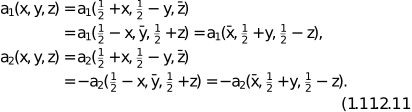
Depending on the space group, other symmetry elements can enforce further restrictions on and :
 :
:
 :
:
 : (1.11.2.10) and
 : (1.11.2.10) and
 : (1.11.2.10) and
 : (1.11.2.11) and (1.11.2.12).
 : (1.11.2.10)
 : (1.11.2.10) and
 : (1.11.2.11) and
 : (1.11.2.11) and
 : (1.11.2.10) and
 : (1.11.2.10) and
 : (1.11.2.11) and
 : (1.11.2.10), (1.11.2.12) and (1.11.2.19).
 : (1.11.2.10), (1.11.2.13) and (1.11.2.15).
 : (1.11.2.10), (1.11.2.12) and (1.11.2.20).
 : (1.11.2.10), (1.11.2.13) and (1.11.2.19).
 : (1.11.2.10), (1.11.2.14) and (1.11.2.19).
 : (1.11.2.10), (1.11.2.13) and (1.11.2.20).
 : (1.11.2.11), (1.11.2.12) and (1.11.2.21).
For all , the sets of coordinates are chosen here as in International Tables for Crystallography Volume A
(Hahn, 2005); the first one being adopted if Volume A offers two alternative origins. The expressions (1.11.2.10) or (1.11.2.11) appear for all space groups because all of them are supergroups of  or
or  .
.
The tensor structure factors of forbidden reflections can be further restricted by the cubic symmetry, see Table 1.11.2.2. For the glide plane , the tensor structure factor of  reflections is given by (1.11.2.6), whereas for the diagonal glide plane
  , it is given by
 and additional restrictions on and can become effective for
  or
or  . For forbidden reflections of the
  type, the tensor structure factor is either
 or
or see Table 1.11.2.2.
|
 for the cubic space groups (


 for
for 
















 for
for 

There are two important properties that distinguish forbidden reflections from conventional (`allowed') ones: non-trivial polarization effects and strong azimuthal dependence of intensity (and sometimes also of polarization) corresponding to the symmetry of the direction of the scattering vector. The azimuthal dependence means that the intensity and polarization properties of the reflection can change when the crystal is rotated around the direction of the reciprocal-lattice vector, i.e. they change with the azimuthal angle of the incident wavevector k defined relative to the scattering vector. The polarization and azimuthal properties, both mainly determined by symmetry, are two of the most informative characteristics of forbidden reflections. A third one, energy dependence, is determined by physical interactions, electronic and/or magnetic, where the role of symmetry is indirect but nevertheless also important (e.g. in splitting of atomic levels etc., see Section 1.11.4).
In the kinematical theory, usually used for weak reflections, one obtains for unpolarized incident radiation the intensity of a conventional reflection as given by where
where  is the Bragg angle,
  is the scalar structure factor of reflection , and
  is a scale factor, which depends on the incident beam intensity, the sample volume, the geometry of diffraction etc. (see International Tables for Crystallography Volume B
), and can be set to
is a scale factor, which depends on the incident beam intensity, the sample volume, the geometry of diffraction etc. (see International Tables for Crystallography Volume B
), and can be set to  hereafter.
If the structure factor is a tensor of rank 2, then the reflection intensity obtained with incident and reflected radiation with polarization vectors, respectively,  and
and  (prepared and analysed by a corresponding polarizer and analyser) is given by
 where the star denotes the complex conjugate. The maximum of this expression is reached when is equal to the polarization of the diffracted beam. In general, the polarization of the diffracted secondary radiation,
  , depends on the incident beam polarization :
 where
where (the second term in this expression provides orthogonality between the polarization vector and the corresponding wavevector). If the polarization of the diffracted beam is not analysed, the total intensity of the diffracted beam
  is equal to
  . If the tensor structure factor is a direct product of two vectors, then the polarization of the diffracted beam does not depend on the incident polarization.
The polarization analysis of forbidden reflections frequently uses the linear polarization vectors  and
and  . Vector is perpendicular to the scattering plane, whereas the vectors and
  are in the scattering plane so that
  and
and  form right-hand triads. Note that the components of the polarization vectors,
  etc., change with the azimuthal angle if the crystal is rotated about the scattering vector.
In special cases, circular polarizations are very useful and sometimes even indispensable, because they enable us to distinguish right- and left-hand crystals or to unravel interferences between magnetic and electric scattering (see below).
If the incident radiation is - or -polarized or non-polarized, then the total reflection intensities for these three cases are given by the following expressions:

 A more general approach uses the Stokes parameters for the description of partially polarized X-rays and the Müller matrices for the scattering process (see a survey by Detlefs et al., 2012). This issue will, however, not be discussed further since there is no principal difference to conventional optics.
Let us consider the polarization and azimuthal characteristics of screw-axis forbidden reflections listed in Table 1.11.2.1. These characteristics are rather different for two types of reflections: type I reflections are those for which  , while all other reflections constitute the rest, type II.
The type-I forbidden reflections have the simplest polarization properties. From equations (1.11.3.5)–(1.11.3.7) and Table 1.11.2.1, one obtains  and
and 
 , where
  is given by
 for a screw axis and
 for
for  ,
,  , and screw axes, where
  is the azimuthal angle of crystal rotation about the scattering vector . Thus, -polarized incident radiation results in reflected radiation with polarization and vice versa; and unpolarized incident radiation gives unpolarized reflected radiation.
Note that there is no azimuthal dependence of intensity in (1.11.3.10). Nevertheless, the phase of the diffracted beams changes with azimuthal rotation, as might be observed via interference with another scattering process, for example, with multiple (Renninger) diffraction. Such measurements could also be useful for determining the phases of the complex and above.
The polarization properties of type-II reflections are quite distinct from those of type-I reflections. The intensities belonging to various polarization channels, i.e. combinations of primary and secondary beam polarizations ( ,
,  etc.), exhibit different azimuthal symmetries for different screw axes.
For  and
and  screw axes, the azimuthal symmetry is threefold:
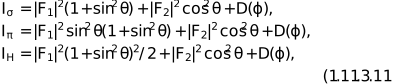 where
where  . The
. The  sign corresponds to
  in Table 1.11.2.1.
For , , and  screw axes, the symmetry is fourfold:
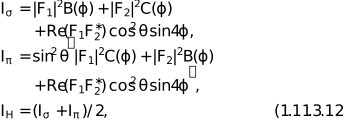 where
where  and
and  .
.
No azimuthal dependence exists for the screw axes ,  ,
,  and :
and :
Unlike the type-I reflections, the intensities of the type-II reflections are different for - and -polarized incident beams. What is more interesting is that type-II reflections are `chiral', i.e. their intensities differ for right-hand and left-hand circularly polarized incident radiation. As an example, we take the type-II back-reflections ( ) for three- and sixfold screw axes. We find from Table 1.11.2.1 and equations (1.11.3.1) and (1.11.3.3) that only the beams with definite circular polarization (right-hand if
  and left-hand if
  ) are reflected and that the back-reflected radiation has the same circular polarization in both cases. For opposite polarization, the reflection is absent. Thus, under these circumstances, the crystal may be regarded as a circular polarizer or analyser. If
  , the eigen-polarizations are elliptic and the axial ratio of the polarization ellipse is equal to
  for the sixfold screw axes (whereas for the three- and fourfold screw axes, this ratio depends on the parameters and ).
The chirality of type-II reflections can be used to distinguish enantiomorphous crystals. Although this was suggested many years ago, its potential was only recently proved by experiments, first on α-quartz, SiO2, and berlinite, AlPO4 (Tanaka et al., 2008; Tanaka, Kojima et al., 2010), later for tellurium (Tanaka, Collins et al., 2010). All three candidates crystallize in the space groups  or
or  . The case of tellurium is particularly interesting because standard X-ray diffraction methods for absolute structure determination fail in elemental crystals.
The non-trivial polarization and azimuthal properties discussed above are, in most cases, determined by symmetry, and they are used as evidence confirming the origin of the forbidden reflections. They are also used for obtaining detailed information about anisotropy of local susceptibility and, hence, about structural and electronic properties. For instance, careful analysis of polarization and azimuthal dependences allows one to distinguish between different scenarios of the Verwey phase transition in magnetite, Fe3O4 – a longstanding and confusing problem (see Hagiwara et al., 1999; García et al., 2000; Renevier et al., 2001; García & Subías, 2004; Nazarenko et al., 2006; Subías et al., 2012).
Conventional non-resonant Thomson scattering in condensed matter is the result of the interaction of the electric field of the electromagnetic wave with the charged electron subsystem. However, there are also other mechanisms of interaction, e.g. interaction of electromagnetic waves with spin and orbital moments, which was first considered by Platzman & Tzoar (1970) for molecules and solids. They predicted the sensitivity of X-ray diffraction to a magnetic structure of a crystal, as later observed in the pioneering works of de Bergevin & Brunel (de Bergevin & Brunel, 1972, 1981; Brunel & de Bergevin, 1981). It is reasonable to describe all X-ray–electron interactions by the Pauli equation (Berestetskii et al., 1982), which is a low-energy approximation to the Dirac equation (typical X-ray energies are 
 where m is the electron mass). The equation accounts for charge and spin interaction with the electromagnetic field of the wave, and spin–orbit interaction (Blume, 1985, 1994) using the following Hamiltonian:
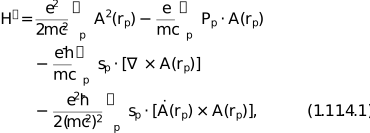 where
where  is the momentum of the pth electron, and
  is the vector potential of the electromagnetic wave with wavevector
  and polarization .
Here and below  +
+  , where is a quantization volume, index
  labels two polarizations of each wave,
  are the polarizations vectors, and
  and
and  are the photon annihilation and creation operators.
Considering X-ray scattering by different atoms in solids as independent processes [in Section 1.2.4
of International Tables for Crystallography Volume B, this is called `the isolated-atom approximation in X-ray diffraction'; the validity of this approximation has been discussed by Kolpakov et al. (1978)], the atomic scattering amplitude  , which describes the scattering of a wave with wavevector and polarization into a wave with wavevector
  and polarization , can be written as
 where the tensor atomic factor
  depends not only on the wavevectors but also on the atomic environment, magnetic and orbital moments etc. From equation (1.11.4.1) and with the help of perturbation theory (Berestetskii et al., 1982), the atomic factor can be expressed as
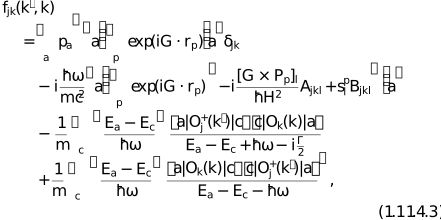 where the first line describes the non-resonant Thomson scattering and
  is the energy width of the excited state
  . The second line gives non-resonant magnetic scattering with the spin and orbital terms given by the rank-3 tensors
  (1.11.5.2) and
  (1.11.5.1), respectively. Compared to the second-to-last line, where the energy denominator can be close to zero, the last line is usually neglected, but sometimes it has to be added to the non-resonant terms, in particular at photon energies far from resonance. The third term gives the dispersion corrections also addressed as resonant scattering, magnetic and non-magnetic. In equation (1.11.4.3),
  and
and  are the ground and excited states energies, respectively;
  is the probability that the incident state of the scatterer
  is occupied; and
  is the scattering vector (in the case of diffraction
  , where is the Bragg angle). The vector operator
  has the form
 The second term in this equation is small and is frequently omitted.
In general, the total atomic scattering factor looks like where
where  is the ordinary Thomson (non-resonant) factor,
  and
and  are the isotropic corrections to the dispersion and absorption, which become stronger near absorption edges (
 ), and
  and
and  are the real and imaginary contributions accounting for resonant anisotropic scattering and are sensitive to the local symmetry of the resonant atom and its magnetism. In the latter case, one should add the tensor
  (
( –
– ) describing magnetic non-resonant scattering, which is also anisotropic (see the next section).
Far from resonance ( ), the non-resonant parts of the scattering factor,
  and , described by the first two terms in (1.11.4.3) are the most important. In the classical approximation (Brunel & de Bergevin, 1981), there are four physical mechanisms (electric or magnetic, dipolar or quadrupolar) describing the interaction of an electron and its magnetic moment with an electromagnetic wave, causing the re-emission of radiation. The non-resonant magnetic term
  is small compared to the charge (Thomson) scattering owing (a) to small numbers of unpaired (magnetic) electrons and (b) to the factor
  of about 0.02 for a typical X-ray energy
  . This is the reason why it is so difficult to observe non-resonant magnetic scattering with conventional X-ray sources (de Bergevin & Brunel, 1972, 1981; Brunel & de Bergevin, 1981), in contrast to the nowadays normal use of synchrotron radiation.
Non-resonant magnetic scattering yields polarization properties quite different from those obtained from charge scattering. Moreover, it can be divided into two parts, which are associated with the spin and orbital moments. In contrast to the case of neutron magnetic scattering, the polarization properties of these two parts are different, as described by the tensors (Blume, 1994)
 where
where  is a completely antisymmetric unit tensor (the Levi-Civita symbol).
Being convoluted with polarization vectors (Blume, 1985; Lovesey & Collins, 1996; Paolasini, 2012), the non-resonant magnetic term can be rewritten as with vectors
  and
and  given by
 According to (1.11.5.4) and (1.11.5.5), the polarization dependences of the spin and orbit contributions to the atomic scattering factor are significantly different. Consequently, the two contributions can be separated by analysing the polarization of the scattered radiation with the help of an analyser crystal (Gibbs et al., 1988). Usually the incident (synchrotron) radiation is σ-polarized, i.e. the polarization vector is perpendicular to the scattering plane. If due to the orientation of the analysing crystal only the σ-polarized part of the scattered radiation is recorded, we can see from (1.11.5.4) that the orbital contribution to the scattering atomic factor vanishes, whereas it differs from zero considering the
  scattering channel.
Strong enhancement of resonant scattering occurs when the energy of the incident radiation gets close to the energy of an electron transition from an inner shell to an empty state (be it localized or not) above the Fermi level. There are two widely used approaches for calculating resonant atomic amplitudes. One uses Cartesian, the other spherical (polar) coordinates, and both have their own advantages and disadvantages. Supposing in (1.11.4.3) and using the expression for the velocity matrix element
  (Berestetskii et al., 1982)
  , it is possible to present the resonant part of the atomic factor (1.11.4.3) as
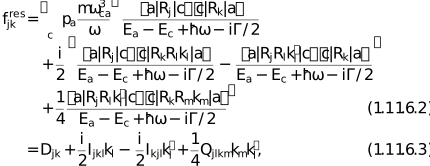 where
where  ,
,  is a dimensionless tensor corresponding to the dipole–dipole
  contribution,
  is the dipole–quadrupole
  contribution and
  is the quadrupole–quadrupole
  term. All the tensors are complex and depend on the energy and the local properties of the medium. The expansion (1.11.6.1) over the wavevectors is possible near X-ray absorption edges because the products
  are small for the typical sizes of the inner shells involved. In resonant X-ray absorption and scattering, the contribution of the magnetic multipole
  transitions is usually much less than that of the electric multipole
  transitions. Nevertheless, the scattering amplitude corresponding to
  events has also been considered (Collins et al., 2007). The tensors and describe the spatial dispersion effects similar to those in visible optics.
Different types of tensors transform under the action of the extended orthogonal group (Sirotin & Shaskolskaya, 1982) as where the coefficients
  depend on the kind of tensor (see Table 1.11.6.1) and
  are coefficients describing proper rotations.
|
||||||||||||||||||||||||||||||||||||
 corresponding to various kinds of tensor symmetry with respect to space inversion


Various parts of the resonant scattering factor (1.11.6.3) possess different kinds of symmetry with respect to: (1) space inversion  or parity, (2) rotations
  and (3) time reversal
  . Both dipole–dipole and quadrupole–quadrupole terms are parity-even, whereas the dipole–quadrupole term is parity-odd. Thus, dipole–quadrupole events can exist only for atoms at positions without inversion symmetry.
It is convenient to separate the time-reversible and time-non-reversible terms in the contributions to the atomic tensor factor (1.11.6.3). The dipole–dipole contribution to the resonant atomic factor can be represented as a sum of an isotropic, a symmetric and an antisymmetric part, written as (Blume, 1994) where
where  ,
,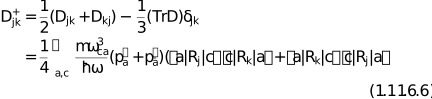 and
and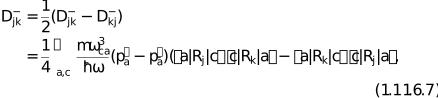
 and
and  ;
;  means the probability of the time-reversed state
  . If, for example, has a magnetic quantum number m, then has a magnetic quantum number
  .
.
In non-magnetic crystals, the probability of states with  is the same, so that
  and
and  ; in this case is symmetric under permutation of the the indices.
Similarly, the dipole–quadrupole atomic factor can be represented as (Blume, 1994)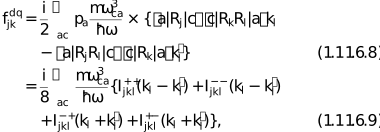 where
where with
with  . In (1.11.6.10) the first plus (
 ) corresponds to the non-magnetic case (time reversal) and the minus (
 ) corresponds to the time-non-reversal magnetic term, while the second
  corresponds to the symmetric and antisymmetric parts of the atomic factor. We see that
  can contribute only to scattering, while
  can contribute to both resonant scattering and resonant X-ray propagation. The latter term is a source of the so-called magnetochiral dichroism, first observed in Cr2O3 (Goulon et al., 2002, 2003), and it can be associated with a toroidal moment in a medium possessing magnetoelectric properties. The symmetry properties of magnetoelectic tensors are described well by Sirotin & Shaskolskaya (1982), Nye (1985) and Cracknell (1975). Which magnetoelectric properties can be studied using X-ray scattering are widely discussed by Marri & Carra (2004), Matsubara et al. (2005), Arima et al. (2005) and Lovesey et al. (2007).
It follows from (1.11.6.8) and (1.11.6.10) that  and the dipole–quadrupole term can be represented as a sum of the symmetric
  and antisymmetric
  parts. From the physical point of view, it is useful to separate the dipole–quadrupole term into
  and
and  , because only works in conventional optics where
  . The dipole–quadrupole terms are due to the hybridization of excited electronic states with different spacial parities, i.e. only for atomic sites without an inversion centre.
The pure quadrupole–quadrupole term in the tensor atomic factor is equal to with the fourth-rank tensor given by
This fourth-rank tensor  has the following symmetries:
We can define with
with  , where
 We see that
  vanishes in time-reversal invariant systems, which is true for non-magnetic structures.
In time-reversal invariant systems, equation (1.11.6.3) can be rewritten as where
where  corresponds to the symmetric part of the dipole–dipole contribution, and mean the symmetric and antisymmetric parts of the third-rank tensor describing the dipole–quadrupole term, and
  denotes a symmetric quadrupole–quadrupole contribution. From the physical point of view, it is useful to separate the dipole–quadrupole term into
  and
and  , because in conventional optics, where , only is relevant.
The tensors contributing to the atomic factor in (1.11.6.16), ,  , ,
, ,  , are of different ranks and must obey the site symmetry of the atomic position. Generally, the tensors can be different, even for crystallographically equivalent positions, but all tensors of the same rank can be related to one of them, because all are connected through the symmetry operations of the crystal space group. In contrast, the scattering amplitude tensor
  does not necessarily comply with the point symmetry of the atomic position, because this symmetry is usually violated considering the arbitrary directions of the radiation wavevectors and .
Equation (1.11.6.16) is also frequently considered as a phenomenological expression of the tensor atomic factor where each tensor possesses internal symmetry (with respect to index permutations) and external symmetry (with respect to the atomic environment of the resonant atom). For instance, the tensor is symmetric, the rank-3 tensor has a symmetric and a antisymmetric part, and the rank-4 tensor is symmetric with respect to the permutation of each pair of indices. The external symmetry of coincides with the symmetry of the dielectric susceptibility tensor (Chapter 1.6
). Correspondingly, the third-rank tensors and are similar to the gyration susceptibility and electro-optic tensors (Chapter 1.6
), and has the same tensor form as that for elastic constants (Chapter 1.3
). The symmetry restrictions on these tensors (determining the number of independent elements and relationships between tensor elements) are very important and widely used in practical work on resonant X-ray scattering. Since they can be found in Chapters 1.3
and 1.6
or in textbooks (Sirotin & Shaskolskaya, 1982; Nye, 1985), we do not discuss all possible symmetry cases in the following, but consider in the next section one specific example for X-ray scattering when the symmetries of the tensors given by expression (1.11.6.3) do not coincide with the most general external symmetry that is dictated by the atomic environment.
It is fairly obvious from expressions (1.11.6.3) and (1.11.6.16) that in the non-magnetic case the symmetric and antisymmetric third-rank tensors, and  , which describe the dipole–quadrupole contribution to the X-ray scattering factor, are not independent: the antisymmetric part, which is also responsible for optical-activity effects, can be expressed via the symmetric part (but not vice versa). Indeed, both of them can be described by a symmetric third-rank tensor
  resulting from the second-order Born approximation (1.11.6.3),
 where
where From equation (1.11.6.17), one can infer that the symmetry restrictions for
  and
and  are the same. Then it can be seen that
  can be expressed via .
For any symmetry, and have the same number of independent elements (with a maximum 18 for site symmetry 1). Thus, one can reverse equation (1.11.6.17) and express directly in terms of :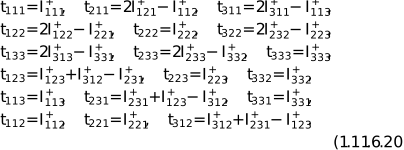
Using equations (1.11.6.18) and (1.11.6.20), one can express all nine elements of through : according to which the antisymmetric part of the dipole–quadrupole term is a linear function of the symmetric one [however, not vice versa: equations (1.11.6.21) cannot be reversed].
Note that the equations (1.11.6.21) impose an additional restriction on , which applies to all atomic site symmetries: This is, in fact, a well known result: the pseudo-scalar part of vanishes in the dipole–quadrupole approximation used in equation (1.11.6.3). Thus, for point symmetry 1, has only eight independent elements rather than nine. This additional restriction works in all cases of higher symmetries provided the pseudo-scalar part is allowed by the symmetry (i.e. point groups 2, 3, 4, 6, 222, 32, 422, 622, 23 and 432). All other symmetry restrictions on arise automatically from equation (1.11.6.21) taking into account the symmetry of [symmetry limitations on and for all crystallographic point groups can be found in Sirotin & Shaskolskaya (1982) and Nye (1985)].
Let us consider two examples, ZnO and anatase, TiO2, where the dipole–dipole contributions to forbidden reflections vanish, whereas both the symmetric and antisymmetric dipole-quadrupole terms are in principal allowed. In these crystals, the dipole–quadrupole terms have been measured by Goulon et al. (2007) and Kokubun et al. (2010).
In ZnO, crystallizing in the wurtzite structure, the 3m symmetry of the atomic positions imposes the following restrictions on :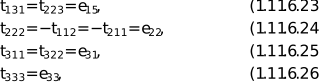 where
where  ,
,  ,
,  ,
,  are energy-dependent complex tensor elements [keeping the notations by Sirotin & Shaskolskaya (1982), the x axis is normal to the mirror plane, the y axis is normal to the glide plane and the z axis corresponds to the c axis of ZnO]. If we suppose these restrictions for Zn at
  , then for the other Zn at
  , which is related to the first site by the glide plane, there is the following set of elements:
  . Therefore, the structure factors of the glide-plane forbidden reflections are proportional to .
For the symmetric and antisymmetric parts one obtains from equations (1.11.6.17) and (1.11.6.18) the non-zero components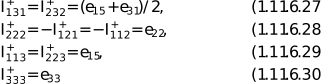 and
and
Physically, we can expect that  because
  survives even for tetrahedral symmetry
  , whereas
  is non-zero owing to a deviation from tetrahedral symmetry; in ZnO, the local coordinations of the Zn positions are only approximately tetrahedral.
In the anatase structure of TiO2, the  symmetry of the atomic positions imposes restrictions on the tensors [keeping the notations of Sirotin & Shaskolskaia (1982): the x and y axes are normal to the mirror planes, and the z axis is parallel to the c axis]:
 where and are energy-dependent complex parameters. If we apply these restrictions to the Ti atoms at
  and
and  , then for the other two inversion-related Ti atoms at
  and
and  (centre
  ), the parameters are
  and
and  .
.
For the symmetric and antisymmetric parts one obtains as non-vanishing components and
and
It is important to note that the symmetric part of the atomic factor can be affected by a contribution from thermal-motion-induced dipole–dipole terms. The latter terms are tensors of rank 3 proportional to the spatial derivatives  , which take the same tensor form as but are not related to by equations (1.11.6.21). In ZnO, which was studied in detail by Collins et al. (2003), the thermal-motion-induced contribution is rather significant, while for anatase the situation is less clear.
Once the tensor atomic factors have been determined [either from phenomenological expressions like (1.11.6.16), according to the site-symmetry restrictions, or from given microscopic expressions, e.g. (1.11.4.3)], tensor structure factors are obtained by summation over the contributions of all atoms in the unit cell, as in conventional diffraction theory: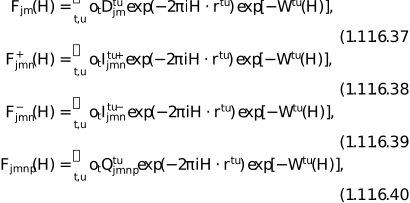 where the index t enumerates the crystallographically different types of scatterers (atoms belonging to the same or different chemical elements), the index u denotes the crystallographically equivalent positions;
  is a site-occupancy factor, and
  is the Debye–Waller temperature factor. The tensors of the atomic factors,
  ,
,  ,
,  ,
,  , are, in general, different for crystallographically equivalent positions, that is for different u, and it is exactly this difference that enables the excitation of the resonant forbidden reflections.
Extinction rules and polarization properties for forbidden reflections are different for tensor structure factors of different ranks, a circumstance that may be used for experimental separation of different tensor contributions (for tensors of rank 2, information is given in Tables 1.11.2.1 and 1.11.2.2). In the harmonic approximation, anisotropies of the atomic thermal displacements (Debye–Waller factor) are also described by tensors of rank 2 or higher, but, owing to these, excitations of glide-plane and screw-axis forbidden reflections are not possible.
Magnetic crystals possess different densities of states with opposite spin directions. During a multipole transition from the ground state to an excited state (or the reverse), the projection of an electron spin does not change, but the projection of the orbital moment varies. The consideration of all possible transitions allows for the formulation of the sum rules (Carra et al., 1993; Strange, 1994) that are widely used in X-ray magnetic circular dichroism (XMCD). When measuring the differences of the absorption coefficients at the  absorption edges of transition elements or at the M edges of rare-earth elements (Erskine & Stern, 1975; Schütz et al., 1987; Chen et al., 1990), these rules allow separation of the spin and orbital contributions to the XMCD signal, and hence the study of the spin and orbital moments characterizing the ground state. In magnetic crystals, the tensors change their sign with time reversal because
  if
if  and/or
  (Zeeman splitting in a magnetic field). That the antisymmetric parts of the tensors differ from zero follows from equations (1.11.6.7), (1.11.6.10) and (1.11.6.15).
Time reversal also changes the incident and scattered vectors corresponding to permutation of the Cartesian tensor indices. For dipole–dipole resonant events, the symmetric part  does not vary with exchange of indices, hence it is time- and parity-even. The antisymmetric part
  changes its sign upon permutation of the indices, so it is parity-even and time-odd, being associated with a magnetic moment (1.11.6.41). This part of the tensor is responsible for the existence of X-ray magnetic circular dichroism (XMCD) and the appearance of the magnetic satellites in various kinds of magnetic structures.
If the rotation symmetry of a second-rank tensor is completely described by rotation about the magnetic moment m, then the antisymmetric second-rank tensor  can be represented as
  , where
  is an antisymmetric third-rank unit tensor and
  are the coordinates of the magnetic moment of the resonant atom. So, the scattering amplitude for the dipole–dipole
  transition can be given as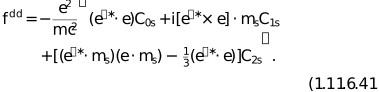
 ,
,  and
and  are energy-dependent coefficients referring to the sth atom in the unit cell and
  is a unit vector along the magnetic moment. The third term in (1.11.6.41) is time non-reversal, and it is responsible for the magnetic linear dichroism (XMLD). This kind of X-ray dichroism is also influenced by the crystal field (Thole et al., 1986; van der Laan et al., 1986).
The coefficients , and involved in (1.11.6.41) may be represented in terms of spherical harmonics. Using the relations (Berestetskii et al., 1982; Hannon et al., 1988) and
and for
for  ,
,  and
and  ,
,  , respectively, one obtains
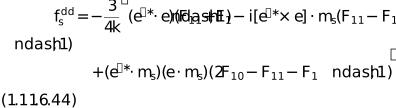 with
with where
where  is the probability of the initial state
  ,
,  is that for the transition from state to a final state , and
  is the ratio of the partial line width of the excited state due to a pure
 radiative decay and the width due to all processes, both radiative and non-radiative (for example, the Auger decay).
Magnetic ordering is frequently accompanied by a local anisotropy in the crystal. In this case, both kinds of local anisotropies exist simultaneously and must be taken into account in, for example, XMLD (van der Laan et al., 1986) and XMχD (Goulon et al., 2002). In resonant X-ray scattering experiments, simultaneous existence of forbidden reflections provided by spin and orbital ordering (Murakami et al., 1998) as well as magnetic and crystal anisotropy (Ji et al., 2003; Paolasini et al., 2002, 1999) have been observed. The explicit Cartesian form of the tensor atomic factor in the presence of both a magnetic moment and crystal anisotropy has been proposed by Blume (1994). When the symmetry of the atomic site is high enough, i.e. the atom lies on an n-order axis ( ), then the tensors
  and
and  can be represented as
 and
and where
where  and
and  depend on the energy, and
  is a unit vector along the symmetry axis under consideration. One can see that the atomic tensor factor is given by a sum of three terms: the first is due to the symmetry of the local crystal anisotropy, the second describes pure magnetic scattering, and the last (`combined') term is induced by interference between magnetic and non-magnetic resonant scattering. This issue was first discussed by Blume (1994) and later in more detail by Ovchinnikova & Dmitrienko (1997, 2000). All the terms can give rise to forbidden reflections, i.e. sets of pure resonant forbidden magnetic and non-magnetic reflections can be observed for the same crystal, see Ji et al. (2003) and Paolasini et al. (2002, 1999). Only reflections caused by the `combined' term (Ovchinnikova & Dmitrienko, 1997) have not been observed yet.
Neglecting the crystal field, an explicit form of the fourth-rank tensors describing the quadrupole–quadrupole  events in magnetic structures was proposed by Hannon et al. (1988) and Blume (1994):
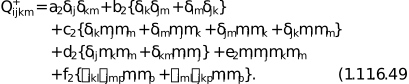
Then, being convoluted with polarization vectors, the scattering amplitude of the quadrupole transition ( ) can be written as a sum of 13 terms belonging to five orders of magnetic moments (Hannon et al., 1988; Blume, 1994). The final expression that gives the quadrupole contribution to the magnetic scattering amplitude in terms of individual spin components is rather complicated and can be found, for example, in Hill & McMorrow (1996). In the presence of both a magnetic moment and local crystal anisotropy, the fourth-rank tensor describing events depends on both kinds of anisotropy and can include the `combined' part in explicit form, as found by Ovchinnikova & Dmitrienko (2000).
Another representation of the scattering amplitude is widely used in the scientific literature (Hannon et al., 1988; Luo et al., 1993; Carra et al., 1993; Lovesey & Collins, 1996) for the description of resonant multipole transitions. In order to obtain the scattering amplitude and intensity for a resonant process described by some set of spherical tensor components, the tensor that describes the atomic scattering must be contracted by a tensor of the same rank and inversion/time-reversal symmetry which describes the X-ray probe, so that the result would be a scalar. There are well known relations between the components of the atomic factor tensor, both in Cartesian and spherical representations. For the dipole–dipole transition, the resonant scattering amplitude can be written as (Hannon et al., 1988; Collins et al., 2007; Paolasini, 2012; Joly et al., 2012) where
where  are the Cartesian tensor components,
  depends only on the incident and scattered radiation and the polarization vectors, and
  is associated with the tensor properties of the absorbing atom and can be represented in terms of a multipole expansion.
It is convenient to decompose each tensor into its irreducible parts. For example, an tensor containing nine Cartesian components can be represented as a sum of three irreducible tensors with ranks  (one component),
  (three components) and
  (five components). This decomposition is unique.




It follows from (1.11.6.14) that the fourth-rank tensor describing the quadrupole–quadrupole X-ray scattering can also be divided into two parts: the time-reversal part,  , and the non-time-reversal part,
  . Both can be explicitly represented by (1.11.6.3) and (1.11.6.2), in which all these tensors are parity-even. The explicit form of the fourth-rank tensors is suitable for the analysis of possible effects in resonant X-ray absorption and scattering. Nevertheless, sometimes the following representation of the scattering amplitude as a product of spherical tensors is preferable:
Here, the dipole–quadrupole tensor atomic factor given by (1.11.6.10) is represented by a sum over several tensors with different symmetries. All tensors are parity-odd, but the tensors  and
and  are also non-time-reversal. The scattering amplitude corresponding to the dipole–quadrupole resonant X-ray scattering can be represented as
 The explicit form of can be found in Marri & Carra (2004). Various parts of possess different symmetry with respect to the reversal of space
  and time .
The spherical representation of the tensor atomic factor allows one to analyse its various components, as they possess different symmetries with respect to rotations or space and time inversion. For each  , is related to a specific term of the multipole expansion of the system. Multipole expansions of electric and magnetic fields generated by charges and permanent currents are widely used in characterizing the electromagnetic state of a physical system (Berestetskii et al., 1982). The transformation rules for electric and magnetic multipoles of both parities under space inversion and time reversal are of great importance for electromagnetic effects in crystals. The correspondence between the and electromagnetic multipoles is shown in Table 1.11.6.2. In this table, the properties of the tensors under time reversal and space inversion on one side are identified with multipole terms describing the physical system on the other. In fact, for any given tensor of rank
  there is one electromagnetic multipole of the same rank (
 dipole,
  quadrupole,
  octupole,
  hexadecapole) and with the same and properties. Note that -odd
  tensors have both -odd (−) and -even (+) terms for any , whereas -even tensors (both and ) are -odd for odd rank and -even for even rank, respectively (Di Matteo et al., 2005).
|
An important contribution of Luo et al. (1993) and Carra et al. (1993) consisted of expressing the amplitude coefficients in terms of experimentally significant quantities, electron spin and orbital moments. This procedure is valid within the fast-collision approximation, when either the deviation from resonance,  , or the width, , is large compared to the splitting of the excited-state configuration. The approximation is expected to hold for the
  and
and  edges of the rare earths and actinides, as well as for the
  and
and  edges of the actinides. In this energy regime, the resonant factors can be summed independently, leaving amplitude coefficients that may be written in terms of multipole moment operators, which are themselves single-particle operators summed over the valence electrons in the initial state.
Magnetic scattering has become a powerful method for understanding magnetic structures (Tonnere, 1996; Paolasini, 2012), particularly as it is suitable even for powder samples (Collins et al., 1995). Since the first studies (Gibbs et al., 1988), resonant magnetic X-ray scattering has been observed at various edges of transition metals and rare earths. The studies include magnetics and multiferroics with commensurate and incommensurate modulation (Walker et al., 2009; Kim et al., 2011; Ishii et al., 2006; Partzsch et al., 2012; Lander, 2012; Beale et al., 2012; Lovesey et al., 2012; Mazzoli et al., 2007) as well as multi-k magnetic structures (Bernhoeft et al., 2012), and structures with orbital ordering (Murakami et al., 1998) and higher-order multipoles (Princep et al., 2011). It has also been shown that effects can be measured not only at the edges of magnetic atoms [K edges of transition metals, L edges of rare-earth elements and M edges of actinides (Vettier, 2001, 2012)], but also at the edges of non-magnetic atoms (Mannix et al., 2001; van Veenendaal, 2003).
Thus, magnetic and non-magnetic resonant X-ray diffraction clearly has the potential to be an important working tool in modern materials research. The advantage of polarized X-rays is their sensitivity to both the local atomic environments of resonant atoms and their partial structures. The knowledge of the local and global crystal symmetries and of the interplay of their effects is therefore of great value for a better understanding of structural, electronic and magnetic features of crystalline condensed matter.
|


 : the dipole;
  : the quadrupole


References
 Altarelli, M. (2006). Resonant X-ray scattering: a theoretical introduction. Lecture Notes in Physics, Vol. 697, pp. 201–242. Heidelberg: Springer.Google Scholar
Arenholz, E., van der Laan, G., Chopdekar, R. V. & Suzuki, Y. (2006). Anisotropic X-ray magnetic linear dichroism at the Fe L2,3 edges in Fe3O4. Phys. Rev. B, 74, 094407.Google Scholar
Arima, T., Jung, J.-H., Matsubara, M., Kubota, M., He, J.-P., Kaneko, Y. & Tokura, Y. (2005). Resonant magnetochiral X-ray scattering in LaFeO3: observation of ordering of toroidal moments. J. Phys. Soc. Jpn, 74, 1419–1422.Google Scholar
Authier, A. (2005). Dynamical Theory of X-ray Diffraction. Oxford University Press.Google Scholar
Authier, A. (2008). In International Tables for Crystallography, Volume B, Reciprocal Space, edited by U. Shmueli, 3rd ed., pp. 626–646. Heidelberg: Springer.Google Scholar
Barois, P., Gleeson, H., Huang, C. & Pindak, R. (2012). Application of X-ray resonant diffraction to structural studies of liquid crystals. Eur. Phys. J. Spec. Top. 208, 333–350.Google Scholar
Beale, T. A. W., Beutier, G., Bland, S. R., Bombardi, A., Bouchenoire, L., Bunau, O., Di Matteo, S., Fernández-Rodríguez, J., Hamann-Borrero, J. E., Herrero-Martin, J., Jacques, V. L. R., Johnson, R. D., Juhin, A., Matsumura, T., Mazzoli, C., Mulders, A. M., Nakao, H., Okamoto, J., Partzsch, S., Princep, A. J., Scagnoli, V., Strempfer, J., Vecchini, C., Wakabayashi, Y., Walker, H. C., Wermeille, D. & Yamasaki, Y. (2012). REXS contribution to electronic ordering investigation in solids. Eur. Phys. J. Spec. Top. 208, 89–98.Google Scholar
Belyakov, V. A. (1975). Diffraction of Mössbauer gamma-radiation in crystals. Sov. Phys. Usp. 18, 267–299.Google Scholar
Belyakov, V. A. & Aivazyan, Y. M. (1969). Quadrupole diffraction maxima in Mossbauer scattering. JETP Lett. 9, 393.Google Scholar
Belyakov, V. A. & Dmitrienko, V. E. (1985). The blue phase of liquid crystals. Sov. Phys. Usp. 28, 535–562.Google Scholar
Belyakov, V. A. & Dmitrienko, V. E. (1989). Polarisation phenomena in X-ray optics. Sov. Phys. Usp. 32, 697–719.Google Scholar
Berestetskii, V. B., Lifshitz, E. M. & Pitaevskii, L. P. (1982). Quantum Electrodynamics. Oxford: Pergamon Press.Google Scholar
Bergevin, F. de & Brunel, M. (1972). Observation of magnetic superlattice peaks by X-ray diffraction on an antiferromagnetic NiO crystal. Phys. Lett. A, 39, 141–142.Google Scholar
Bergevin, F. de & Brunel, M. (1981). Diffraction of X-rays by magnetic materials. I. General formulae and measurements on ferro- and ferrimagnetic compounds. Acta Cryst. A37, 314–324.Google Scholar
Bernhoeft, N., Paixao, J. A., Detlefs, C., Wilkins, S. B., Javorsky, P., Blackburn, E. & Lander, G. H. (2012). Resonant X-ray scattering from UAs0.8Se0.2: multi-k configurations. Phys. Rev. B, 69, 174415.Google Scholar
Blume, M. (1985). Magnetic scattering of X-rays. J. Appl. Phys. 57, 3615–3618.Google Scholar
Blume, M. (1994). Resonant X-ray diffraction and polarization analysis at the iron K-edge. In Resonant Anomalous X-ray Scattering. Theory and Applications, edited by G. Materlik, C. J. Sparks & K. Fischer, pp. 91–97. Amsterdam: North-Holland.Google Scholar
Brouder, C. (1990). Angular dependence of X-ray absorption spectra. J. Phys. Condens. Matter, 2, 701–738.Google Scholar
Brunel, M. & de Bergevin, F. (1981). Diffraction of X-rays by magnetic materials. II. Measurements on antiferromagnetic Fe2O3. Acta Cryst. A37, 324–331.Google Scholar
Carra, P. & Thole, B. T. (1994). Anisotropic X-ray anomalous diffraction and forbidden reflections. Rev. Mod. Phys. 66, 1509–1515.Google Scholar
Carra, P., Thole, B. T., Altarelli, M. & Wang, X. (1993). X-ray circular dichroism and local magnetic fields. Phys. Rev. Lett. 70, 694–697.Google Scholar
Champeney, D. C. (1979). The scattering of Mössbauer radiation by condensed matter. Rep. Prog. Phys. 42, 1017–1054.Google Scholar
Chen, C. T., Sette, F., Ma, Y. & Modesti, S. (1990). Soft X-ray magnetic circular dichroism at the L2,3 edges of nickel. Phys. Rev. B, 42, 7363–7265.Google Scholar
Collins, S. & Bombardi, A. (2010). Resonant X-ray scattering and absorption. In Magnetism and Synchrotron Radiation, edited by E. Beaurepaire, H. Bulou, F. Scheurer & K. Jean-Paul. Springer Proceedings in Physics, Vol. 133, pp. 223–262. Berlin, Heidelberg: Springer.Google Scholar
Collins, S., Lovesey, S. & Balcar, E. (2007). Dichroism and resonant diffraction in X-ray scattering by complex materials. J. Phys. Condens. Matter, 19, 213201.Google Scholar
Collins, S. P., Laundy, D., Dmitrienko, V., Mannix, D. & Thompson, P. (2003). Temperature-dependent forbidden resonant X-ray scattering in zinc oxide. Phys. Rev. B, 68, 064110.Google Scholar
Collins, S. P., Laundy, D., Tang, C. C. & Cernik, R. J. (1995). Magnetic X-ray powder diffraction from antiferromagnetic uranium oxide. J. Phys. Condens. Matter, 7, L223–L229.Google Scholar
Cracknell, A. P. (1975). Group Theory in Solid-State Physics. London: Taylor and Francis Ltd.Google Scholar
Crooker, P. P. (2001). Blue phases. In Chirality in Liquid Crystals, edited by H.-S. Kitzerow & C. Bahr, pp. 186–222. New York: Springer.Google Scholar
Dawson, B. (1975). Studies of atomic charge density by X-ray and neutron diffraction – a perspective. In Advances in Structure Research by Diffraction Methods, Vol. 6, edited by W. Hoppe & R. Mason. Oxford: Pergamon Press.Google Scholar
Detlefs, C., Sanchez del Rio, M. & Mazzoli, C. (2012). X-ray polarization: general formalism and polarization analysis. Eur. Phys. J. Spec. Top. 208, 359–371.Google Scholar
Di Matteo, S., Joly, Y. & Natoli, C. R. (2005). Detection of electromagnetic multipoles by X-ray spectroscopies. Phys. Rev. B, 72, 144406.Google Scholar
Dmitrienko, V. E. (1983). Forbidden reflections due to anisotropic X-ray susceptibility of crystals. Acta Cryst. A39, 29–35.Google Scholar
Dmitrienko, V. E. (1984). Anisotropy of X-ray susceptibility and Bragg reflections in cubic crystals. Acta Cryst. A40, 89–95.Google Scholar
Dmitrienko, V. E., Ishida, K., Kirfel, A. & Ovchinnikova, E. N. (2005). Polarization anisotropy of X-ray atomic factors and `forbidden' resonant reflections. Acta Cryst. A61, 481–493.Google Scholar
Eichhorn, K. & Kirfel, A. (1988). Genaue Strukturuntersuchung mit Synchrotron Strahlung. II. Anisotropie der anomalen Dispersion in Cuprit, Cu2O. Z. Kristallogr. 185, 56–58.Google Scholar
Erskine, J. L. & Stern, E. A. (1975). Calculation of the M23 magneto-optical absorption spectrum of ferromagnetic nickel. Phys. Rev. B, 12, 5016–5024.Google Scholar
Finkelstein, K. D. & Dmitrienko, V. E. (2012). Resonant scattering techniques. In Characterization of Materials, edited by E. N. Kaufmann, pp. 1–15. New Jersey: John Wiley & Sons, Inc.Google Scholar
García, J. & Subías, G. (2004). The Verwey transition – a new perspective. J. Phys. Condens. Matter, 16, R145–R178.Google Scholar
García, J., Subías, G., Proietti, M. G., Renevier, H., Joly, Y., Hodeau, J. L., Blasco, J., Sánchez, M. C. & Bérar, J. F. (2000). Resonant forbidden reflections in magnetite. Phys. Rev. Lett. 85, 578–581.Google Scholar
Gibbs, D., Harshmann, D. R., Isaacs, E. D., McWhan, D. B., Mills, D. & Vettier, C. (1988). Polarization and resonance properties of magnetic X-ray scattering in holmium. Phys. Rev. Lett. 61, 1241–1244.Google Scholar
Gleeson, H. & Hirst, L. (2006). Resonant X-ray scattering: a tool for structure elucidation in liquid crystals. Chem. Phys. Chem. 7, 321–328.Google Scholar
Goulon, J., Jaouen, N., Rogalev, A., Wilhelm, F., Goulon-Ginet, C., Brouder, C., Joly, Y., Ovchinnikova, E. N. & Dmitrienko, V. E. (2007). Vector part of optical activity probed with X-rays in hexagonal ZnO. J. Phys. Condens. Matter, 19, 156201.Google Scholar
Goulon, J., Rogalev, A., Wilhelm, F., Goulon-Ginet, C. & Carra, P. (2002). X-ray magnetochiral dichroism: a new spectroscopic probe of parity nonconserving magnetic solids. Phys. Rev. Lett. 88, 237401.Google Scholar
Goulon, J., Rogalev, A., Wilhelm, F., Goulon-Ginet, C., Carra, P., Marri, I. & Brouder, C. (2003). X-ray optical activity: application of sum rules. J. Exp. Theor. Phys. 97, 402–431.Google Scholar
Gukasov, A. & Brown, P. J. (2010). Determination of atomic site susceptibility tensors from neutron diffraction data on polycrystalline samples. J. Phys. Condens. Matter, 22, 502201.Google Scholar
Hagiwara, K., Kanazawa, M., Horie, K., Kokubun, J. & Ishida, K. (1999). Measurements of ATS scattering from magnetite near the Fe K-absorption edge in the temperature range 290 K–80 K. J. Phys. Soc. Jpn, 68, 1592–1597.Google Scholar
Hahn, Th. (2005). Editor. International Tables for Crystallography, Volume A, Space-Group Symmetry, 5th ed. Heidelberg: Springer.Google Scholar
Hannon, J. P., Trammell, G. T., Blume, M. & Gibbs, D. (1988). X-ray resonance exchange scattering. Phys. Rev. Lett. 61, 1245–1248.Google Scholar
Hart, M. & Rodriques, A. R. D. (1981). Optical activity and the Faraday effect at X-ray frequencies. Philos. Mag. B, 43, 321–332.Google Scholar
Hill, J. P. & McMorrow, D. F. (1996). Resonant exchange scattering: polarization dependence and correlation function. Acta Cryst. A52, 236–244.Google Scholar
Hodeau, J.-L., Favre-Nicolin, V., Bos, S., Renevier, H., Lorenzo, E. & Bérar, J.-F. (2001). Resonant diffraction. Chem. Rev. 101, 1843–1867.Google Scholar
International Tables for Crystallography
(2004). Volume C, Mathematical, Physical and Chemical Tables, 3rd ed., edited by E. Prince. Dordrecht: Kluwer.Google Scholar
International Tables for Crystallography
(2008). Volume B, Reciprocal Space, 3rd ed., edited by U. Shmueli. Heidelberg: Springer.Google Scholar
Ishii, K., Kuzushita, K., Murakami, Y., Haga, Y., Yamamoto, E. & Onuki, Y. (2006). Resonant magnetic X-ray scattering study of UPd2Al3. J. Phys. Soc. Jpn, 75S, 102–104.Google Scholar
Ji, S., Song, C., Koo, J., Lee, K.-B., Park, Y. J., Kim, J. Y., Park, J.-H., Shin, H. J., Rhyee, J. S., Oh, B. H. & Cho, B. K. (2003). Interference of magnetic and ATS reflections in resonant X-ray scattering of GdB4. Phys. Rev. Lett. 91, 257205.Google Scholar
Joly, Y., Di Matteo, S. & Bunau, O. (2012). Resonant X-ray diffraction: basic theoretical principles. Eur. Phys. J. Spec. Top. 208, 21–38.Google Scholar
Kim, M. G., Kreyssig, A., Lee, Y. B., McQueeney, R. J., Harmon, B. N. & Goldman, A. I. (2011). Fe K-edge X-ray resonant magnetic scattering from Ba(Fe1−xCox)2As2 superconductors. Phys. Rev. B, 83, 134522.Google Scholar
Kirfel, A. & Morgenroth, W. (1993). Anisotropy of anomalous scattering in X-ray diffraction. III. `Forbidden' axial reflections in space groups up to orthorhombic symmetry. Acta Cryst. A49, 35–45.Google Scholar
Kirfel, A. & Petcov, A. (1991). Anisotropy of anomalous dispersion. An application to partial structure determination. Z. Kristallogr. 195, 1–15.Google Scholar
Kirfel, A. & Petcov, A. (1992). Anisotropy of anomalous scattering in X-ray diffraction. II. Combining polarization-dependent transmission and diffraction, and an application to partial-structure analysis. Acta Cryst. A48, 247–259.Google Scholar
Kirfel, A., Petcov, A. & Eichhorn, K. (1991). Anisotropy of anomalous dispersion in X-ray diffraction. Acta Cryst. A47, 180–195.Google Scholar
Kokubun, J., Sawai, H., Uehara, M., Momozawa, N., Ishida, K., Kirfel, A., Vedrinskii, R. V., Novikovskii, N., Novakovich, A. A. & Dmitrienko, V. E. (2010). Pure dipole–quadrupole resonant scattering induced by the p–d hybridization of atomic orbitals in anatase TiO2. Phys. Rev. B, 82, 205206.Google Scholar
Kolpakov, A. V., Bushuev, V. A. & Kuz'min, R. N. (1978). Dielectric permittivity in the X-ray region. Sov. Phys. Usp. 21, 959–977.Google Scholar
Laan, G. van der, Arenholz, E., Chopdekar, R. V. & Suzuki, Y. (2008). Influence of crystal field on anisotropic X-ray magnetic linear dichroism at the Co2+ L2,3 edges. Phys. Rev. B, 77, 064407.Google Scholar
Laan, G. van der, Thole, B. T., Sawatzky, G., Goedkoop, J. B., Fuggle, J. C., Esteva, J.-M., Karnatak, R., Remeika, J. P. & Dabkowska, H. A. (1986). Experimental proof of magnetic X-ray dichroism. Phys. Rev. B, 34, 6529–6531.Google Scholar
Lander, G. H. (2012). Resonant elastic X-ray scattering from 5f systems. Eur. Phys. J. Spec. Top. 208, 129–132.Google Scholar
Lovesey, S. W., Balcar, E., Knight, K. S. & Fernández-Rodríguez, J. (2005). Electronic properties of crystalline materials observed in X-ray diffraction. Phys. Rep. 411, 233–289.Google Scholar
Lovesey, S. W. & Collins, S. P. (1996). X-ray Scattering and Absorption by Magnetic Materials. Oxford: Clarendon Press.Google Scholar
Lovesey, S. W., Detlefs, C. & Rodríguez-Fernández, A. (2012). Neptunium multipoles and resonant X-ray Bragg diffraction by neptunium dioxide (NpO2). J. Phys. Condens. Matter, 24, 256009.Google Scholar
Lovesey, S. W., Fernández-Rodríguez, J., Blanco, J. A., Sivia, D. S., Knight, K. S. & Paolasini, L. (2007). Vanadium magnetoelectric multipoles in V2O3. Phys. Rev. B, 75, 014409.Google Scholar
Luo, J., Trammell, G. T. & Hannon, J. P. (1993). Scattering operator for elastic and inelastic resonant X-ray scattering. Phys. Rev. Lett. 71, 287–290.Google Scholar
Mannix, D., Stunault, A., Bernhoeft, N., Paolasini, L., Lander, G. H., Vettier, C., de Bergevin, F., Kaczorowski, D. & Czopnik, A. (2001). Resonant enhancements at nonmagnetic ions: new possibilities for magneic X-ray scattering. Phys. Rev. Lett. 86, 4128–4131.Google Scholar
Marri, I. & Carra, P. (2004). Scattering operators for E1–E2 X-ray resonant diffraction. Phys. Rev. B, 69, 113101.Google Scholar
Materlik, G., Sparks, C. J. & Fischer, K. (1994). Editors. Resonant Anomalous X-ray Scattering. Theory and Applications. Amsterdam: North-Holland.Google Scholar
Matsubara, M., Shimada, Y., Arima, T., Taguchi, Y. & Tokura, Y. (2005). Observation of nonreciprocal magnetoelectric X-ray scattering in magnetite. Phys. Rev. B, 72, 220404.Google Scholar
Mazzoli, C., Fabrizi, F., Di Matteo, S., Paolasini, L., de Bergevin, F., Bombardi, A., Ghigna, P. & Caciuffo, R. (2007). Resonant magnetic X-ray scattering study of KCuF3. J. Magn. Magn. Mater. 310, 796–797.Google Scholar
Morgenroth, W., Kirfel, A. & Fischer, K. (1994). Anisotropy of anomalous scattering in X-ray diffraction. 'Forbidden' axial reflections in tetragonal space groups. Z. Kristallogr. 209, 124–131.Google Scholar
Murakami, Y., Kawada, H., Kawata, H., Tanaka, M., Arima, T., Moritomo, Y. & Tokura, Y. (1998). Direct observation of charge and orbital ordering in La0.5Sr1.5MnO4. Phys. Rev. Lett. 80, 1932–1935.Google Scholar
Natoli, C. R., Brouder, C., Sainctavit, P., Goulon, J., Goulon-Ginet, C. & Rogalev, A. (1998). Calculation of X-ray natural circular dichroism. Eur. Phys. J. B, 4, 1–11.Google Scholar
Nazarenko, E., Lorenzo, J. E., Joly, Y., Hodeau, J. L., Mannix, D. & Marin, C. (2006). Resonant X-ray diffraction studies on the charge ordering in magnetite. Phys. Rev. Lett. 97, 056403.Google Scholar
Nye, J. F. (1985). Physical Properties of Crystals: Their Representation by Tensors and Matrices. Oxford University Press.Google Scholar
Ovchinnikova, E. N. & Dmitrienko, V. E. (1997). Combined effects of magnetic structure and local crystal fields in anisotropic X-ray anomalous scattering. Acta Cryst. A53, 388–395.Google Scholar
Ovchinnikova, E. N. & Dmitrienko, V. E. (2000). Resonant X-ray scattering in the presence of several anisotropic factors. Acta Cryst. A56, 2–10.Google Scholar
Paolasini, L. (2012). Magnetism in condensed matter: resonant and magnetic scattering by synchrotron radiation. In Italian School on Magnetism, Pavia 2012, pp. 1–83. Universita di Pavia.Google Scholar
Paolasini, L., Caciuffo, R., Sollier, A., Ghigna, P. & Altarelli, M. (2002). Coupling between spin and orbital degrees of freedom in KCuF3. Phys. Rev. Lett. 88, 106403.Google Scholar
Paolasini, L., Vettier, C., de Bergevin, F., Yakhou, F., Mannix, D., Stunault, A., Neubeck, W., Altarelli, M., Fabrizio, M., Metcalf, P. & Honig, J. (1999). Orbital occupancy order in V2O3: resonant X-ray scattering results. Phys. Rev. Lett. 82, 4718–4722.Google Scholar
Partzsch, S., Wilkins, S. B., Schierle, E., Hamann-Borrero, J. E., Wadati, H., Soltwisch, V., Hill, J. P., Weschke, E., Souptel, D., Buchner, B. & Geck, J. (2012). Resonant soft X-ray scattering studies of multiferroic YMn2O5. Eur. Phys. J. Spec. Top. 208, 133–140.Google Scholar
Platzman, P. M. & Tzoar, N. (1970). Magnetic scattering of X-rays from electrons in molecules and solids. Phys. Rev. B, 2, 3556–3559.Google Scholar
Princep, A. J., Mulders, A. M., Staub, U., Scagnoli, V., Nakamura, T., Kikkawa, A., Lovesey, S. W. & Balcar, E. (2011). Triakontadipole and high-order dysprosium multipoles in the antiferromagnetic phase of DyB2C2. J. Phys. Condens. Matter, 23, 266002.Google Scholar
Renevier, H., Joly, Y., García, J., Subías, G., Proietti, M. G., Hodeau, J. L. & Blasco, J. (2001). Diffraction anomalous fine structure of forbidden Bragg reflections: charge localization and structure of the octahedral site in magnetite. J. Synchrotron Rad. 8, 390–392.Google Scholar
Rogalev, A., Wilhelm, F., Jaouen, N., Goulon, J. & Kappler, J.-P. (2006). X-ray magnetic circular dichroism: historical perspective and recent highlights. Lecture Notes in Physics, Vol. 697, pp. 71–89. Heidelberg: Springer.Google Scholar
Schütz, G., Wagner, W., Wilhelm, W., Kenle, P., Zeller, R., Frahm, R. & Materlik, G. (1987). Absorption of circularly polarized X-rays in iron. Phys. Rev. Lett. 58, 737–740.Google Scholar
Seideman, T. (1990). The liquid-crystalline blue phases. Rep. Prog. Phys. 53, 659–705.Google Scholar
Sirotin, Y. & Shaskolskaya, M. P. (1982). Fundamentals of Crystal Physics. Moscow: Mir.Google Scholar
Strange, P. (1994). Magnetic absorption dichroism and sum rules in itinerant magnets. J. Phys. Condens. Matter, 6, L491–L495.Google Scholar
Subías, G., García, J., Blasco, J., Herrero-Martín, J., Sánchez, M. C., Orna, J. & Morellón, L. (2012). Structural distortion, charge modulation and local anisotropies in magnetite below the Verwey transition using resonant X-ray scattering. J. Synchrotron Rad. 19, 159–173.Google Scholar
Tanaka, Y., Collins, S. P., Lovesey, S. W., Matsumami, M., Moriwaki, T. & Shin, S. (2010). Determination of the absolute chirality of tellurium using resonant diffraction with circularly polarized X-rays. J. Phys. Condens. Matter, 22, 122201.Google Scholar
Tanaka, Y., Kojima, T., Takata, Y., Chainani, A., Lovesey, S. W., Knight, K. S., Takeuchi, T., Oura, M., Senba, Y., Ohashi, H. & Shin, S. (2010). Determination of structural chirality of berlinite and quartz using resonant X-ray diffraction with circularly polarized X-rays. Phys. Rev. B, 81, 144104.Google Scholar
Tanaka, Y., Takeuchi, T., Lovesey, S. W., Knight, K. S., Chainani, A., Takata, Y., Oura, M., Senba, Y., Ohashi, H. & Shin, S. (2008). Right handed or left handed? Forbidden X-ray diffraction reveals chirality. Phys. Rev. Lett. 100, 145502.Google Scholar
Templeton, D. H. & Templeton, L. K. (1980). Polarized X-ray absorption and double refraction in vanadyl bisacetylacetonate. Acta Cryst. A36, 237–241.Google Scholar
Templeton, D. H. & Templeton, L. K. (1982). X-ray dichroism and polarized anomalous scattering of the uranyl ion. Acta Cryst. A38, 62–67.Google Scholar
Templeton, D. H. & Templeton, L. K. (1985). Tensor X-ray optical properties of the bromate ion. Acta Cryst. A41, 133–142.Google Scholar
Templeton, D. H. & Templeton, L. K. (1986). X-ray birefringence and forbidden reflections in sodium bromate. Acta Cryst. A42, 478–481.Google Scholar
Thole, B. T., Carra, P., Sette, F. & van der Laan, G. (1992). X-ray circular dichroism as a probe of orbital magnetization. Phys. Rev. Lett. 68, 1943–1946.Google Scholar
Thole, B. T., van der Laan, G. & Sawatzky, G. (1986). Strong magnetic dichroism predicted in the M4,5 X-ray absorption spectra of magnetic rare-earth materials. Phys. Rev. Lett. 55, 2086–2088.Google Scholar
Tonnere, J.-M. (1996). X-ray magnetic scattering. In Magnetism and Synchrotron Radiation. Lectures Notes, edited by E. Beaurepaire, B. Carriere & J.-P. Kappler, pp. 245–273. Mittelwihr: Les Editions de Physique.Google Scholar
Veenendaal, M. van (2003). Resonant X-ray magnetic scattering at nonmagnetic ions. Phys. Rev. B, 67, 134112.Google Scholar
Vettier, C. (2001). Resonant X-ray scattering in transition metal and rare-earth materials. J. Electron Spectrosc. Relat. Phenom. 117, 113–128.Google Scholar
Vettier, C. (2012). Resonant elastic X-ray scattering: Where from? Where to? Eur. Phys. J. Spec. Top. 208, 3–14.Google Scholar
Walker, H. C., McEwen, K. A., McMorrow, D. F., Bleckmann, M., Lee, J. G. P. S., Iga, F. & Mannix, D. (2009). X-ray resonant scattering study of the structural and magnetic transitions in PrB6. Phys. Rev. B, 79, 054402.Google Scholar
Wright, D. C. & Mermin, N. D. (1989). Crystalline liquids: the blue phases. Rev. Mod. Phys. 61, 385–432.Google Scholar
Altarelli, M. (2006). Resonant X-ray scattering: a theoretical introduction. Lecture Notes in Physics, Vol. 697, pp. 201–242. Heidelberg: Springer.Google Scholar
Arenholz, E., van der Laan, G., Chopdekar, R. V. & Suzuki, Y. (2006). Anisotropic X-ray magnetic linear dichroism at the Fe L2,3 edges in Fe3O4. Phys. Rev. B, 74, 094407.Google Scholar
Arima, T., Jung, J.-H., Matsubara, M., Kubota, M., He, J.-P., Kaneko, Y. & Tokura, Y. (2005). Resonant magnetochiral X-ray scattering in LaFeO3: observation of ordering of toroidal moments. J. Phys. Soc. Jpn, 74, 1419–1422.Google Scholar
Authier, A. (2005). Dynamical Theory of X-ray Diffraction. Oxford University Press.Google Scholar
Authier, A. (2008). In International Tables for Crystallography, Volume B, Reciprocal Space, edited by U. Shmueli, 3rd ed., pp. 626–646. Heidelberg: Springer.Google Scholar
Barois, P., Gleeson, H., Huang, C. & Pindak, R. (2012). Application of X-ray resonant diffraction to structural studies of liquid crystals. Eur. Phys. J. Spec. Top. 208, 333–350.Google Scholar
Beale, T. A. W., Beutier, G., Bland, S. R., Bombardi, A., Bouchenoire, L., Bunau, O., Di Matteo, S., Fernández-Rodríguez, J., Hamann-Borrero, J. E., Herrero-Martin, J., Jacques, V. L. R., Johnson, R. D., Juhin, A., Matsumura, T., Mazzoli, C., Mulders, A. M., Nakao, H., Okamoto, J., Partzsch, S., Princep, A. J., Scagnoli, V., Strempfer, J., Vecchini, C., Wakabayashi, Y., Walker, H. C., Wermeille, D. & Yamasaki, Y. (2012). REXS contribution to electronic ordering investigation in solids. Eur. Phys. J. Spec. Top. 208, 89–98.Google Scholar
Belyakov, V. A. (1975). Diffraction of Mössbauer gamma-radiation in crystals. Sov. Phys. Usp. 18, 267–299.Google Scholar
Belyakov, V. A. & Aivazyan, Y. M. (1969). Quadrupole diffraction maxima in Mossbauer scattering. JETP Lett. 9, 393.Google Scholar
Belyakov, V. A. & Dmitrienko, V. E. (1985). The blue phase of liquid crystals. Sov. Phys. Usp. 28, 535–562.Google Scholar
Belyakov, V. A. & Dmitrienko, V. E. (1989). Polarisation phenomena in X-ray optics. Sov. Phys. Usp. 32, 697–719.Google Scholar
Berestetskii, V. B., Lifshitz, E. M. & Pitaevskii, L. P. (1982). Quantum Electrodynamics. Oxford: Pergamon Press.Google Scholar
Bergevin, F. de & Brunel, M. (1972). Observation of magnetic superlattice peaks by X-ray diffraction on an antiferromagnetic NiO crystal. Phys. Lett. A, 39, 141–142.Google Scholar
Bergevin, F. de & Brunel, M. (1981). Diffraction of X-rays by magnetic materials. I. General formulae and measurements on ferro- and ferrimagnetic compounds. Acta Cryst. A37, 314–324.Google Scholar
Bernhoeft, N., Paixao, J. A., Detlefs, C., Wilkins, S. B., Javorsky, P., Blackburn, E. & Lander, G. H. (2012). Resonant X-ray scattering from UAs0.8Se0.2: multi-k configurations. Phys. Rev. B, 69, 174415.Google Scholar
Blume, M. (1985). Magnetic scattering of X-rays. J. Appl. Phys. 57, 3615–3618.Google Scholar
Blume, M. (1994). Resonant X-ray diffraction and polarization analysis at the iron K-edge. In Resonant Anomalous X-ray Scattering. Theory and Applications, edited by G. Materlik, C. J. Sparks & K. Fischer, pp. 91–97. Amsterdam: North-Holland.Google Scholar
Brouder, C. (1990). Angular dependence of X-ray absorption spectra. J. Phys. Condens. Matter, 2, 701–738.Google Scholar
Brunel, M. & de Bergevin, F. (1981). Diffraction of X-rays by magnetic materials. II. Measurements on antiferromagnetic Fe2O3. Acta Cryst. A37, 324–331.Google Scholar
Carra, P. & Thole, B. T. (1994). Anisotropic X-ray anomalous diffraction and forbidden reflections. Rev. Mod. Phys. 66, 1509–1515.Google Scholar
Carra, P., Thole, B. T., Altarelli, M. & Wang, X. (1993). X-ray circular dichroism and local magnetic fields. Phys. Rev. Lett. 70, 694–697.Google Scholar
Champeney, D. C. (1979). The scattering of Mössbauer radiation by condensed matter. Rep. Prog. Phys. 42, 1017–1054.Google Scholar
Chen, C. T., Sette, F., Ma, Y. & Modesti, S. (1990). Soft X-ray magnetic circular dichroism at the L2,3 edges of nickel. Phys. Rev. B, 42, 7363–7265.Google Scholar
Collins, S. & Bombardi, A. (2010). Resonant X-ray scattering and absorption. In Magnetism and Synchrotron Radiation, edited by E. Beaurepaire, H. Bulou, F. Scheurer & K. Jean-Paul. Springer Proceedings in Physics, Vol. 133, pp. 223–262. Berlin, Heidelberg: Springer.Google Scholar
Collins, S., Lovesey, S. & Balcar, E. (2007). Dichroism and resonant diffraction in X-ray scattering by complex materials. J. Phys. Condens. Matter, 19, 213201.Google Scholar
Collins, S. P., Laundy, D., Dmitrienko, V., Mannix, D. & Thompson, P. (2003). Temperature-dependent forbidden resonant X-ray scattering in zinc oxide. Phys. Rev. B, 68, 064110.Google Scholar
Collins, S. P., Laundy, D., Tang, C. C. & Cernik, R. J. (1995). Magnetic X-ray powder diffraction from antiferromagnetic uranium oxide. J. Phys. Condens. Matter, 7, L223–L229.Google Scholar
Cracknell, A. P. (1975). Group Theory in Solid-State Physics. London: Taylor and Francis Ltd.Google Scholar
Crooker, P. P. (2001). Blue phases. In Chirality in Liquid Crystals, edited by H.-S. Kitzerow & C. Bahr, pp. 186–222. New York: Springer.Google Scholar
Dawson, B. (1975). Studies of atomic charge density by X-ray and neutron diffraction – a perspective. In Advances in Structure Research by Diffraction Methods, Vol. 6, edited by W. Hoppe & R. Mason. Oxford: Pergamon Press.Google Scholar
Detlefs, C., Sanchez del Rio, M. & Mazzoli, C. (2012). X-ray polarization: general formalism and polarization analysis. Eur. Phys. J. Spec. Top. 208, 359–371.Google Scholar
Di Matteo, S., Joly, Y. & Natoli, C. R. (2005). Detection of electromagnetic multipoles by X-ray spectroscopies. Phys. Rev. B, 72, 144406.Google Scholar
Dmitrienko, V. E. (1983). Forbidden reflections due to anisotropic X-ray susceptibility of crystals. Acta Cryst. A39, 29–35.Google Scholar
Dmitrienko, V. E. (1984). Anisotropy of X-ray susceptibility and Bragg reflections in cubic crystals. Acta Cryst. A40, 89–95.Google Scholar
Dmitrienko, V. E., Ishida, K., Kirfel, A. & Ovchinnikova, E. N. (2005). Polarization anisotropy of X-ray atomic factors and `forbidden' resonant reflections. Acta Cryst. A61, 481–493.Google Scholar
Eichhorn, K. & Kirfel, A. (1988). Genaue Strukturuntersuchung mit Synchrotron Strahlung. II. Anisotropie der anomalen Dispersion in Cuprit, Cu2O. Z. Kristallogr. 185, 56–58.Google Scholar
Erskine, J. L. & Stern, E. A. (1975). Calculation of the M23 magneto-optical absorption spectrum of ferromagnetic nickel. Phys. Rev. B, 12, 5016–5024.Google Scholar
Finkelstein, K. D. & Dmitrienko, V. E. (2012). Resonant scattering techniques. In Characterization of Materials, edited by E. N. Kaufmann, pp. 1–15. New Jersey: John Wiley & Sons, Inc.Google Scholar
García, J. & Subías, G. (2004). The Verwey transition – a new perspective. J. Phys. Condens. Matter, 16, R145–R178.Google Scholar
García, J., Subías, G., Proietti, M. G., Renevier, H., Joly, Y., Hodeau, J. L., Blasco, J., Sánchez, M. C. & Bérar, J. F. (2000). Resonant forbidden reflections in magnetite. Phys. Rev. Lett. 85, 578–581.Google Scholar
Gibbs, D., Harshmann, D. R., Isaacs, E. D., McWhan, D. B., Mills, D. & Vettier, C. (1988). Polarization and resonance properties of magnetic X-ray scattering in holmium. Phys. Rev. Lett. 61, 1241–1244.Google Scholar
Gleeson, H. & Hirst, L. (2006). Resonant X-ray scattering: a tool for structure elucidation in liquid crystals. Chem. Phys. Chem. 7, 321–328.Google Scholar
Goulon, J., Jaouen, N., Rogalev, A., Wilhelm, F., Goulon-Ginet, C., Brouder, C., Joly, Y., Ovchinnikova, E. N. & Dmitrienko, V. E. (2007). Vector part of optical activity probed with X-rays in hexagonal ZnO. J. Phys. Condens. Matter, 19, 156201.Google Scholar
Goulon, J., Rogalev, A., Wilhelm, F., Goulon-Ginet, C. & Carra, P. (2002). X-ray magnetochiral dichroism: a new spectroscopic probe of parity nonconserving magnetic solids. Phys. Rev. Lett. 88, 237401.Google Scholar
Goulon, J., Rogalev, A., Wilhelm, F., Goulon-Ginet, C., Carra, P., Marri, I. & Brouder, C. (2003). X-ray optical activity: application of sum rules. J. Exp. Theor. Phys. 97, 402–431.Google Scholar
Gukasov, A. & Brown, P. J. (2010). Determination of atomic site susceptibility tensors from neutron diffraction data on polycrystalline samples. J. Phys. Condens. Matter, 22, 502201.Google Scholar
Hagiwara, K., Kanazawa, M., Horie, K., Kokubun, J. & Ishida, K. (1999). Measurements of ATS scattering from magnetite near the Fe K-absorption edge in the temperature range 290 K–80 K. J. Phys. Soc. Jpn, 68, 1592–1597.Google Scholar
Hahn, Th. (2005). Editor. International Tables for Crystallography, Volume A, Space-Group Symmetry, 5th ed. Heidelberg: Springer.Google Scholar
Hannon, J. P., Trammell, G. T., Blume, M. & Gibbs, D. (1988). X-ray resonance exchange scattering. Phys. Rev. Lett. 61, 1245–1248.Google Scholar
Hart, M. & Rodriques, A. R. D. (1981). Optical activity and the Faraday effect at X-ray frequencies. Philos. Mag. B, 43, 321–332.Google Scholar
Hill, J. P. & McMorrow, D. F. (1996). Resonant exchange scattering: polarization dependence and correlation function. Acta Cryst. A52, 236–244.Google Scholar
Hodeau, J.-L., Favre-Nicolin, V., Bos, S., Renevier, H., Lorenzo, E. & Bérar, J.-F. (2001). Resonant diffraction. Chem. Rev. 101, 1843–1867.Google Scholar
International Tables for Crystallography
(2004). Volume C, Mathematical, Physical and Chemical Tables, 3rd ed., edited by E. Prince. Dordrecht: Kluwer.Google Scholar
International Tables for Crystallography
(2008). Volume B, Reciprocal Space, 3rd ed., edited by U. Shmueli. Heidelberg: Springer.Google Scholar
Ishii, K., Kuzushita, K., Murakami, Y., Haga, Y., Yamamoto, E. & Onuki, Y. (2006). Resonant magnetic X-ray scattering study of UPd2Al3. J. Phys. Soc. Jpn, 75S, 102–104.Google Scholar
Ji, S., Song, C., Koo, J., Lee, K.-B., Park, Y. J., Kim, J. Y., Park, J.-H., Shin, H. J., Rhyee, J. S., Oh, B. H. & Cho, B. K. (2003). Interference of magnetic and ATS reflections in resonant X-ray scattering of GdB4. Phys. Rev. Lett. 91, 257205.Google Scholar
Joly, Y., Di Matteo, S. & Bunau, O. (2012). Resonant X-ray diffraction: basic theoretical principles. Eur. Phys. J. Spec. Top. 208, 21–38.Google Scholar
Kim, M. G., Kreyssig, A., Lee, Y. B., McQueeney, R. J., Harmon, B. N. & Goldman, A. I. (2011). Fe K-edge X-ray resonant magnetic scattering from Ba(Fe1−xCox)2As2 superconductors. Phys. Rev. B, 83, 134522.Google Scholar
Kirfel, A. & Morgenroth, W. (1993). Anisotropy of anomalous scattering in X-ray diffraction. III. `Forbidden' axial reflections in space groups up to orthorhombic symmetry. Acta Cryst. A49, 35–45.Google Scholar
Kirfel, A. & Petcov, A. (1991). Anisotropy of anomalous dispersion. An application to partial structure determination. Z. Kristallogr. 195, 1–15.Google Scholar
Kirfel, A. & Petcov, A. (1992). Anisotropy of anomalous scattering in X-ray diffraction. II. Combining polarization-dependent transmission and diffraction, and an application to partial-structure analysis. Acta Cryst. A48, 247–259.Google Scholar
Kirfel, A., Petcov, A. & Eichhorn, K. (1991). Anisotropy of anomalous dispersion in X-ray diffraction. Acta Cryst. A47, 180–195.Google Scholar
Kokubun, J., Sawai, H., Uehara, M., Momozawa, N., Ishida, K., Kirfel, A., Vedrinskii, R. V., Novikovskii, N., Novakovich, A. A. & Dmitrienko, V. E. (2010). Pure dipole–quadrupole resonant scattering induced by the p–d hybridization of atomic orbitals in anatase TiO2. Phys. Rev. B, 82, 205206.Google Scholar
Kolpakov, A. V., Bushuev, V. A. & Kuz'min, R. N. (1978). Dielectric permittivity in the X-ray region. Sov. Phys. Usp. 21, 959–977.Google Scholar
Laan, G. van der, Arenholz, E., Chopdekar, R. V. & Suzuki, Y. (2008). Influence of crystal field on anisotropic X-ray magnetic linear dichroism at the Co2+ L2,3 edges. Phys. Rev. B, 77, 064407.Google Scholar
Laan, G. van der, Thole, B. T., Sawatzky, G., Goedkoop, J. B., Fuggle, J. C., Esteva, J.-M., Karnatak, R., Remeika, J. P. & Dabkowska, H. A. (1986). Experimental proof of magnetic X-ray dichroism. Phys. Rev. B, 34, 6529–6531.Google Scholar
Lander, G. H. (2012). Resonant elastic X-ray scattering from 5f systems. Eur. Phys. J. Spec. Top. 208, 129–132.Google Scholar
Lovesey, S. W., Balcar, E., Knight, K. S. & Fernández-Rodríguez, J. (2005). Electronic properties of crystalline materials observed in X-ray diffraction. Phys. Rep. 411, 233–289.Google Scholar
Lovesey, S. W. & Collins, S. P. (1996). X-ray Scattering and Absorption by Magnetic Materials. Oxford: Clarendon Press.Google Scholar
Lovesey, S. W., Detlefs, C. & Rodríguez-Fernández, A. (2012). Neptunium multipoles and resonant X-ray Bragg diffraction by neptunium dioxide (NpO2). J. Phys. Condens. Matter, 24, 256009.Google Scholar
Lovesey, S. W., Fernández-Rodríguez, J., Blanco, J. A., Sivia, D. S., Knight, K. S. & Paolasini, L. (2007). Vanadium magnetoelectric multipoles in V2O3. Phys. Rev. B, 75, 014409.Google Scholar
Luo, J., Trammell, G. T. & Hannon, J. P. (1993). Scattering operator for elastic and inelastic resonant X-ray scattering. Phys. Rev. Lett. 71, 287–290.Google Scholar
Mannix, D., Stunault, A., Bernhoeft, N., Paolasini, L., Lander, G. H., Vettier, C., de Bergevin, F., Kaczorowski, D. & Czopnik, A. (2001). Resonant enhancements at nonmagnetic ions: new possibilities for magneic X-ray scattering. Phys. Rev. Lett. 86, 4128–4131.Google Scholar
Marri, I. & Carra, P. (2004). Scattering operators for E1–E2 X-ray resonant diffraction. Phys. Rev. B, 69, 113101.Google Scholar
Materlik, G., Sparks, C. J. & Fischer, K. (1994). Editors. Resonant Anomalous X-ray Scattering. Theory and Applications. Amsterdam: North-Holland.Google Scholar
Matsubara, M., Shimada, Y., Arima, T., Taguchi, Y. & Tokura, Y. (2005). Observation of nonreciprocal magnetoelectric X-ray scattering in magnetite. Phys. Rev. B, 72, 220404.Google Scholar
Mazzoli, C., Fabrizi, F., Di Matteo, S., Paolasini, L., de Bergevin, F., Bombardi, A., Ghigna, P. & Caciuffo, R. (2007). Resonant magnetic X-ray scattering study of KCuF3. J. Magn. Magn. Mater. 310, 796–797.Google Scholar
Morgenroth, W., Kirfel, A. & Fischer, K. (1994). Anisotropy of anomalous scattering in X-ray diffraction. 'Forbidden' axial reflections in tetragonal space groups. Z. Kristallogr. 209, 124–131.Google Scholar
Murakami, Y., Kawada, H., Kawata, H., Tanaka, M., Arima, T., Moritomo, Y. & Tokura, Y. (1998). Direct observation of charge and orbital ordering in La0.5Sr1.5MnO4. Phys. Rev. Lett. 80, 1932–1935.Google Scholar
Natoli, C. R., Brouder, C., Sainctavit, P., Goulon, J., Goulon-Ginet, C. & Rogalev, A. (1998). Calculation of X-ray natural circular dichroism. Eur. Phys. J. B, 4, 1–11.Google Scholar
Nazarenko, E., Lorenzo, J. E., Joly, Y., Hodeau, J. L., Mannix, D. & Marin, C. (2006). Resonant X-ray diffraction studies on the charge ordering in magnetite. Phys. Rev. Lett. 97, 056403.Google Scholar
Nye, J. F. (1985). Physical Properties of Crystals: Their Representation by Tensors and Matrices. Oxford University Press.Google Scholar
Ovchinnikova, E. N. & Dmitrienko, V. E. (1997). Combined effects of magnetic structure and local crystal fields in anisotropic X-ray anomalous scattering. Acta Cryst. A53, 388–395.Google Scholar
Ovchinnikova, E. N. & Dmitrienko, V. E. (2000). Resonant X-ray scattering in the presence of several anisotropic factors. Acta Cryst. A56, 2–10.Google Scholar
Paolasini, L. (2012). Magnetism in condensed matter: resonant and magnetic scattering by synchrotron radiation. In Italian School on Magnetism, Pavia 2012, pp. 1–83. Universita di Pavia.Google Scholar
Paolasini, L., Caciuffo, R., Sollier, A., Ghigna, P. & Altarelli, M. (2002). Coupling between spin and orbital degrees of freedom in KCuF3. Phys. Rev. Lett. 88, 106403.Google Scholar
Paolasini, L., Vettier, C., de Bergevin, F., Yakhou, F., Mannix, D., Stunault, A., Neubeck, W., Altarelli, M., Fabrizio, M., Metcalf, P. & Honig, J. (1999). Orbital occupancy order in V2O3: resonant X-ray scattering results. Phys. Rev. Lett. 82, 4718–4722.Google Scholar
Partzsch, S., Wilkins, S. B., Schierle, E., Hamann-Borrero, J. E., Wadati, H., Soltwisch, V., Hill, J. P., Weschke, E., Souptel, D., Buchner, B. & Geck, J. (2012). Resonant soft X-ray scattering studies of multiferroic YMn2O5. Eur. Phys. J. Spec. Top. 208, 133–140.Google Scholar
Platzman, P. M. & Tzoar, N. (1970). Magnetic scattering of X-rays from electrons in molecules and solids. Phys. Rev. B, 2, 3556–3559.Google Scholar
Princep, A. J., Mulders, A. M., Staub, U., Scagnoli, V., Nakamura, T., Kikkawa, A., Lovesey, S. W. & Balcar, E. (2011). Triakontadipole and high-order dysprosium multipoles in the antiferromagnetic phase of DyB2C2. J. Phys. Condens. Matter, 23, 266002.Google Scholar
Renevier, H., Joly, Y., García, J., Subías, G., Proietti, M. G., Hodeau, J. L. & Blasco, J. (2001). Diffraction anomalous fine structure of forbidden Bragg reflections: charge localization and structure of the octahedral site in magnetite. J. Synchrotron Rad. 8, 390–392.Google Scholar
Rogalev, A., Wilhelm, F., Jaouen, N., Goulon, J. & Kappler, J.-P. (2006). X-ray magnetic circular dichroism: historical perspective and recent highlights. Lecture Notes in Physics, Vol. 697, pp. 71–89. Heidelberg: Springer.Google Scholar
Schütz, G., Wagner, W., Wilhelm, W., Kenle, P., Zeller, R., Frahm, R. & Materlik, G. (1987). Absorption of circularly polarized X-rays in iron. Phys. Rev. Lett. 58, 737–740.Google Scholar
Seideman, T. (1990). The liquid-crystalline blue phases. Rep. Prog. Phys. 53, 659–705.Google Scholar
Sirotin, Y. & Shaskolskaya, M. P. (1982). Fundamentals of Crystal Physics. Moscow: Mir.Google Scholar
Strange, P. (1994). Magnetic absorption dichroism and sum rules in itinerant magnets. J. Phys. Condens. Matter, 6, L491–L495.Google Scholar
Subías, G., García, J., Blasco, J., Herrero-Martín, J., Sánchez, M. C., Orna, J. & Morellón, L. (2012). Structural distortion, charge modulation and local anisotropies in magnetite below the Verwey transition using resonant X-ray scattering. J. Synchrotron Rad. 19, 159–173.Google Scholar
Tanaka, Y., Collins, S. P., Lovesey, S. W., Matsumami, M., Moriwaki, T. & Shin, S. (2010). Determination of the absolute chirality of tellurium using resonant diffraction with circularly polarized X-rays. J. Phys. Condens. Matter, 22, 122201.Google Scholar
Tanaka, Y., Kojima, T., Takata, Y., Chainani, A., Lovesey, S. W., Knight, K. S., Takeuchi, T., Oura, M., Senba, Y., Ohashi, H. & Shin, S. (2010). Determination of structural chirality of berlinite and quartz using resonant X-ray diffraction with circularly polarized X-rays. Phys. Rev. B, 81, 144104.Google Scholar
Tanaka, Y., Takeuchi, T., Lovesey, S. W., Knight, K. S., Chainani, A., Takata, Y., Oura, M., Senba, Y., Ohashi, H. & Shin, S. (2008). Right handed or left handed? Forbidden X-ray diffraction reveals chirality. Phys. Rev. Lett. 100, 145502.Google Scholar
Templeton, D. H. & Templeton, L. K. (1980). Polarized X-ray absorption and double refraction in vanadyl bisacetylacetonate. Acta Cryst. A36, 237–241.Google Scholar
Templeton, D. H. & Templeton, L. K. (1982). X-ray dichroism and polarized anomalous scattering of the uranyl ion. Acta Cryst. A38, 62–67.Google Scholar
Templeton, D. H. & Templeton, L. K. (1985). Tensor X-ray optical properties of the bromate ion. Acta Cryst. A41, 133–142.Google Scholar
Templeton, D. H. & Templeton, L. K. (1986). X-ray birefringence and forbidden reflections in sodium bromate. Acta Cryst. A42, 478–481.Google Scholar
Thole, B. T., Carra, P., Sette, F. & van der Laan, G. (1992). X-ray circular dichroism as a probe of orbital magnetization. Phys. Rev. Lett. 68, 1943–1946.Google Scholar
Thole, B. T., van der Laan, G. & Sawatzky, G. (1986). Strong magnetic dichroism predicted in the M4,5 X-ray absorption spectra of magnetic rare-earth materials. Phys. Rev. Lett. 55, 2086–2088.Google Scholar
Tonnere, J.-M. (1996). X-ray magnetic scattering. In Magnetism and Synchrotron Radiation. Lectures Notes, edited by E. Beaurepaire, B. Carriere & J.-P. Kappler, pp. 245–273. Mittelwihr: Les Editions de Physique.Google Scholar
Veenendaal, M. van (2003). Resonant X-ray magnetic scattering at nonmagnetic ions. Phys. Rev. B, 67, 134112.Google Scholar
Vettier, C. (2001). Resonant X-ray scattering in transition metal and rare-earth materials. J. Electron Spectrosc. Relat. Phenom. 117, 113–128.Google Scholar
Vettier, C. (2012). Resonant elastic X-ray scattering: Where from? Where to? Eur. Phys. J. Spec. Top. 208, 3–14.Google Scholar
Walker, H. C., McEwen, K. A., McMorrow, D. F., Bleckmann, M., Lee, J. G. P. S., Iga, F. & Mannix, D. (2009). X-ray resonant scattering study of the structural and magnetic transitions in PrB6. Phys. Rev. B, 79, 054402.Google Scholar
Wright, D. C. & Mermin, N. D. (1989). Crystalline liquids: the blue phases. Rev. Mod. Phys. 61, 385–432.Google Scholar

