|
International
Tables for Crystallography Volume D Physical properties of crystals Edited by A. Authier © International Union of Crystallography 2013 |
International Tables for Crystallography (2013). Vol. D. ch. 1.11, pp. 271-272
Section 1.11.2.3. Local tensorial susceptibility of cubic crystals
a
A. V. Shubnikov Institute of Crystallography, Leninsky pr. 59, Moscow 119333, Russia,bSteinmann Institut der Universität Bonn, Poppelsdorfer Schloss, Bonn, D-53115, Germany, and cFaculty of Physics, M. V. Lomonosov Moscow State University, Leninskie Gory, Moscow 119991, Russia |
Let us consider in more detail the local tensorial properties of cubic crystals. This case is particularly interesting because for cubic symmetry the second-rank tensor is isotropic, so that a global anisotropy is absent (but it exists for tensors of rank 4 and higher). Local anisotropy is of importance for some physical parameters, and it can be described by tensors depending periodically on the three space coordinates. This does not only concern X-ray susceptibility, but can also, for instance, result from describing orientation distributions in chiral liquid crystals (Belyakov & Dmitrienko, 1985 ) or atomic displacements (Chapter 1.9
![[link]](/graphics/greenarr.gif) of this volume) and electric field gradients (Chapter 2.2
of this volume) in conventional crystals.
of this volume) and electric field gradients (Chapter 2.2
of this volume) in conventional crystals.
The symmetry element common to all cubic space groups is the threefold axis along the cube diagonal. The matrix  of the symmetry operation is
 This transformation results in the circular permutation
 , and from equation (1.11.2.1) it is easy to see that invariance of
  demands the general form
 where
where  and
and  are arbitrary functions with the periodicity of the corresponding Bravais lattice:
  for primitive lattices (
 being arbitrary integers) plus in addition
  =
=  for body-centered lattices or
  =
=  =
=  = for face-centered lattices.
Depending on the space group, other symmetry elements can enforce further restrictions on and :
 :
:
 :
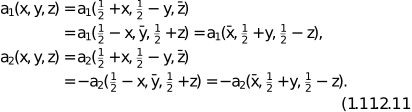
:
 : (1.11.2.10) and
 : (1.11.2.10) and
 : (1.11.2.10) and
 : (1.11.2.11) and (1.11.2.12).
 : (1.11.2.10)
 : (1.11.2.10) and
 : (1.11.2.11) and
 : (1.11.2.11) and
 : (1.11.2.10) and
 : (1.11.2.10) and
 : (1.11.2.11) and
 : (1.11.2.10), (1.11.2.12) and (1.11.2.19).
 : (1.11.2.10), (1.11.2.13) and (1.11.2.15).
 : (1.11.2.10), (1.11.2.12) and (1.11.2.20).
 : (1.11.2.10), (1.11.2.13) and (1.11.2.19).
 : (1.11.2.10), (1.11.2.14) and (1.11.2.19).
 : (1.11.2.10), (1.11.2.13) and (1.11.2.20).
 : (1.11.2.11), (1.11.2.12) and (1.11.2.21).
For all , the sets of coordinates are chosen here as in International Tables for Crystallography Volume A
(Hahn, 2005); the first one being adopted if Volume A offers two alternative origins. The expressions (1.11.2.10) or (1.11.2.11) appear for all space groups because all of them are supergroups of  or
or  .
.
The tensor structure factors of forbidden reflections can be further restricted by the cubic symmetry, see Table 1.11.2.2. For the glide plane  , the tensor structure factor of
  reflections is given by (1.11.2.6), whereas for the diagonal glide plane
  , it is given by
 and additional restrictions on
  and
and  can become effective for
  or
or  . For forbidden reflections of the
  type, the tensor structure factor is either
 or
or see Table 1.11.2.2.
|
 for the cubic space groups (
 )
)


 for
for 






 for
for 











 for
for 

References
 Belyakov, V. A. & Dmitrienko, V. E. (1985). The blue phase of liquid crystals. Sov. Phys. Usp. 28, 535–562.Google Scholar
Hahn, Th. (2005). Editor. International Tables for Crystallography, Volume A, Space-Group Symmetry, 5th ed. Heidelberg: Springer.Google Scholar
Belyakov, V. A. & Dmitrienko, V. E. (1985). The blue phase of liquid crystals. Sov. Phys. Usp. 28, 535–562.Google Scholar
Hahn, Th. (2005). Editor. International Tables for Crystallography, Volume A, Space-Group Symmetry, 5th ed. Heidelberg: Springer.Google Scholar

