|
International
Tables for Crystallography Volume D Physical properties of crystals Edited by A. Authier © International Union of Crystallography 2013 |
International Tables for Crystallography (2013). Vol. D. ch. 1.11, pp. 270-272
Section 1.11.2. Symmetry restrictions on local tensorial susceptibility and forbidden reflections
a
A. V. Shubnikov Institute of Crystallography, Leninsky pr. 59, Moscow 119333, Russia,bSteinmann Institut der Universität Bonn, Poppelsdorfer Schloss, Bonn, D-53115, Germany, and cFaculty of Physics, M. V. Lomonosov Moscow State University, Leninskie Gory, Moscow 119991, Russia |
Several different approaches can be used to determine the local susceptibility with appropriate symmetry. For illustration, we start with the simple but very important case of a symmetric tensor of rank 2 defined in the Cartesian system,  (in this case, we do not distinguish covariant and contravariant components, see Chapter 1.1
![[link]](/graphics/greenarr.gif) ). From the physical point of view, such tensors appear in the dipole–dipole approximation (see Section 1.11.4).
). From the physical point of view, such tensors appear in the dipole–dipole approximation (see Section 1.11.4).
The most general expression for the tensor of susceptibility is exclusively restricted by the crystal symmetry, i.e.  must be invariant against all the symmetry operations
  of the given space group
  :
: where
where  is the matrix of the point operation (rotation or mirror reflection),
  , and
, and  is the associated vector of translation. The index
  indicates a transposed matrix, and summation over repeated indices is implied hereafter. To meet the above demand, it is obviously sufficient for to be invariant against all generators of the group .
There is a simple direct method for obtaining obeying equation (1.11.2.1): we can take an arbitrary second-rank tensor  and average it over all the symmetry operations :
 where
where  is the number of elements in the group . A small problem is that is infinite for any space group, but this can be easily overcome if we take as periodic and obeying the translation symmetry of the given Bravais lattice. Then the number of the remaining symmetry operations becomes finite (an example of this approach is given in Section 1.11.2.3).
In spite of its simplicity, equation (1.11.2.1) provides non-trivial restrictions on the tensorial structure factors of Bragg reflections. The sets of allowed reflections, listed in International Tables for Crystallography Volume A
(Hahn, 2005) for all space groups and for all types of atom sites, are based on scalar X-ray susceptibility. In this case, reflections can be forbidden (i.e. they have zero intensity) owing to glide-plane and/or screw-axis symmetry operations. This is because the scalar atomic factors remain unchanged upon mirror reflection or rotation, so that the contributions from symmetry-related atoms to the structure factors can cancel each other. In contrast, atomic tensors are sensitive to both mirror reflections and rotations, and, in general, the tensor atomic factors of symmetry-related atoms have different orientations in space. As a result, forbidden reflections can in fact be excited just due to the anisotropy of susceptibility, so that the selection rules for possible reflections change.
It is easy to see how the most general tensor form of the structure factors can be deduced from equation (1.11.2.1). The structure factor of a reflection with reciprocal-lattice vector  is proportional to the Fourier harmonics of the susceptibility. The corresponding relations (Authier, 2005, 2008) simply have to be rewritten in tensorial form:
 where
where  is the classical electron radius,
  is the X-ray wavelength and
  is the volume of the unit cell.
Considering first the glide-plane forbidden reflections, there may, for instance, exist a glide plane  perpendicular to the
  axis, i.e. any point
  is transformed by this plane into
  . The corresponding matrix of this symmetry operation changes the sign of ,
 and the translation vector into
  . Substituting (1.11.2.4) into (1.11.2.1) and exchanging the integration variables in (1.11.2.3), one obtains for the structure factors of reflections
 If
If  is scalar, i.e.
  , then
 for odd
  , hence
  vanishes. This is the well known conventional extinction rule for a glide plane, see International Tables for Crystallography Volume A
(Hahn, 2005). If, however, is a tensor, the mirror reflection
vanishes. This is the well known conventional extinction rule for a glide plane, see International Tables for Crystallography Volume A
(Hahn, 2005). If, however, is a tensor, the mirror reflection  changes the signs of the
  and
and  tensor components [as is also obvious from equation (1.11.2.5)]. As a result, the and components should not vanish for
  and the tensor structure factor becomes
 In general, the elements
  and
and  are complex, and it should be emphasized from the symmetry point of view that they are different and arbitrary for different
  and . However, from the physical point of view, they can be readily expressed in terms of tensor atomic factors, where only those chemical elements are relevant whose absorption-edge energies are close to the incident radiation energy (see below).
It is also easy to see that for the non-forbidden (= allowed) reflections  , the non-zero tensor elements are just those which vanish for the forbidden reflections:
 Here the result is mainly provided by the diagonal elements
  , but there is still an anisotropic part that contributes to the structure factor, as expressed by the off-diagonal element. In principle, the effect on the total intensity as well as the element itself can be assessed by careful measurements using polarized radiation.
For the screw-axis forbidden reflections, the most general form of the tensor structure factor can be found as before (Dmitrienko, 1983; see Table 1.11.2.1). Again, as in the case of the glide plane, for each forbidden reflection all components of the tensor structure factor are determined by at most two independent complex elements and . There may, however, exist further restrictions on these tensor elements if other symmetry operations of the crystal space group are taken into account. For example, although there are  screw axes in space group
  ,
,  and reflections
  remain forbidden because the lattice is body centred, and this applies not only to the dipole–dipole approximation considered here, but also within any other multipole approximation.
|
 ) and independent components of their tensorial structure factors
 ,
,  ,
,  . The direction of the


In Table 1.11.2.1, resulting from the dipole–dipole approximation, some reflections still remain forbidden. For instance, in the case of a  screw axis, there is no anisotropy of susceptibility in the plane due to the inevitable presence of the threefold rotation axis. For
  and
and  axes, the reflections with
  also remain forbidden because only dipole–dipole interaction (of X-rays) is taken into account, whereas it can be shown that, for example, quadrupole interaction permits the excitation of these reflections.
Let us consider in more detail the local tensorial properties of cubic crystals. This case is particularly interesting because for cubic symmetry the second-rank tensor is isotropic, so that a global anisotropy is absent (but it exists for tensors of rank 4 and higher). Local anisotropy is of importance for some physical parameters, and it can be described by tensors depending periodically on the three space coordinates. This does not only concern X-ray susceptibility, but can also, for instance, result from describing orientation distributions in chiral liquid crystals (Belyakov & Dmitrienko, 1985) or atomic displacements (Chapter 1.9
of this volume) and electric field gradients (Chapter 2.2
of this volume) in conventional crystals.
The symmetry element common to all cubic space groups is the threefold axis along the cube diagonal. The matrix  of the symmetry operation is
 This transformation results in the circular permutation
 , and from equation (1.11.2.1) it is easy to see that invariance of
  demands the general form
 where
where  and
and  are arbitrary functions with the periodicity of the corresponding Bravais lattice:
  for primitive lattices (
 being arbitrary integers) plus in addition
  =
=  for body-centered lattices or
  =
=  =
=  = for face-centered lattices.
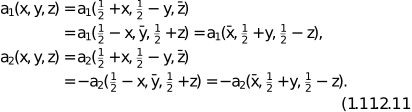
Depending on the space group, other symmetry elements can enforce further restrictions on and :
 :
:
 :
:
 : (1.11.2.10) and
 : (1.11.2.10) and
 : (1.11.2.10) and
 : (1.11.2.11) and (1.11.2.12).
 : (1.11.2.10)
 : (1.11.2.10) and
 : (1.11.2.11) and
 : (1.11.2.11) and
 : (1.11.2.10) and
 : (1.11.2.10) and
 : (1.11.2.11) and
 : (1.11.2.10), (1.11.2.12) and (1.11.2.19).
 : (1.11.2.10), (1.11.2.13) and (1.11.2.15).
 : (1.11.2.10), (1.11.2.12) and (1.11.2.20).
 : (1.11.2.10), (1.11.2.13) and (1.11.2.19).
 : (1.11.2.10), (1.11.2.14) and (1.11.2.19).
 : (1.11.2.10), (1.11.2.13) and (1.11.2.20).
 : (1.11.2.11), (1.11.2.12) and (1.11.2.21).
For all , the sets of coordinates are chosen here as in International Tables for Crystallography Volume A
(Hahn, 2005); the first one being adopted if Volume A offers two alternative origins. The expressions (1.11.2.10) or (1.11.2.11) appear for all space groups because all of them are supergroups of  or
or  .
.
The tensor structure factors of forbidden reflections can be further restricted by the cubic symmetry, see Table 1.11.2.2. For the glide plane , the tensor structure factor of  reflections is given by (1.11.2.6), whereas for the diagonal glide plane
  , it is given by
 and additional restrictions on and can become effective for
  or
or  . For forbidden reflections of the
  type, the tensor structure factor is either
 or
or see Table 1.11.2.2.
|
 for the cubic space groups (


 for
for 
















 for
for 

References
 Authier, A. (2005). Dynamical Theory of X-ray Diffraction. Oxford University Press.Google Scholar
Authier, A. (2008). In International Tables for Crystallography, Volume B, Reciprocal Space, edited by U. Shmueli, 3rd ed., pp. 626–646. Heidelberg: Springer.Google Scholar
Belyakov, V. A. & Dmitrienko, V. E. (1985). The blue phase of liquid crystals. Sov. Phys. Usp. 28, 535–562.Google Scholar
Dmitrienko, V. E. (1983). Forbidden reflections due to anisotropic X-ray susceptibility of crystals. Acta Cryst. A39, 29–35.Google Scholar
Hahn, Th. (2005). Editor. International Tables for Crystallography, Volume A, Space-Group Symmetry, 5th ed. Heidelberg: Springer.Google Scholar
Authier, A. (2005). Dynamical Theory of X-ray Diffraction. Oxford University Press.Google Scholar
Authier, A. (2008). In International Tables for Crystallography, Volume B, Reciprocal Space, edited by U. Shmueli, 3rd ed., pp. 626–646. Heidelberg: Springer.Google Scholar
Belyakov, V. A. & Dmitrienko, V. E. (1985). The blue phase of liquid crystals. Sov. Phys. Usp. 28, 535–562.Google Scholar
Dmitrienko, V. E. (1983). Forbidden reflections due to anisotropic X-ray susceptibility of crystals. Acta Cryst. A39, 29–35.Google Scholar
Hahn, Th. (2005). Editor. International Tables for Crystallography, Volume A, Space-Group Symmetry, 5th ed. Heidelberg: Springer.Google Scholar

