|
International
Tables for Crystallography Volume I X-ray absorption spectroscopy and related techniques Edited by C. T. Chantler, F. Boscherini and B. Bunker © International Union of Crystallography 2024 |
International Tables for Crystallography (2024). Vol. I. ch. 6.17, pp. 809-815
https://doi.org/10.1107/S157487072000333X Chapter 6.17. The OCEAN suite: core excitationsaSensor Science Division, National Institute of Standards and Technology, 100 Bureau Drive MS 8441, Gaithersburg, MD 20899-8441, USA,bMaterials Measurement Science Division, National Institute of Standards and Technology, 100 Bureau Drive MS 8372, Gaithersburg, MD 20899-8372, USA,cTheory Group, European Synchrotron Radiation Facility, 71 Avenue des Martyrs, 38043 Grenoble, France,dCondensed Matter Physics and Materials Science Division, Brookhaven National Laboratory, Upton, NY 12973-5000, USA, and ePhysics Department and IRIS Adlershof, Humboldt-Universität zu Berlin, Zum Grossen Windkanal 6, 12489 Berlin, Germany This chapter is a high-level description of a suite of programs denoted by the acronym OCEAN (Obtaining Core Excitation spectra Ab initio and with NBSE), where NBSE denotes the underlying NIST Bethe–Salpeter equation program. The chapter discusses the main computational steps, physical approximations and scope of user input, and presents various examples of calculated results. Likely improvements and extensions, and how to access OCEAN and its documentation, are also discussed. Keywords: Bethe–Salpeter equation; core excitation; near-edge spectra; nonresonant inelastic X-ray scattering; OCEAN; resonant inelastic X-ray scattering; X-ray absorption. |
OCEAN is a first-principles, pseudopotential-based tool for modelling core-level near-edge spectroscopies. Multiple scattering, another type of first-principles technique, is efficacious far above edges, spanning energy ranges that reveal structural information. Further, full-potential versions can also describe unoccupied electron states completely near X-ray edges. Pseudopotential-based tools such as OCEAN can also claim such completeness because all-electron counterparts to pseudized wavefunctions can be found as needed. Theoretical treatments of near-edge spectra also range from independent-electron types [for example density-functional theory (DFT)], which reflect density-of-states effects, to many-electron methods (for example configuration interaction), which include local correlation. OCEAN solves a form of the Bethe–Salpeter equation (BSE), i.e. an interacting electron-plus-hole picture of the core-excitation process, retaining some advantages of independent-electron methods and including some correlation effects. OCEAN generates core-excitation spectra from the outputs of plane-wave pseudopotential calculations and solves the electron–core-hole pair equation of motion (EOM). OCEAN can treat valence excitations (not discussed here) and core excitations. Valence excitations also matter in resonant inelastic X-ray scattering (RIXS), which has an electron–valence-hole pair final state, versus the electron–core-hole pair X-ray absorption spectroscopy (XAS) final state and RIXS intermediate state.
Section 2 discusses OCEAN's methodology. A large body of work has been perfomed using OCEAN and its predecessors. Section 3 gives examples of results. These include low-Z near-edge spectra, multiplet spectra in d0 transition-metal (TM) compounds, spectra featuring electric dipole and quadrupole transitions in TM oxides, O 1s spectra for ice and liquid water, and results for nonresonant inelastic X-ray scattering (NRIXS, also known as X-ray Raman scattering for core excitations), a complement of electron energy-loss spectroscopy (EELS) for large momentum transfers. Section 4 discusses future developments and foreseen limitations of OCEAN. One growth area is including effects of nuclear motions on spectra. This can include Franck–Condon and Jahn–Teller effects, but thermal motion also matters, especially in low-Z compounds. Section 5 indicates how to access OCEAN, which continues to undergo updates, improvements and extensions, and is open-source. Others are encouraged to contact the authors regarding its use.
Calculations begin with a ground-state self-consistent-field DFT calculation (Hohenberg & Kohn, 1964; Kohn & Sham, 1965). OCEAN next computes random-phase approximation (RPA) or adiabatic local-density approximation (ALDA) screening of a core hole, requiring input of the macroscopic dielectric constant ɛ∞. Self-energy corrections may be applied to the DFT band structure. OCEAN assumes that excitation spectra are found using the BSE as an effective EOM for the electron–hole pair. Strongly correlated systems could be treated poorly within such a simple picture. The effective Hamiltonian includes the screened potential of the core hole, including its central and multipole parts (which account for exchange and multiplet effects), spin, core-hole orbital angular momentum and core-level spin–orbit interactions. An atomic program within OCEAN (Shirley, 1991) facilitates treatment of atomic effects and reconstruction of all-electron wavefunctions. Knowledge of self-energy corrections, whether full (Soininen et al., 2003), model (Fister et al., 2011) or on the level of the multipole self-energy methodology (Kas et al., 2007), can renormalize the band structure and introduce lifetime broadening and satellite features into excitation spectra in post-processing steps applied to output. Thus, OCEAN's calculations entail many effects: core-level electronic structure, a DFT description of the valence-level electronic structure, the screened core-hole potential, self-energy effects, the effective EOM of the electron–hole pair, periodicity effects (real or artificial) and final-state valence-hole effects in RIXS. Below we summarize these aspects, emphasizing the main equations describing the physics.
The atomic electronic structure program performs all-electron and norm-conserving pseudopotential calculations. Other options include relativistic versus nonrelativistic calculations and Hartree–Fock versus LDA calculations. In pseudopotential calculations, electron partial waves with low angular momentum l, up to l = 2 or l = 3, experience a different potential in the core region and are solutions of the radial Schrödinger equation with accurate scattering properties in chemically relevant energy ranges. Because OCEAN works within a pseudopotential context, users must provide pseudopotentials in the form Vl(r) to the atomic program, which can calculate corresponding pseudized and all-electron partial waves at any energy.
All-electron (ae) wavefunctions are reconstructed from pseudized (ps) wavefunctions using `optimized projector functions' (OPFs), which are described elsewhere (Shirley, 2004) and inspired by the projector-augmented-wave method (Blöchl, 1994). The atomic program finds a few (about four) normalized OPFs that best span partial waves within a user-specified energy range and cutoff radius Rc that should enclose pseudized regions and pertinent core orbitals. Spherical harmonics times ae and ps projector functions, {fae(ν, l, r)} and {fps(ν, l, r)}, form a basis for band states inside r < Rc. For a site at the origin, ae and ps band states and coefficients for basis functions are related by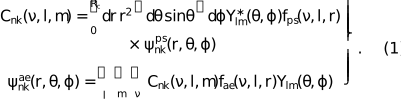 Reconstruction is performed when calculating transition-matrix elements, the electron–core-hole interaction and (as of version 2.0) calculating core-hole screening, the latter typically increasing screening near the nucleus, presumably because the reintroduction of radial nodes also reintroduces radial antinodes.
OCEAN obtains ground-state electronic structure and related quantities by using a plane-wave/pseudopotential program [for example ABINIT (Gonze et al., 2009) or Quantum ESPRESSO (Giannozzi et al., 2009)]. Bloch states are calculated on a regular grid throughout the full Brillouin zone. The grid can be displaced to preclude degeneracies among k points and accelerate convergence versus grid density.
The largest part of the electron–core-hole interaction is the spherically symmetrical central potential. It is important to screen the central potential accurately. This differs from the valence-hole case, where a model dielectric function (Levine & Louie, 1982) with local field effects (Hybertsen & Louie, 1988) suffices. Obviously, the atomic core environment is very different from a nearly free-electron gas. OCEAN includes screening by the excited site's core electrons in the atomic program and by valence electrons in situ. If the Green's function is where Enk is a band energy and ±iη reflects state occupancy, then the bare and full ALDA polarization functions are
 Here x and x′ are a real-space coordinate, Kxc is a local vertex correction and EF is the Fermi energy. The RPA omits Kxc, retaining only the Coulomb interaction v. The function χ screens the core hole (already screened by core electrons) plus a sphere of charge −e with radius ∼0.2 nm. A model screens a compensating sphere of charge +e. Quadrature facilitates radial and angular integrations (Shirley, 2006).
Multipole interactions lead to multiplet effects and a repulsive exchange part. Slater Fk and Gk integrals are calculated in the atomic program for all-electron OPFs. A scaling-factor parameter can be affixed, for example 0.83 improves the results in first-row TM systems. It may be possible to compute solid-state (although not atomic) contributions to this factor using screening calculations within OCEAN.
DFT band gaps and widths differ from those revealed using photoemission and inverse photoemission, which is a quite systematic effect (Shirley, 1998a). OCEAN allows one to amend the band structure suitably, typically by relating quasiparticle (qp) and DFT electron-level energies according to the form for occupied (v) and unoccupied (c) states, respectively, allowing rigid shifts Δv, Δc and stretches sv, sc of bands. The actual band shifts and stretches can be measured or calculated (Hedin, 1999). State-dependent and energy-dependent self-energy corrections can also be incorporated into an OCEAN calculation (Vinson & Rehr, 2012).
OCEAN considers electron–hole pair states of the form The operators act on the ground state to create the electron–hole pair. N, L, mh and σh are standard quantum numbers for an atomic core level, while n, k and σe denote electron band index, crystal momentum and spin, respectively. By including core orbital angular momentum and all spin momentum degrees of freedom, multiplet and spin–orbit effects are included naturally. Thus, multiplet spectra can be computed for nominally d0 systems such as Ti4+ in rutile, because there is no other electron in the 3d subshell. Also, DFT includes the ligand or crystal field automatically, unlike model multiplet calculations.
A spectrum can be computed using Fermi's golden rule. A site contributes to the imaginary part of the dielectric function at X-ray wavevector q and energy ω according to where Ω is the unit-cell volume. In XAS the operator that acts on a core electron is
 The electron coordinate r is relative to the nucleus, while e and q are the X-ray electric field and momentum. For NRIXS and EELS, one has O ∝ exp(iQ · r) for momentum transfer Q, and the spectrum is related to the dynamic structure factor. Spectra can be evaluated efficiently within the Haydock recursion method (Vinson et al., 2011). Treating RIXS requires evaluating
 such as by using the generalized minimal residual (GMRES) approach (Saad & Schultz, 1986). The subsequent electron–valence-hole pair can also be treated with OCEAN (Shirley et al., 2001).
The effective Hamiltonian is HBSE = He + Hh + Hs.o. + HC + HM. He includes the electron-band energy, Hh the average core-level binding energy, Hs.o. core-level spin–orbit coupling, HC the central potential of the core hole and HM multipolar terms. The action of multipolar terms and spatially varying parts of HC inside the OPF cutoff radius are performed within the OPF basis. The remainder of HC is smooth, and its action is evaluated on a real-space grid using fast Fourier transform techniques. All of the above allow fast evaluation of HBSE acting on an arbitrary state.
OCEAN employs periodic boundary conditions. Systems lacking translational invariance (for example molecules, liquids and surfaces) require the use of a large periodic box, possibly with multiple atomic configurations (Vinson et al., 2012; Niskanen et al., 2017; Petitgirard et al., 2019; Spiekermann et al., 2019). Additionally, nominally periodic systems lose periodicity owing to thermal or zero-point motion (Vinson et al., 2014). However, judicious sampling of atomic displacements can render an accurate averaging of spectra with only a few calculations.
OCEAN has been used to calculate near-edge core-excitation spectra in a wide variety of systems, and RIXS spectra in a few cases. Here, we present results for several different systems and compare them with experimental results to illustrate the reasonably expected accuracy of computed spectra.
Diamond is a simple system offering high-quality spectra. It is easy to calculate spectra up to about 100 eV above the C 1s edge including only 60 conduction bands with good Brillouin-zone sampling. The most reliable spectroscopies at the C 1s near edge are NRIXS and EELS, followed by XAS, which might rely on electron-yield or fluorescence-yield signatures of absorption and suffer from instrument carbon build-up. Fig. 1 shows near-edge spectra obtained using OCEAN, NRIXS (Galambosi et al., 2007) and, above 315 eV, XAS (B. N. Ravel, private communication). Despite the prediction of a low-lying s-symmetry core-hole exciton (Jackson & Pederson, 1991), EELS (Batson, 1993), NRIXS (Galambosi et al., 2007) and calculations using the predecessor of OCEAN (Shirley, 1998b) suggested otherwise.
![[Figure 1]](/figures/qx0017fig1thm.gif)
Vinson et al. (2011) and Vinson & Rehr (2012) consider a wide range of 3d TM systems at the 2p edge of the TM species. SrTiO3 and CaF2 serve as standard systems and allow comparison to all-electron core BSE results (Laskowski & Blaha, 2010; Gulans et al., 2014). Vinson and Rehr also consider other systems, including metallic calcium. Results are shown in Fig. 2.
![[Figure 2]](/figures/qx0017fig2thm.gif)
Spectra of TM compounds can be of interest at a TM 1s pre-edge. OCEAN can treat such systems, which can feature dipole-allowed 1s→np and quadrupole-allowed 1s→md transitions, such as in rutile (Shirley, 2004). Perovskites such as SrTiO3 and PbTiO3 are of interest (Woicik et al., 2007) because 3d–4p mixing causes Eg-symmetry Ti 3d states to acquire partial 4p character, giving rise to strong absorption cross sections that help to reveal local atomic geometries.
Vinson et al. (2012) modelled the O 1s spectra of liquid water and two ice phases as presented in Fig. 3. Calculations for the liquid sample multiple molecular configurations. Care is required to estimate core-level shifts for inequivalent sites, such as oxygen sites in water, as discussed elsewhere (Pasquarello et al., 1996).
![[Figure 3]](/figures/qx0017fig3thm.gif)
Direct RIXS calculations are more involved because they entail core-excited and valence-excited state calculations. Diamond was an early subject of RIXS measurements (Ma et al., 1992; Carlisle et al., 1999) and calculations (Shirley, 2000). OCEAN is able to capture several of the changes in X-ray emission for incident energy from 5 to 25 eV above the C 1s edge.
LiF demonstrates the ability of NRIXS to probe excitations of different symmetries. A small peak below the dipole-allowed F 1s edge was attributed to a vibrationally allowed, s-symmetry core-hole exciton. OCEAN and NRIXS (Hämäläinen et al., 2002; Vinson et al., 2011) at various momentum transfers confirmed this, as shown in Fig. 4. Finite-temperature molecular-dynamics simulations provide snapshots of atomic positions that make the pre-edge feature optically allowed (Pascal et al., 2014). Others (Tse et al., 2014) have also compared measured and calculated NRIXS of pressurized silicon to study the pressure-induced insulator-to-metal transition in this material.
![[Figure 4]](/figures/qx0017fig4thm.gif)
Working only within a single electron–hole pair picture undermines OCEAN's treatment of strongly correlated systems, although its output might guide the development of model Hamiltonians for such systems. Larger supercells can lessen the effects of artificially imposed periodicity. Many effects of atomic displacements and multi-electron excitations are becoming treatable in a statistically averaged sense by combining the results of different atomic configurations and/or post-processing results.
Debye–Waller (DW) effects are ubiquitous in core spectra, affecting electron-scattering processes because of displacements of atoms from equilibrium positions, as has been reviewed elsewhere (Rehr & Albers, 2000). Others (Story et al., 2014) show how spectra can include some vibrational effects to all orders using a cumulant approach and system-specific knowledge of vibrational properties that is obtained elsewhere. Near-edge features are also affected for reasons outside the above DW treatment. One can also vary atomic coordinates by sampling phonon modes or using molecular-dynamics amenable to disordered systems (Vinson et al., 2014; Brouder et al., 2010; Nemausat et al., 2015; Pascal et al., 2014; Prendergast & Galli, 2006; Niskanen et al., 2017). Others (de Groot et al., 1990) cite vibrational effects in d0 transition-metal compounds for broadening in cases of strong ligand–TM hybridization, for example E–e Jahn–Teller effects couple Eg electron states and eg modes. OCEAN can help to determine the coupling strength to use in effective Jahn–Teller Hamiltonians (Tinte & Shirley, 2008; Gilmore & Shirley, 2010) to amend computed spectra. Still others (Zacharias & Giustino, 2016) have analysed valence edges, and core edges should also be treatable.
Multi-electron excitations broaden spectral features whenever an electron and/or hole state is far from the Fermi level. The `electron–hole continuum' part of the loss function smoothens the onset of broadening (Soininen et al., 2003; Kas et al., 2007; Fister et al., 2011). Multi-electron excitation also transfers spectral weight to satellites, as largely captured by a cumulant approach related to Hedin's GW self-energy (Hedin, 1999). This improves calculated photoemission (Guzzo et al., 2011; Gumhalter et al., 2016; Lischner et al., 2015) and near-edge (Kas et al., 2015) spectra. Others (Kas et al., 2016) have presented a method that allows the inclusion of all losses, including interference between intrinsic and extrinsic losses because of the coupling of all particles to the valence electron density. Including such effects should become a standard aspect of calculations performed using tools such as OCEAN.
The systems that OCEAN can treat are limited by our use of the BSE. Many-electron effects are included only with a more complete description of departures from the ground-state wavefunction. However, even Coster–Kronig decay (Coster & Kronig, 1935) and charge-transfer effects can be studied in limited cases if response-theory analysis of the environment facilitates an enhanced description of on-site excitations, with adequate separability of excitations near a site versus at longer range.
Interested parties should access http://ocean-code.com
, which offers the source code and documentation. As of version 2, OCEAN also incorporates valence BSE capabilities. Its flexible input format allows future use with many DFT programs. ABINIT and Quantum ESPRESSO, both of which are open source, are already accommodated. Scaling of computation time, memory and storage requirements, and a parallelized version of OCEAN that should be particularly helpful for large unit cells or large-scale structures have been discussed elsewhere (Gilmore et al., 2015).
Acknowledgements
The OCEAN project has benefitted from many, including L. X. Benedict, H. M. Lawler, J. A. Soininen, J. J. Rehr, J. J. Kas, F. D. Vila, D. G. Prendergast, C. D. Pemmaraju and Y. Liang. Some aided discussions and coordination, and others provided key technical innovations. Benedict spearheaded the valence excitation work, which was extended by Lawler and repackaged for OCEAN. Soininen pioneered NRIXS and EELS work and RPA core-hole screening. Kas and co-workers shared innovations treating self-energy, Debye–Waller and satellite effects in electron spectroscopies in general.
References
 Batson, P. E. (1993). Phys. Rev. Lett. 70, 1822–1825.Google ScholarBlöchl, P. E. (1994). Phys. Rev. B, 50, 17953–17979.Google ScholarBrouder, C., Cabaret, D., Juhin, A. & Sainctavit, P. (2010). Phys. Rev. B, 81, 115125.Google ScholarCarlisle, J. A., Shirley, E. L., Terminello, L. J., Jia, J. J., Callcott, T. A., Ederer, D. L., Perera, R. C. C. & Himpsel, F. J. (1999). Phys. Rev. B, 59, 7433–7445.Google ScholarCoster, D. & Kronig, R. De L. (1935). Physica, 2, 13–24.Google ScholarFink, J., Müller-Heinzerling, T., Scheerer, B., Speier, W., Hillebrecht, F. U., Fuggle, J. C., Zaanen, J. & Sawatzky, G. A. (1985). Phys. Rev. B, 32, 4899–4904.Google ScholarFister, T. T., Schmidt, M., Fenter, P., Johnson, C. S., Slater, M. D., Chan, M. K. & Shirley, E. L. (2011). J. Chem. Phys. 135, 224513.Google ScholarGalambosi, S., Soininen, J. A., Nygård, K., Huotari, S. & Hämäläinen, K. (2007). Phys. Rev. B, 76, 195112.Google ScholarGiannozzi, P., Baroni, S., Bonini, N., Calandra, M., Car, R., Cavazzoni, C., Ceresoli, D., Chiarotti, G. L., Cococcioni, M., Dabo, I., Dal Corso, A., de Gironcoli, S., Fabris, S., Fratesi, G., Gebauer, R., Gerstmann, U., Gougoussis, C., Kokalj, A., Lazzeri, M., Martin-Samos, L., Marzari, N., Mauri, F., Mazzarello, R., Paolini, S., Pasquarello, A., Paulatto, L., Sbraccia, C., Scandolo, S., Sclauzero, G., Seitsonen, A. P., Smogunov, A., Umari, P. & Wentzcovitch, R. M. (2009). J. Phys. Condens. Matter, 21, 395502.Google ScholarGilmore, K. & Shirley, E. L. (2010). J. Phys. Condens. Matter, 22, 315901.Google ScholarGilmore, K., Vinson, J., Shirley, E. L., Prendergast, D., Pemmaraju, C. D., Kas, J. J., Vila, F. D. & Rehr, J. J. (2015). Comput. Phys. Commun. 197, 109–117.Google ScholarGonze, X., Amadon, B., Anglade, P. M., Beuken, J. M., Bottin, F., Boulanger, P., Bruneval, F., Caliste, D., Caracas, R., Côté, M., Deutsch, T., Genovese, L., Ghosez, P., Giantomassi, M., Goedecker, S., Hamann, D. R., Hermet, P., Jollet, F., Jomard, G., Leroux, S., Mancini, M., Mazevet, S., Oliveira, M. J. T., Onida, G., Pouillon, Y., Rangel, T., Rignanese, G. M., Sangalli, D., Shaltaf, R., Torrent, M., Verstraete, M. J., Zerah, G. & Zwanziger, J. W. (2009). Comput. Phys. Commun. 180, 2582–2615.Google ScholarGroot, F. M. F. de, Fuggle, J. C., Thole, B. T. & Sawatzky, G. A. (1990). Phys. Rev. B, 41, 928–937.Google ScholarGulans, A., Kontur, S., Meisenbichler, C., Nabok, D., Pavone, P., Rigamonti, S., Sagmeister, S., Werner, U. & Draxl, C. (2014). J. Phys. Condens. Matter, 26, 363202.Google ScholarGumhalter, B., Kovač, V., Caruso, F., Lambert, H. & Giustino, F. (2016). Phys. Rev. B, 94, 035103.Google ScholarGuzzo, M., Lani, G., Sottile, F., Romaniello, P., Gatti, M., Kas, J. J., Rehr, J. J., Silly, M. G., Sirotti, F. & Reining, L. (2011). Phys. Rev. Lett. 107, 166401.Google ScholarHämäläinen, K., Galambosi, S., Soininen, J. A., Shirley, E. L., Rueff, J. P. & Shukla, A. (2002). Phys. Rev. B, 65, 155111.Google ScholarHedin, L. (1999). J. Phys. Condens. Matter, 11, R489–R528.Google ScholarHohenberg, P. & Kohn, W. (1964). Phys. Rev. 136, B864–B871.Google ScholarHybertsen, M. S. & Louie, S. G. (1988). Phys. Rev. B, 37, 2733–2736.Google ScholarJackson, K. A. & Pederson, M. R. (1991). Phys. Rev. Lett. 67, 2521–2524.Google ScholarKas, J. J., Rehr, J. J. & Curtis, J. B. (2016). Phys. Rev. B, 94, 035156.Google ScholarKas, J. J., Sorini, A. P., Prange, M. P., Cambell, L. W., Soininen, J. A. & Rehr, J. J. (2007). Phys. Rev. B, 76, 195116.Google ScholarKas, J. J., Vila, F. D., Rehr, J. J. & Chambers, S. A. (2015). Phys. Rev. B, 91, 121112.Google ScholarKohn, W. & Sham, L. J. (1965). Phys. Rev. 140, A1133–A1138.Google ScholarLaskowski, R. & Blaha, P. (2010). Phys. Rev. B, 82, 205104.Google ScholarLevine, Z. H. & Louie, S. G. (1982). Phys. Rev. B, 25, 6310–6316.Google ScholarLischner, J., Pálsson, G. K., Vigil-Fowler, D., Nemsak, S., Avila, J., Asensio, M. C., Fadley, C. S. & Louie, S. G. (2015). Phys. Rev. B, 91, 205113.Google ScholarMa, Y., Wassdahl, N., Skytt, P., Guo, J., Nordgren, J., Johnson, P. D., Rubensson, J. E., Boske, T., Eberhardt, W. & Kevan, S. D. (1992). Phys. Rev. Lett. 69, 2598–2601.Google ScholarNemausat, R., Cabaret, D., Gervais, C., Brouder, C., Trcera, N., Bordage, A., Errea, I. & Mauri, F. (2015). Phys. Rev. B, 92, 144310.Google ScholarNilsson, A., Nordlund, D., Waluyo, I., Huang, N., Ogasawara, H., Kaya, S., Bergmann, U., Näslund, L. Å., Öström, H., Wernet, P., Andersson, K. J., Schiros, T. & Pettersson, L. G. M. (2010). J. Electron Spectrosc. Relat. Phenom. 177, 99–129.Google ScholarNiskanen, J., Sahle, C. J., Gilmore, K., Uhlig, F., Smiatek, J. & Föhlisch, A. (2017). Phys. Rev. E, 96, 013319.Google ScholarPascal, T. A., Boesenberg, U., Kostecki, R., Richardson, T. J., Weng, T. C., Sokaras, D., Nordlund, D., McDermott, E., Moewes, A., Cabana, J. & Prendergast, D. (2014). J. Chem. Phys. 140, 034107.Google ScholarPasquarello, A., Hybertsen, M. S. & Car, R. (1996). Phys. Rev. B, 53, 10942–10950.Google ScholarPetitgirard, S., Sahle, C. J., Weis, C., Gilmore, K., Spiekermann, G., Tse, J. S., Wilke, M., Cavallari, C., Cerantola, V. & Sternemann, C. (2019). Geochem. Persp. Lett. 9, 32–37.Google ScholarPrendergast, D. & Galli, G. (2006). Phys. Rev. Lett. 96, 215502.Google ScholarPylkkänen, T., Giordano, V. M., Chervin, J. C., Sakko, A., Hakala, M., Soininen, J. A., Hämäläinen, K., Monaco, G. & Huotari, S. (2010). J. Phys. Chem. B, 114, 3804–3808.Google ScholarRehr, J. J. & Albers, R. C. (2000). Rev. Mod. Phys. 72, 621–654.Google ScholarSaad, Y. & Schultz, M. H. (1986). SIAM J. Sci. Stat. Comput. 7, 856–869.Google ScholarShirley, E. L. (1991). Thesis. University of Illinois at Urbana Champaign, USA.Google ScholarShirley, E. L. (1998a). Phys. Rev. B, 58, 9579–9583.Google ScholarShirley, E. L. (1998b). Phys. Rev. Lett. 80, 794–797.Google ScholarShirley, E. L. (2000). J. Electron Spectrosc. Relat. Phenom. 110–111, 305–321.Google ScholarShirley, E. L. (2004). J. Electron Spectrosc. Relat. Phenom. 136, 77–83.Google ScholarShirley, E. L. (2006). Ultramicroscopy, 106, 986–993.Google ScholarShirley, E. L., Soininen, J. A., Zhang, G. P., Carlisle, J. A., Callcott, T. A., Ederer, D. L., Terminello, L. J. & Perera, R. C. C. (2001). J. Electron Spectrosc. Relat. Phenom. 114–116, 939–946.Google ScholarSoininen, J. A., Rehr, J. J. & Shirley, E. L. (2003). J. Phys. Condens. Matter, 15, 2573–2586.Google ScholarStory, S. M., Kas, J. J., Vila, F. D., Verstraete, M. J. & Rehr, J. J. (2014). Phys. Rev. B, 90, 195135.Google ScholarSpiekermann, G., Harder, M., Gilmore, K., Zalden, P., Sahle, Ch. J., Petitgirard, S., Wilke, M., Biedermann, N., Weis, C., Morgenroth, W., Tse, J. S., Kulik, E., Nishiyama, N., Yavaş, H. & Sternemann, C. (2019). Phys. Rev. X, 9, 011025.Google ScholarTinte, S. & Shirley, E. L. (2008). J. Phys. Condens. Matter, 20, 365221.Google ScholarTse, J. S., Hanfland, M., Flacau, R., Desgreniers, S., Li, Z., Mende, K., Gilmore, K., Nyrow, A., Moretti Sala, M. & Sternemann, C. (2014). J. Phys. Chem. C, 118, 1161–1166.Google ScholarTse, J. S., Shaw, D. M., Klug, D. D., Patchkovskii, S., Vankó, G., Monaco, G. & Krisch, M. (2008). Phys. Rev. Lett. 100, 095502.Google ScholarVinson, J., Jach, T., Elam, W. T. & Denlinger, J. D. (2014). Phys. Rev. B, 90, 205207.Google ScholarVinson, J., Kas, J. J., Vila, F. D., Rehr, J. J. & Shirley, E. L. (2012). Phys. Rev. B, 85, 045101.Google ScholarVinson, J. & Rehr, J. J. (2012). Phys. Rev. B, 86, 195135.Google ScholarVinson, J., Rehr, J. J., Kas, J. J. & Shirley, E. L. (2011). Phys. Rev. B, 83, 115106.Google ScholarWoicik, J. C., Shirley, E. L., Hellberg, C. S., Andersen, K. E., Sambasivan, S., Fischer, D. A., Chapman, B. D., Stern, E. A., Ryan, P., Ederer, D. L. & Li, H. (2007). Phys. Rev. B, 75, 140103.Google ScholarZacharias, M. & Giustino, F. (2016). Phys. Rev. B, 94, 075125.Google Scholar

