|
International
Tables for Crystallography Volume A Space-group symmetry Edited by Th. Hahn © International Union of Crystallography 2006 |
International Tables for Crystallography (2006). Vol. A. ch. 8.1, pp. 724-725
Section 8.1.6. Space groups and point groups
a
Institut für Kristallographie, Universität, D-76128 Karlsruhe, Germany |
As mentioned in Section 8.1.3 , the set of all symmetry operations of an object forms a group, the symmetry group of that object.
Definition:
The symmetry group of a three-dimensional crystal pattern is called its space group. In  , the symmetry group of a (two-dimensional) crystal pattern is called its plane group. In
  , the symmetry group of a (one-dimensional) crystal pattern is called its line group. To each crystal pattern belongs an infinite set of translations
  which are symmetry operations of that pattern. The set of all forms a group known as the translation subgroup
  of the space group
  of the crystal pattern. Since the commutative law
  holds for any two translations, is an Abelian group.
With the aid of the translation subgroup , an insight into the architecture of the space group can be gained.
Referred to a coordinate system  , the space group is described by the set
  of matrices W and columns w. The group is represented by the set of elements
  , where
  are the columns of coefficients of the translation vectors
  of the lattice L. Let (W, w) describe an arbitrary symmetry operation
  of . Then, all products
  for the different j have the same matrix part W. Conversely, every symmetry operation of the space group with the same matrix part W is represented in the set
  . The corresponding set of symmetry operations can be denoted by
  . Such a set is called a right coset of with respect to , because the element is the right factor in the products . Consequently, the space group may be decomposed into the right cosets
  , where the symmetry operations of the same column have the same matrix part W, and the symmetry operations
  differ by their matrix parts
  . This coset decomposition of with respect to may be displayed by the array
 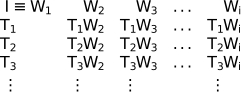 Here,
Here,  is the identity operation and the elements of form the first column, those of
  the second column etc. As each column may be represented by the common matrix part W of its symmetry operations, the number i of columns, i.e. the number of cosets, is at the same time the number of different matrices W of the symmetry operations of . This number i is always finite, and is the order of the point group belonging to , as explained below. Any element of a coset
  may be chosen as the representative element of that coset and listed at the top of its column. Choice of a different representative element merely results in a different order of the elements of a coset, but the coset does not change its content.5
Analogously, a coset  is called a left coset of with respect to , and can be decomposed into the left cosets
  . This left coset decomposition of a space group is always possible with the same
  as in the right coset decomposition. Moreover, both decompositions result in the same cosets, except for the order of the elements in each coset. A subgroup of a group with these properties is called a normal subgroup of the group; cf. Ledermann (1976). Thus, the translation subgroup is a normal subgroup of the space group .
The decomposition of a space group into cosets is the basis of the description of the space groups in these Tables. The symmetry operations of the space group are referred to a `conventional' coordinate system (cf. Section 8.3.1
) and described by  matrices. In the space-group tables as general position (cf. Section 8.3.2
) for each column, a representative is listed whose coefficients
matrices. In the space-group tables as general position (cf. Section 8.3.2
) for each column, a representative is listed whose coefficients  obey the condition
  . The matrix is not listed completely, however, but is given in a short-hand notation. In the expression
  , all vanishing terms and all
  are omitted, e.g.
 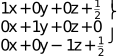 is replaced by
  . The first entry of the general position is always the identity mapping, listed as x, y, z. It represents all translations of the space group too.
As groups, some space groups are more complicated than others. Most easy to survey are the `symmorphic' space groups which may be defined as follows:
Definition:
A space group is called symmorphic if the coset representatives can be chosen in such a way that they leave one common point fixed.
In this case, the representative symmetry operations of a symmorphic space group form a (finite) group. If the fixed point is chosen as the origin of the coordinate system, the column parts  of the representative symmetry operations obey the equations
  Thus, for a symmorphic space group the representative symmetry operations may always be described by the special matrix–column pairs
  .
.
Symmorphic space groups may be easily identified by their Hermann–Mauguin symbols because these do not contain any glide or screw operation. For example, the monoclinic space groups with the symbols P2, C2, Pm, Cm,  and
and  are symmorphic, whereas those with the symbols
  , Pc, Cc,
  and
and  are not.
Unlike most textbooks of crystallography, in this section point groups are treated after space groups because the space group of a crystal pattern, and thus of a crystal structure, determines its point group uniquely.
The external shape (morphology) of a macroscopic crystal is formed by its faces. In order to eliminate the influence of growth conditions, the set of crystal faces is replaced by the set of face normals, i.e. by a set of vectors. Thus, the symmetry group of the macroscopic crystal is the symmetry group of the vector set of face normals. It is not the group of motions in point space, therefore, that determines the symmetry of the macroscopic crystal, but the corresponding group of linear mappings of vector space; cf. Section 8.1.2. This group of linear mappings is called the point group of the crystal. Since to each macroscopic crystal a crystal structure corresponds and, furthermore, to each crystal structure a space group, the point group of the crystal defined above is also the point group of the crystal structure and the point group of its space group.
To connect more formally the concept of point groups with that of space groups in n-dimensional space, we consider the coset decomposition of a space group with respect to the normal subgroup , as displayed above. We represent the right coset decomposition by  and the corresponding left coset decomposition by
  . If is referred to a coordinate system, the symmetry operations of are described by matrices W and columns w. As a result of the one-to-one correspondence between the i cosets
  and the i matrices , the cosets may alternatively be represented by the matrices . These matrices form a group of (finite) order i, and they describe linear mappings of the vector space
  connected with
  ; cf. Section 8.1.2. This group (of order i) of linear mappings is the point group
  of the space group , introduced above.
The difference between symmetry in point space and that in vector space may be exemplified again by means of some monoclinic space groups. Referred to conventional coordinate systems, space groups Pm, Pc, Cm and Cc have the same  matrices of their symmetry operations. Thus, the point groups of all these space groups are of the same type m. The space groups themselves, however, show a rather different behaviour. In Pm and Cm reflections occur, whereas in Pc and Cc only glide reflections are present.
Remark:
The usage of the term `point group' in connection with space groups is rather unfortunate as the point group of a space group is not a group of motions of point space but a group acting on vector space. As a consequence, the point group of a space group may contain operations which do not occur in the space group at all. This is apparent from the example of monoclinic space groups above. Nevertheless, the term `point group of a space group' is used here for historical reasons. A more adequate term would be `vector point group' of a space group or a crystal. It must be mentioned that the term `point group' is also used for the `site-symmetry group', defined in Section 8.3.2
. Site-symmetry groups are groups acting on point space.
It is of historic interest that the 32 types of three-dimensional crystallographic point groups were determined more than 50 years before the 230 (or 219) types of space group were known. The physical methods of the 19th century, e.g. the determination of the symmetry of the external shape or of tensor properties of a crystal, were essentially methods of determining the point group, not the space group of the crystal.
References
 Ledermann, W. (1976). Introduction to group theory. London: Longman.Google Scholar

